Author: cxdig

Bots sustain and inflate striking opposition in online social systems

Societies are complex systems which tend to polarize into sub-groups of individuals with dramatically opposite perspectives. This phenomenon is reflected — and often amplified — in online social networks where, however, humans are no more the only players, and co-exist alongside with social bots, i.e. software-controlled accounts. Analyzing large-scale social data collected during the Catalan referendum for independence on October 1 2017, consisting of nearly 4 millions Twitter posts generated by almost 1 million users, we identify the two polarized groups of Independentists and Constitutionalists and quantify the structural and emotional roles played by social bots. We show that bots act from peripheral areas of the social system to target influential humans of both groups, mostly bombarding Independentists with negative and violent contents, sustaining and inflating instability in this online society. These results quantify the potential dangerous influence of political bots during voting processes.


Bots sustain and inflate striking opposition in online social systems
Massimo Stella, Emilio Ferrara, Manlio De Domenico

Source: arxiv.org

10th congress of the European Union for Systemics (UES2018)

The objective of the 10th congress of the European Union for Systemics (EUS) is to develop a systemic representation of the processes inherent to crises during interdisciplinary meetings, combined with a trans-disciplinary vision. This systemic representation will provide theoretic, methodological and practical tools applicable to specific cases of systems in crisis. All these resources will help the agent taking relevant actions for the benefit of a society willing to reach a high level of sustainability for future generations.


A SYSTEMIC VISION OF THE CRISES
From optimization to change strategy?
10th congress of the European Union for Systemics (UES2018)
15-16-17/10/2018, Brussels, Belgium

Source: ues2018.eu

The Evolution of Contextual Information Processing in Informatics

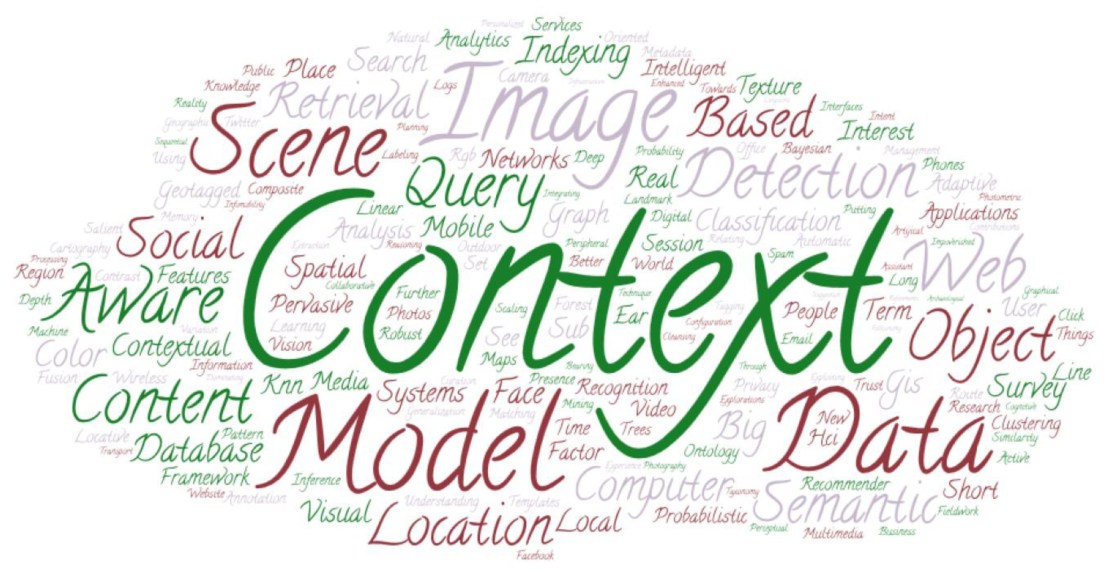
After many decades of flourishing computer science it is now rather evident that in a world dominated by different kinds of digital information, both applications and people are forced to seek new, innovative structures and forms of data management and organization. Following this blunt observation, researchers in informatics have strived over the recent years to tackle the non-unique and rather evolving notion of context, which aids significantly the data disambiguation process. Motivated by this environment, this work attempts to summarize and organize in a researcher-friendly tabular manner important or pioneer related research works deriving from diverse computational intelligence domains: Initially, we discuss the influence of context with respect to traditional low-level multimedia content analysis and search, and retrieval tasks and then we advance to the fields of overall computational context-awareness and the so-called human-generated contextual elements. In an effort to provide meaningful information to fellow researchers, this brief survey focuses on the impact of context in modern and popular computing undertakings of our era. More specifically, we focus to the presentation of a short review of visual context modeling methods, followed by the depiction of context-awareness in modern computing. Works dealing with the interpretation of context by human-generated interactions are also discussed herein, as the particular domain gains an ever-increasing proportion of related research nowadays. We then conclude the paper by providing a short discussion on (i) the motivation behind the included context type categorization into three main pillars; (ii) the findings and conclusions of the survey for each context category; and (iii) a couple of brief advices derived from the survey for both interested developers and fellow researchers.


The Evolution of Contextual Information Processing in Informatics
Phivos Mylonas

Information 2018, 9(3), 47; doi:10.3390/info9030047

Source: www.mdpi.com

Conflict and Convention in Dynamic Networks

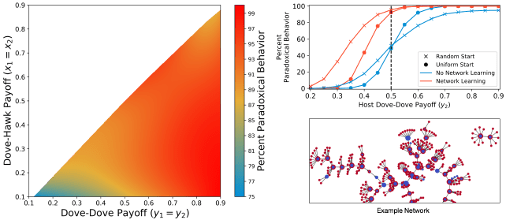
An important way to resolve games of conflict (snowdrift, hawk–dove, chicken) involves adopting a convention: a correlated equilibrium that avoids any conflict between aggressive strategies. Dynamic networks allow individuals to resolve conflict via their network connections rather than changing their strategy. Exploring how behavioral strategies coevolve with social networks reveals new dynamics that can help explain the origins and robustness of conventions. Here, we model the emergence of conventions as correlated equilibria in dynamic networks. Our results show that networks have the tendency to break the symmetry between the two conventional solutions in a strongly biased way. Rather than the correlated equilibrium associated with ownership norms (play aggressive at home, not away), we usually see the opposite host–guest norm (play aggressive away, not at home) evolve on dynamic networks, a phenomenon common to human interaction. We also show that learning to avoid conflict can produce realistic network structures in a way different than preferential attachment models.

Paper on journal website: http://rsif.royalsocietypublishing.org/content/15/140/20170835

Interactive visualization: here