
Author: cxdig

Horizontal transfer of code fragments between protocells can explain the origins of the genetic code without vertical descent

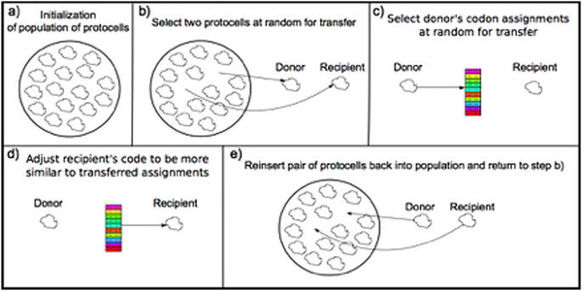
Theories of the origin of the genetic code typically appeal to natural selection and/or mutation of hereditable traits to explain its regularities and error robustness, yet the present translation system presupposes high-fidelity replication. Woese’s solution to this bootstrapping problem was to assume that code optimization had played a key role in reducing the effect of errors caused by the early translation system. He further conjectured that initially evolution was dominated by horizontal exchange of cellular components among loosely organized protocells (“progenotes”), rather than by vertical transmission of genes. Here we simulated such communal evolution based on horizontal transfer of code fragments, possibly involving pairs of tRNAs and their cognate aminoacyl tRNA synthetases or a precursor tRNA ribozyme capable of catalysing its own aminoacylation, by using an iterated learning model. This is the first model to confirm Woese’s conjecture that regularity, optimality, and (near) universality could have emerged via horizontal interactions alone.


Horizontal transfer of code fragments between protocells can explain the origins of the genetic code without vertical descent
Tom Froese, Jorge I. Campos, Kosuke Fujishima, Daisuke Kiga & Nathaniel Virgo
Scientific Reportsvolume 8, Article number: 3532 (2018)
doi:10.1038/s41598-018-21973-y

Source: www.nature.com

Convergence of marine megafauna movement patterns in coastal and open oceans

Understanding the key drivers of animal movement is crucial to assist in mitigating adverse impacts of anthropogenic activities on marine megafauna. We found that movement patterns of marine megafauna are mostly independent of their evolutionary histories, differing significantly from patterns for terrestrial animals. We detected a remarkable convergence in the distribution of speed and turning angles across organisms ranging from whales to turtles (epitome for the slowest animals on land but not at sea). Marine megafauna show a prevalence of movement patterns dominated by search behavior in coastal habitats compared with more directed, ballistic movement patterns when the animals move across the open ocean. The habitats through which they move will therefore need to be considered for effective conservation.


Convergence of marine megafauna movement patterns in coastal and open oceans

A. M. M. Sequeira, et al.

PNAS

Source: www.pnas.org

Why Self-Taught Artificial Intelligence Has Trouble With the Real World

Until very recently, the machines that could trounce champions were at least respectful enough to start by learning from human experience.

To beat Garry Kasparov at chess in 1997, IBM engineers made use of centuries of chess wisdom in their Deep Blue computer. In 2016, Google DeepMind’s AlphaGo thrashed champion Lee Sedol at the ancient board game Go after poring over millions of positions from tens of thousands of human games.

But now artificial intelligence researchers are rethinking the way their bots incorporate the totality of human knowledge. The current trend is: Don’t bother.

Source: www.quantamagazine.org

8th Morphogenetic Engineering Workshop at ALife 2018

This special session aims to promote and expand Morphogenetic Engineering, a field of research exploring the artificial design and implementation of autonomous systems capable of developing complex, heterogeneous morphologies. Particular emphasis is set on the programmability and computing abilities of self-organization, properties that are often underappreciated in complex systems science—while, conversely, the benefits of self-organization are often underappreciated in engineering methodologies.


8th MEW at ALife 2018
Morphogenetic Engineering (Workshop) Special Session, at the
2018 Conference on Artificial Life
July 23-27, 2018
National Museum of Emerging Science and Innovation, Odaiba, Tokyo, Japan

Source: doursat.free.fr

BIOTS – Blockchain + Internet of Things: Welcome to the Future!

Presentation by Dirk Helbing


See Also: 


Source: www.youtube.com