
Presentation by Dirk Helbing
Source: www.youtube.com
Networking the complexity community since 1999
Author: cxdig

CALL FOR PAPERS
The 2018 Conference on Artificial Life (ALIFE 2018)
A Hybrid of the European Conference on Artificial Life (ECAL) and the International Conference on the Synthesis and Simulation of Living Systems (ALife)
July 23-27, 2018
Tokyo, Japan
BEYOND A.I.
The “ALIFE 2018” conference will be a stimulating home for a rich and diverse research community in Artificial Life and related fields from around the world, with a special emphasis on encouraging communication and building bridges between the different research threads that make Artificial Life such an exciting field. Following in the tradition of recent artificial life conferences, the meeting will also have an overall theme that reflects the global nature of the first joint conference: Beyond AI. We believe that AI is just a side effect of ALIFE and we believe that this conference is going to be a turning point for both ALIFE and AI researchers.
We are inviting especially contributions to solve new challenges in ALife. Since the first ALife conference in 1987, the computational landscape has been completely reshaped in terms of scale, means, capacity, and spheres of application in our society. The use of massive real-world data has now the potential to offer an important new avenue for ALife, to help us understand the nature of living systems by understanding bridges between simple idealized models and complex data-rich phenomena? An epistemology for a modern artificial life that can operate at scale and in partnership with data, but without sacrificing the complexity of the systems that we observe, has yet to be achieved.
Submissions are welcome on all topics.
By widening the focus of artificial life, the field can avoid conventional approaches and be a source of radically new concepts, methods, models, and technologies.
We are honoured to welcome keynote speakers who include:
Rodney Brooks (iRobot, MIT, USA)
Inman Harvey (University of Sussex, UK)
Hiroshi Ishiguro (Osaka University, Japan)
David Oreilly (Artist, USA)
Margaret Boden (University of Sussex, UK)
Kenneth O. Stanley (University of Central Florida, USA).
Source: 2018.alife.org
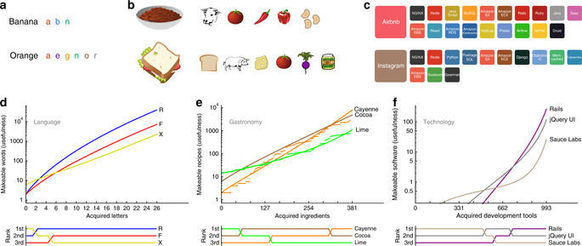
Innovation is to organizations what evolution is to organisms: it is how organizations adapt to environmental change and improve. Yet despite advances in our understanding of evolution, what drives innovation remains elusive. On the one hand, organizations invest heavily in systematic strategies to accelerate innovation. On the other, historical analysis and individual experience suggest that serendipity plays a significant role. To unify these perspectives, we analysed the mathematics of innovation as a search for designs across a universe of component building blocks. We tested our insights using data from language, gastronomy and technology. By measuring the number of makeable designs as we acquire components, we observed that the relative usefulness of different components can cross over time. When these crossovers are unanticipated, they appear to be the result of serendipity. But when we can predict crossovers in advance, they offer opportunities to strategically increase the growth of the product space.
Serendipity and strategy in rapid innovation
T. M. A. Fink, M. Reeves, R. Palma & R. S. Farr
Nature Communications 8, Article number: 2002 (2017)
doi:10.1038/s41467-017-02042-w
Source: www.nature.com
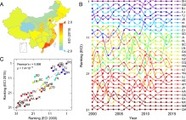
China’s regional economic complexity is quantified by modeling 25 years’ public firm data.
High positive correlation between economic complexity and macroeconomic indicators is shown.
Economic complexity has explanatory power for economic development and income inequality.
Multivariate regressions suggest the robustness of these results with controlling socioeconomic factors.
Quantifying China’s regional economic complexity
Jian Gao, Tao Zhou
Physica A: Statistical Mechanics and its Applications
Volume 492, 15 February 2018, Pages 1591-1603
Source: www.sciencedirect.com

Corina Tarnita deciphers bizarre patterns in the soil created by competing life-forms. She’s found that they can reveal whether an ecosystem is thriving or on the verge of collapse.
Source: www.quantamagazine.org

