Author: cxdig

Network control principles predict neuron function in the Caenorhabditis elegans connectome

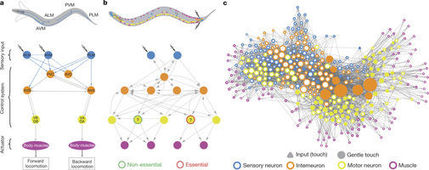
Recent studies on the controllability of complex systems offer a powerful mathematical framework to systematically explore the structure–function relationship in biological, social, and technological networks1, 2, 3. Despite theoretical advances, we lack direct experimental proof of the validity of these widely used control principles. Here we fill this gap by applying a control framework to the connectome of the nematode Caenorhabditis elegans4, 5, 6, allowing us to predict the involvement of each C. elegans neuron in locomotor behaviours. We predict that control of the muscles or motor neurons requires 12 neuronal classes, which include neuronal groups previously implicated in locomotion by laser ablation7, 8, 9, 10, 11, 12, 13, as well as one previously uncharacterized neuron, PDB. We validate this prediction experimentally, finding that the ablation of PDB leads to a significant loss of dorsoventral polarity in large body bends. Importantly, control principles also allow us to investigate the involvement of individual neurons within each neuronal class. For example, we predict that, within the class of DD motor neurons, only three (DD04, DD05, or DD06) should affect locomotion when ablated individually. This prediction is also confirmed; single cell ablations of DD04 or DD05 specifically affect posterior body movements, whereas ablations of DD02 or DD03 do not. Our predictions are robust to deletions of weak connections, missing connections, and rewired connections in the current connectome, indicating the potential applicability of this analytical framework to larger and less well-characterized connectomes.


Network control principles predict neuron function in the Caenorhabditis elegans connectomeNetwork control principles predict neuron function in the Caenorhabditis elegans connectome
Gang Yan, Petra E. Vértes, Emma K. Towlson, Yee Lian Chew, Denise S. Walker, William R. Schafer & Albert-László Barabási

Nature (2017) doi:10.1038/nature24056

Source: www.nature.com
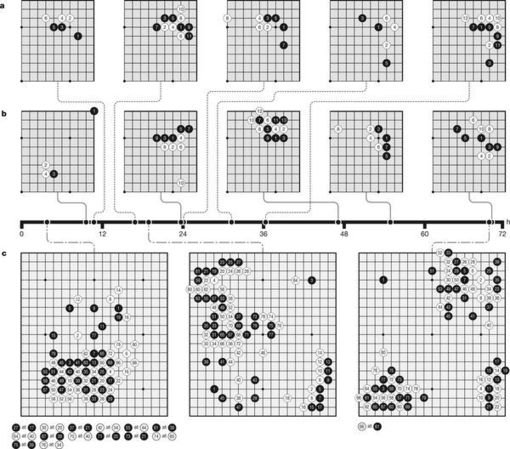
Mastering the game of Go without human knowledge

A long-standing goal of artificial intelligence is an algorithm that learns, tabula rasa, superhuman proficiency in challenging domains. Recently, AlphaGo became the first program to defeat a world champion in the game of Go. The tree search in AlphaGo evaluated positions and selected moves using deep neural networks. These neural networks were trained by supervised learning from human expert moves, and by reinforcement learning from self-play. Here we introduce an algorithm based solely on reinforcement learning, without human data, guidance or domain knowledge beyond game rules. AlphaGo becomes its own teacher: a neural network is trained to predict AlphaGo’s own move selections and also the winner of AlphaGo’s games. This neural network improves the strength of the tree search, resulting in higher quality move selection and stronger self-play in the next iteration. Starting tabula rasa, our new program AlphaGo Zero achieved superhuman performance, winning 100–0 against the previously published, champion-defeating AlphaGo.


Mastering the game of Go without human knowledgeMastering the game of Go without human knowledge
David Silver, Julian Schrittwieser, Karen Simonyan, Ioannis Antonoglou, Aja Huang, Arthur Guez, Thomas Hubert, Lucas Baker, Matthew Lai, Adrian Bolton, Yutian Chen, Timothy Lillicrap, Fan Hui, Laurent Sifre, George van den Driessche, Thore Graepel & Demis Hassabis

Nature 550, 354–359 (19 October 2017) doi:10.1038/nature24270

Source: www.nature.com

It might be argued that since Alpha Go learned from human knowledge and Alpha Go Zero learned from Alpha Go, then Alpha Go Zero does require (indirect) human knowledge. Still, the results are impressive and relevant.

Interview about the Conference on Complex Systems 2017

In this episode, Haley interviews Dr. Carlos Gershenson who is a research professor, Editor-in-Chief of Complexity Digest, and a Co-Chair member of the Conference on Complex Systems. Dr. Gershenson discusses this year’s conference and how it is relevant to events happening in the world today. He also shares details about next year’s Conference on Complex Systems.

Source: soundcloud.com

Waste Is Information

Waste is material information. Landfills are detailed records of everyday consumption and behavior; much of what we know about the distant past we know from discarded objects unearthed by archaeologists and interpreted by historians. And yet the systems and infrastructures that process our waste often remain opaque. In this book, Dietmar Offenhuber examines waste from the perspective of information, considering emerging practices and technologies for making waste systems legible and how the resulting datasets and visualizations shape infrastructure governance. He does so by looking at three waste tracking and participatory sensing projects in Seattle, São Paulo, and Boston.

Offenhuber expands the notion of urban legibility—the idea that the city can be read like a text—to introduce the concept of infrastructure legibility. He argues that infrastructure governance is enacted through representations of the infrastructural system, and that these representations stem from the different stakeholders’ interests, which drive their efforts to make the system legible. The Trash Track project in Seattle used sensor technology to map discarded items through the waste and recycling systems; the Forager project looked at the informal organization processes of waste pickers working for Brazilian recycling cooperatives; and mobile systems designed by the city of Boston allowed residents to report such infrastructure failures as potholes and garbage spills. Through these case studies, Offenhuber outlines an emerging paradigm of infrastructure governance based on a
complex negotiation among users, technology, and the city.


Waste Is Information
Infrastructure Legibility and Governance
By Dietmar Offenhuber

MIT Press

Source: mitpress.mit.edu

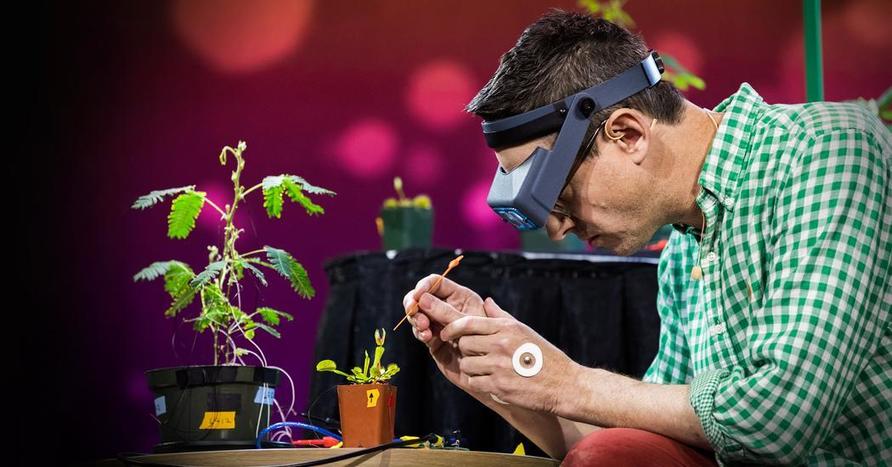
Electrical experiments with plants that count and communicate

Neuroscientist Greg Gage takes sophisticated equipment used to study the brain out of graduate-level labs and brings them to middle- and high-school classrooms (and, sometimes, to the TED stage.) Prepare to be amazed as he hooks up the Mimosa pudica, a plant whose leaves close when touched, and the Venus flytrap to an EKG to show us how plants use electrical signals to convey information, prompt movement and even count.

Source: www.ted.com