

The Lab of Digital and Computational Demography is recruiting highly qualified Post-Docs/Research Scientists, at various levels of seniority.
Source: www.demogr.mpg.de
Networking the complexity community since 1999
Category: Announcements
The Lab of Digital and Computational Demography is recruiting highly qualified Post-Docs/Research Scientists, at various levels of seniority.
Source: www.demogr.mpg.de
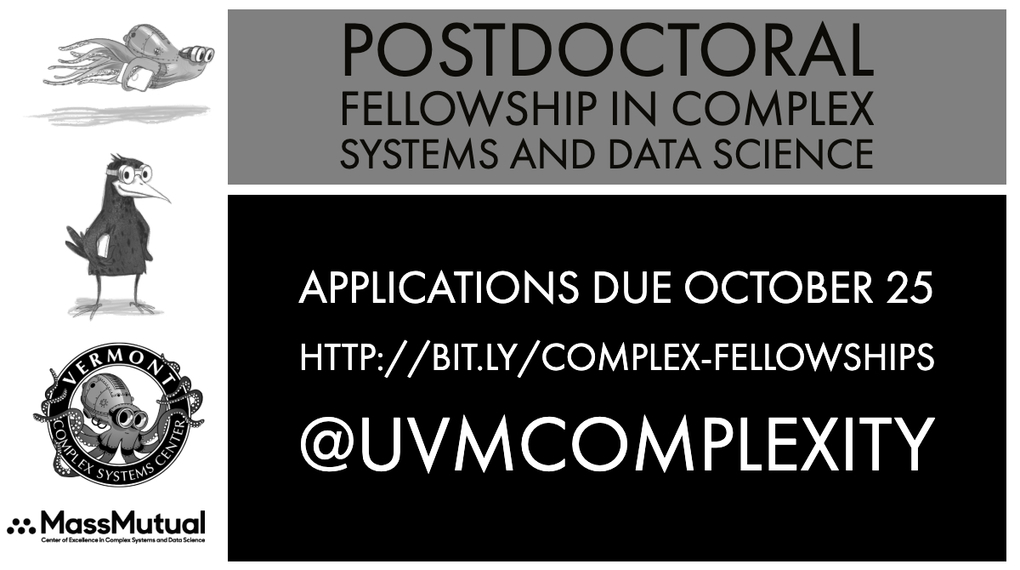
This Postdoctoral Fellowship in Complex Systems and Data Science at the University of Vermont’s Complex Systems Center offers early-career scientists a unique experience to tackle open questions related to complex systems and data science that are of utmost importance in science, industry, and society. This postdoctoral fellowship provides a high level of intellectual freedom and the opportunity to work alongside leading academic researchers and industry partners.
Source: vermontcomplexsystems.org

OUR MISSION
Cross Labs’ mission is to bridge between intelligence science and AI technology at the service of human society. At Cross Labs, we focus on pushing fundamental research towards a thorough mathematical understanding of all intelligent processes observable both in nature and in artificial environments.
POSITION
To reach our goals, we are seeking ambitious, highly-skilled researchers to solve open problems on both natural and artificial intelligence fronts. Our current research priorities cover a large range of intelligence science topics, including artificial life, cognitive neuroscience, collective intelligence, deep learning, robotics, and computational linguistics. Other research topics will be seriously considered if you can make a case for their tractability and relevance to intelligence science research as envisioned by Cross Labs.
IDEAL PROFILE
The ideal candidate shares our excitement to understand the fundamental principles of intelligence, has a career interest in our core research questions and aims to eventually develop into a senior research fellow at Cross Labs, or continue these avenues of research at another institution after completing substantial work at Cross Labs.
Source: www.crosslabs.org

ELSI aims to answer the fundamental questions of how the Earth was formed, how life originated in the environment of early Earth, and how this life evolved into complexity. ELSI pursues these questions by studying the "origin and evolution of life" and the "origin and evolution of the Earth" through an interdisciplinary collaboration between the fields of Earth, Life, and Planetary Sciences. By understanding the early Earth context that allowed for the rise of initial life, we also work to establish a greater understanding of the likelihood of extraterrestrial life elsewhere in the universe.
We are now seeking exceptional candidates for the role of Principal Investigator (Professor or Associate Professor) to lead world-class interdisciplinary research relevant to the origin and evolution of life. ELSI works positively to eliminate biases against gender or national origin. We welcome all qualified candidates, regardless of nationality or gender. We encourage and support our candidates’ close collaborations with overseas research institutes. Our institutional language is English; Japanese language skills are not required. An unprecedented level of support for researchers to live and thrive in Japan is provided by our talented staff.
Source: www.elsi.jp
One of the defining features of living systems is their ability to process, exchange and store large amounts of information at multiple levels of organization, ranging from the biochemical to the ecological. At the same time, living entities are non-equilibrium—possibly at criticality—physical systems that continuously exchange matter and energy with structured environments, all while obeying the laws of thermodynamics. These properties not only lead to the emergence of biological information, but also impose constraints and trade-offs on the costs of such information processing. Some of these costs arise due to the particular properties of the material substrate of living matter in which information processing takes place, while others are universal and apply to all physical systems that process information.
In the past decade, the relationship between thermodynamics and information has received renewed scientific attention, attracting an increasing number of researchers and achieving significant progress. Despite this, the field is full of open problems and challenges at all levels, especially when dealing with biological systems. In spite of these difficulties, continued progress has the potential to fundamentally shape our future understanding of biology.
In this Special Issue we encourage researchers from theoretical biology, statistical physics, neuroscience, information theory, and complex systems to present their research on the connection between thermodynamics and information, with special emphasis on their implications for biological phenomena. We welcome contributions that focus on a particular biological system, as well as contributions that propose general theoretical approaches. We also welcome contributions that use mathematical techniques from statistical physics (variational methods, fluctuation theorems, uncertainty relations, etc.) to investigate biological questions.
Source: www.mdpi.com

