Category: Announcements

Two postdoctoral positions in computational social science at the Network Science Institute

Two postdoctoral positions in computational social science are available at the Network Science Institute, to work with David Lazer and Christoph Riedl. Candidates will be expected to work on a combination of their own research and collaborative projects within the institute.

Source: christophriedl.net

Assistant Professor (Tenure Track), Communication Theory employing Computational Methods, UC Davis

We seek a colleague whose primary research interests are concerned with explicating, understanding, and evaluating fundamental processes of communication. The candidate must satisfy two criteria.

First, candidates must have a track record of communication research that is theoretically innovative. Specifically, the successful candidate is expected to have a research program that advances at least one key area of communication, such as neuroscience, virtual reality, serious games, persuasion, media processes and effects, computer-mediated communication, political communication, social cognition, organizational communication, or interpersonal communication.

Second, candidates must have experience and expertise in employing computational analytical or data science methods in communication research. Such methods may include computer-assisted text analysis, fMRI, sensing technologies, Bayesian inference, Markov models, time series analysis, dynamic network analysis, machine learning, or other state-of-the-art techniques.

Our new colleague will be expected to teach courses in communication theory, innovative methods in her or his area of expertise, courses in the candidate’s substantive area, and other courses based on the Department’s needs.

A doctorate degree is required before the first day of instruction. Applications must be submitted by October 8, 2018 to receive full consideration. This position is subject to final administrative approval. Position to begin July 1, 2019.

Source: recruit.ucdavis.edu

Entropy | Special Issue : Information Theory in Complex Systems

Complex systems are ubiquitous in the natural and engineered worlds. Examples are self-assembling materials, the Earth’s climate, single- and multi-cellular organisms, the brain, and coupled socio-economic and socio-technical systems, to mention a few canonical examples. The use of Shannon information theory to study the behavior of such systems, and to explain and predict their dynamics, has gained significant attention, both from a theoretical and from an experimental viewpoint. There have been many advances in applying Shannon theory to complex systems, including correlation analyses for spatial and temporal data and construction and clustering techniques for complex networks. Progress has often been driven by the application areas, such as genetics, neurosciences, and the Earth sciences.

The application of Shannon theory to data of real-world complex systems are often hindered by the frequent lack of stationarity and sufficient statistics. Further progress on this front call for new statistical techniques based on Shannon information theory, for the sophistication of known techniques, as well as for an improved understanding of the meaning of entropy in complex systems. Contributions addressing any of these issues are very welcome.

This Special Issue aims to be a forum for the presentation of new and improved techniques of information theory for complex systems. In particular, the analysis and interpretation of real-world natural and engineered complex systems with the help of statistical tools based on Shannon information theory fall within the scope of this Special Issue.

Source: www.mdpi.com

Complexity Explorables | I herd you!

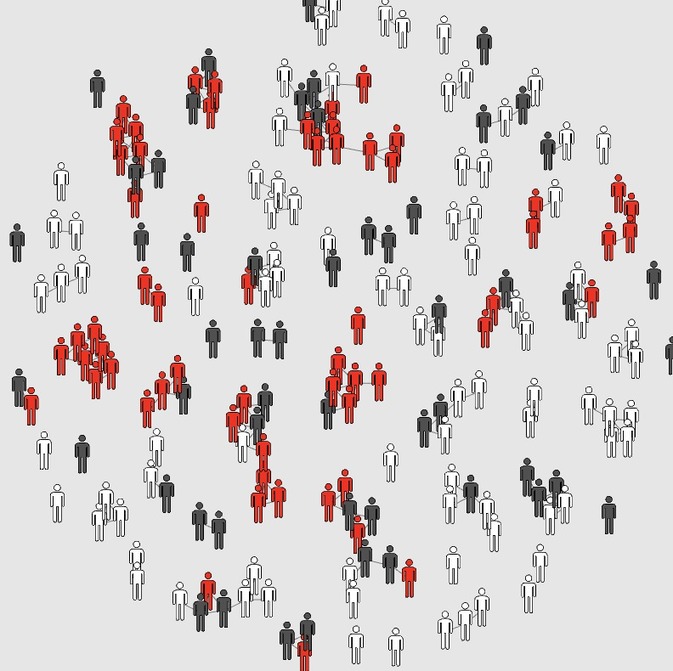
This explorable illustrates the mechanism of herd immunity. When an infectious disease spreads in a population, an individual can be protected by a vaccine that delivers immunity. But there’s a greater good. Immunization not only projects the individual directly. The immunized person will also never transmit the disease to others, effectively reducing the likelihood that the disease can proliferate in the population. Because of this, a disease can be eradicated even if not the entire population is immunized. This population wide effect is known as herd immunity.

Source: www.complexity-explorables.org