Category: Books

Conflicting Models for the Origin of Life

Editor(s):Stoyan K. Smoukov, Joseph Seckbach, Richard Gordon

Conflicting Models for the Origin of Life provides a forum to compare and contrast the many hypotheses that have been put forward to explain the origin of life.

There is a revolution brewing in the field of Origin of Life: in the process of trying to figure out how Life started, many researchers believe there is an impending second creation of life, not necessarily biological. Up-to-date understanding is needed to prepare us for the technological, and societal changes it would bring. Schrodinger’s 1944 “What is life?” included the insight of an information carrier, which inspired the discovery of the structure of DNA. In “Conflicting Models of the Origin of Life” a selection of the world’s experts are brought together to cover different aspects of the research: from progress towards synthetic life – artificial cells and sub-cellular components, to new definitions of life and the unexpected places life could (have) emerge(d). Chapters also cover fundamental questions of how memory could emerge from memoryless processes, and how we can tell if a molecule may have emerged from life. Similarly, cutting-edge research discusses plausible reactions for the emergence of life both on Earth and on exoplanets. Additional perspectives from geologists, philosophers and even roboticists thinking about the origin of life round out this volume. The text is a state-of-the-art snapshot of the latest developments on the emergence of life, to be used both in graduate classes and by citizen scientists.

More at: onlinelibrary.wiley.com

End Times: Elites, Counter-Elites, and the Path of Political Disintegration – by Turchin, Peter

From the pioneering co-founder of cliodynamics, the ground-breaking new interdisciplinary science of history, a big-picture explanation for America’s civil strife and its possible endgames

Peter Turchin, one of the most interesting social scientists of our age, has infused the study of history with approaches and insights from other fields for over a quarter century. End Times is the culmination of his work to understand what causes political communities to cohere and what causes them to fall apart, as applied to the current turmoil within the United States.

Back in 2010, when Nature magazine asked leading scientists to provide a ten-year forecast, Turchin used his models to predict that America was in a spiral of social disintegration that would lead to a breakdown in the political order ca 2020. The years since have proved his prediction more and more accurate, and End Times reveals why.

The lessons of world history are clear, Turchin argues: when the equilibrium between ruling elites and the majority tips too far in favor of elites, political instability is all but inevitable. Since the start of the industrial era, this imbalance has been caused not by excessive population growth but by phase shifts of technological innovation and globalization.

More at: www.amazon.com

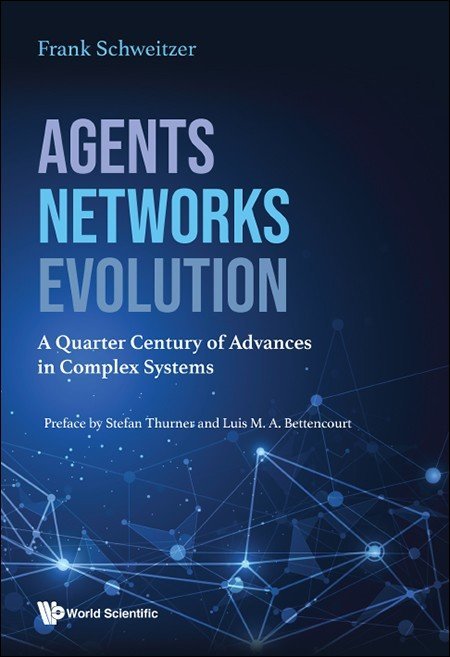
Agents, Networks, Evolution: A Quarter Century of Advances in Complex Systems, edited by Frank Schweitzer

Scientific progress during the last three decades has greatly profited from our advances in understanding complex systems. Fundamental modeling approaches were considerably improved, particularly agent-based modeling, network science, nonlinear dynamics, and system science. At the same time, these approaches have been applied to and adopted by various scientific disciplines, ranging from physics and chemistry to engineering, molecular biology, economics, and the social sciences.

This book reflects the success of complexity science both from a historical and a modeling perspective. It uses 25 articles from different disciplines, published over 25 years, to demonstrate the power and problems of modeling complex systems.

The book’s four parts, Agent-based Models, Network Models, Models of System Dynamics, and Models of Evolution, each provide an informative synopsis of the respective modeling approach. An introductory overview summarizes each approach’s essential concepts, addresses the main research directions, and reviews applications in various disciplines. The selection of reprinted publications is motivated by their scientific relevance and methodological contributions to understanding complex phenomena. A chronological list of publications details the development of each modeling approach over the past 25 years.

The e-book is freely accessible for one year from the date of release.

Read the full book at: www.worldscientific.com

The Primacy of Doubt: From Quantum Physics to Climate Change, How the Science of Uncertainty Can Help Us Understand Our Chaotic World, by Tim Palmer

Learn how the tools that enabled us to overcome the uncertainty of the weather will enable us to find new answers to modern science’s most pressing questions.

Why does your weather app say “There’s a 10% chance of rain” instead of “It will be sunny tomorrow”? In large part this is due to the insight of Tim Palmer, who made uncertainty essential to the study of weather and climate. Now he wants to apply it to how we study everything else.

In The Primacy of Doubt, Palmer argues that embracing the mathematics of uncertainty is vital to understanding ourselves and the universe around us. Whether we want to predict climate change or market crashes, understand how the brain is able to outpace supercomputers, or find a theory that links quantum and cosmological physics, Palmer shows how his vision of mathematical uncertainty provides new insights into some of the deepest problems in science. The result is a revolution—one that shows that power begins by embracing what we don’t know.

More at: www.basicbooks.com

Early Detection of Mental Health Disorders by Social Media Monitoring: The First Five Years of the eRisk Project

Editors: Fabio Crestani, David E. Losada, Javier Parapar
Presents techniques for the early Detection of Mental Health Disorders by Social Media Monitoring

Recent research on eRisk which stands for Early Risk Prediction on the Internet

Presents the best results of the first five years of the eRisk project

Read the full article at: link.springer.com