Category: Books

Handbook on Cities and Complexity, edited by Juval Portugali

Written by some of the founders of complexity theory and complexity theories of cities (CTC), this Handbook expertly guides the reader through over forty years of intertwined developments: the emergence of general theories of complex self-organized systems and the consequent emergence of CTC. 

Examining studies from the end of 1970 through to the current leading approach to urbanism, planning and design, the book provides an up-to-date snapshot of CTC. Insightful chapters are split into five parts covering the early foundations of the topic, the evolution of towns and cities and urban complexity, the links between complexity, languages and cities, modelling traffic and parking in cities, and urban planning and design. The Handbook on Cities and Complexity concludes with the contributors’ personal statements on their observations of COVID-19’s impact upon global cities.
 
This book will be an invaluable resource for those researching cities and complexity and also for scholars of urban studies, planning, physics, mathematics, AI, and architecture.

More at: www.e-elgar.com

The 2021 Conference on Artificial Life Proceedings

Edited by Jitka ČejkováSilvia HollerLisa SorosOlaf Witkowski

MIT Press

This volume contains the proceedings of the 2021 Conference on Artificial Life (ALIFE 2021) which was originally scheduled to be held in Prague (Czech Republic) 19 – 23 July 2021, but because of the covid-19 pandemic and its repercussions, is being held virtually only. (https://2021.alife.org/). The International Conference on the Synthesis and Simulation of Living Systems (ALIFE) and the European Conference on Artificial Life (ECAL) have been the major meetings of the artificial life (ALife) research community since 1987 and 1991, respectively. Currently, these scientific gatherings are supported by the International Society for Artificial Life (ISAL) – a democratic, international, professional society dedicated to promoting scientific research and education relating to artificial life, including sponsoring this conference annually, publishing scientific journals and proceedings, and maintaining web sites related to artificial life.

Read the full proceedings at: direct.mit.edu

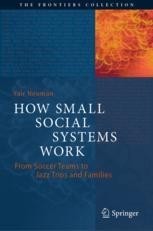
How Small Social Systems Work – From Soccer Teams to Jazz Trios and Families | Yair Neuman | Springer

Most of us are intuitively familiar with small social systems, such as families and soccer teams. Surprisingly, though, most of us are unaware of how complex these systems are or of the fact that they have a unique character distinguishing them from both populations and individuals. The current manuscript, which emerged from high-level scientific publications on the subject, aims to bridge this gap in our understanding of small social systems. The book aims to explain, illustrate, and model the unique and fascinating nature of small (social) systems by relying on deep scientific foundations and by using examples from sport, movies, music, and the martial arts. To support its friendly exposition of challenging scientific ideas, the book also discusses entertaining questions such as (1) why inviting your mother-in-law to dinner might be a challenging event, for reasons you have never considered; (2) why soccer teams should be messy in order to win; (3) why Nazis are deeply wrong in their understanding of the importance of entropy; and (4) why “panda fighters” failed in the UFC (Ultimate Fighting Championship).

More at: www.springer.com

Introduction to Urban Science

A novel, integrative approach to cities as complex adaptive systems, applicable to issues ranging from innovation to economic prosperity to settlement patterns.

Human beings around the world increasingly live in urban environments. In Introduction to Urban Science, Luis Bettencourt takes a novel, integrative approach to understanding cities as complex adaptive systems, claiming that they require us to frame the field of urban science in a way that goes beyond existing theory in such traditional disciplines as sociology, geography, and economics. He explores the processes facilitated by and, in many cases, unleashed for the first time by urban life through the lenses of social heterogeneity, complex networks, scaling, circular causality, and information.

Though the idea that cities are complex adaptive systems has become mainstream, until now those who study cities have lacked a comprehensive theoretical framework for understanding cities and urbanization, for generating useful and falsifiable predictions, and for constructing a solid body of empirical evidence so that the discipline of urban science can continue to develop. Bettencourt applies his framework to such issues as innovation and development across scales, human reasoning and strategic decision-making, patterns of settlement and mobility and their influence on socioeconomic life and resource use, inequality and inequity, biodiversity, and the challenges of sustainable development in both high- and low-income nations. It is crucial, says Bettencourt, to realize that cities are not “zero-sum games” and that knowledge, human cooperation, and collective action can build a better future.

More at: mitpress.mit.edu

Atlas of Forecasts: Modeling and Mapping Desirable Futures

Forecasting the future with advanced data models and visualizations.

To envision and create the futures we want, society needs an appropriate understanding of the likely impact of alternative actions. Data models and visualizations offer a way to understand and intelligently manage complex, interlinked systems in science and technology, education, and policymaking. Atlas of Forecasts, from the creator of Atlas of Science and Atlas of Knowledge, shows how we can use data to predict, communicate, and ultimately attain desirable futures.

Using advanced data visualizations to introduce different types of computational models, Atlas of Forecasts demonstrates how models can inform effective decision-making in education, science, technology, and policymaking. The models and maps presented aim to help anyone understand key processes and outcomes of complex systems dynamics, including which human skills are needed in an artificial intelligence–empowered economy; what progress in science and technology is likely to be made; and how policymakers can future-proof regions or nations. This Atlas offers a driver’s seat-perspective for a test-drive of the future.

More at: mitpress.mit.edu