Category: Books

ScienceBites

In science, concepts such as organism, evolution and life, are used almost every day. Every scientist knows the general meaning of such concepts. At the same time, nature is complex, and for this reason, it is difficult to draw stringent lines around classes of things. Scientists therefore accept the use of so called ‘working definitions’ for many concepts. It is frequently advocated that working on definitions has little use for practical research.

This book explores a different viewpoint, in which definitions are compared with tools. If your toolbox contains too few tools, tools that are worn down, or tools that don’t fit, it becomes difficult to carry out even the most easy maintenance or repair job. Experts know: suitable tools make the work easier.

The aim of this book is to examine much-used concepts in science as if these are tools in a scientific toolbox. Do the current definitions represent quality tools? To explore this question, this book uses a recently developed hierarchy theory, the operator theory, as a reference. This theory is explained in the first chapter. Whenever the analyses suggest to do so, the ScienceBites offer directions for improvement of current definitions.


ScienceBites
A fresh take on commonly used terms in science

Gerard Jagers op Akkerhuis
Published: 2019 Pages: 142

eISBN: 978-90-8686-887-2 | ISBN: 978-90-8686-336-5
https://doi.org/10.3920/978-90-8686-887-2

Source: www.wageningenacademic.com

Physics Is Pointing Inexorably to Mind

As I elaborate extensively in my new book, The Idea of the World, none of this implies solipsism. The mental universe exists in mind but not in your personal mind alone. Instead, it is a transpersonal field of mentation that presents itself to us as physicality—with its concreteness, solidity and definiteness—once our personal mental processes interact with it through observation. This mental universe is what physics is leading us to, not the hand-waving word games of information realism.

Source: blogs.scientificamerican.com

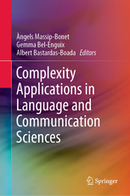
Complexity Applications in Language and Communication Sciences

This book offers insights on the study of natural language as a complex adaptive system. It discusses a new way to tackle the problem of language modeling, and provides clues on how the close relation between natural language and some biological structures can be very fruitful for science. The book examines the theoretical framework and then applies its main principles to various areas of linguistics. It discusses applications in language contact, language change, diachronic linguistics, and the potential enhancement of classical approaches to historical linguistics by means of new methodologies used in physics, biology, and agent systems theory. It shows how studying language evolution and change using computational simulations enables to integrate social structures in the evolution of language, and how this can give rise to a new way to approach sociolinguistics. Finally, it explores applications for discourse analysis, semantics and cognition.


Complexity Applications in Language and Communication Sciences

Editors: Massip Bonet, Àngels, Bel-Enguix, Gemma, Bastardas-Boada, Albert

Source: www.springer.com

See Also: Introduction https://www.researchgate.net/publication/330715416_Introduction_Chapter_1 

The Human Network

It discusses how a handful of simple and quantifiable features of human networks yield enormous insight into why we behave the way we do.   Two threads are interwoven: why human networks have special features, and how those features determine our power, opinions, opportunities, behaviors, and accomplishments.  Some of the topics included are:  the different ways in which a person’s position in a network determines their influence;  which systematic errors we make when forming opinions based on what we learn from our friends; how financial contagions work and why are they different from the spread of a flu; how splits in our social networks feed inequality, immobility, and polarization; and how network patterns of trade and globalization are changing international conflict and wars.
The book is non-technical, with no equations but many pictures, and is full of rich examples and cases that illustrate the points.  It is not only useful for explaining network science to a lay audience, but also as a supplement for a course on networks.

Source: web.stanford.edu

An Introduction to Complex Systems – Making Sense of a Changing World​ | Joseph V. Tranquillo | Springer

This textbook explores the interdisciplinary field of complex systems theory and how it relates to practical questions and issues. The text is interspersed with both philosophical and quantitative arguments, and each chapter ends with questions and prompts that help readers make mor

Source: www.springer.com