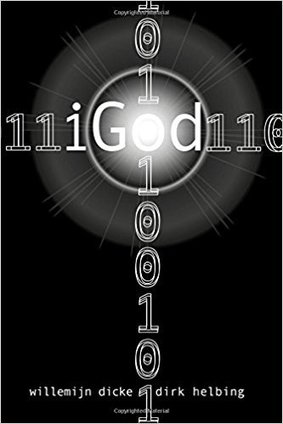
iGod is a science fiction novel with heroes, love, defeat and hope. But it is much more than that. This book aims to explore how societies may develop, given the technologies that we see at present. As Dirk Helbing describes it in his introduction: We have come to the conclusion that neither a scientific study nor an investigative report would allow one to talk about certain things that, we believe, need to be thought and talked about. So, a science fiction story appeared to be the right approach. It seems the perfect way to think “what if scenarios” through. It is not the first time that this avenue has been taken. George Orwell’s “1984” and “Animal Farm” come to mind, or Dave Eggers “The Circle”. The film ‘The Matrix’ and the Netflix series ‘Black Mirror are good examples too. “iGod” outlines how life could be in a couple of years from now, certainly in our lifetime. At some places, this story about our future society seems far-fetched. For example, in “iGod”, all citizens have a Social Citizen Score. This score is established based on their buying habits, their communication in social media and social contacts they maintain. It is obtained by mass-surveillance and has a major impact on everyone’s life. It determines whether you are entitled to get a loan, what jobs you are offered, and even how long you will receive medical care. The book is set in the near future in Amsterdam, the Netherlands. Lex is an unemployed biologist. One day he is contacted by a computer which, gradually reveals the machinery behind the reality we see. It is a bleak world. Together with his girlfriend Diana and Seldon, a Professor at Amsterdam Tech, he starts the quest to regain freedom. Excerpt: ‘Clever way out, Lex! I did not expect your solution in this episode of the game at all. You are the first person to come up with it. This makes me curious.’ Lex looked puzzled at his screen. This direct and personal intervention was not how game managers would normally address the users of MultiLayer. Lex responded puzzled: ‘Who, who are you?’ ‘I thought you would never ask’ – a low, raspy but still velvety feminine voice sounded in his apartment. Lex checked where the sound came from. If he was not mistaken, the voice employed the same sound devices he used for his games and his communication with the SmartHouseProgram. ‘I like to call myself “I am”. I am the mastermind behind what happens in the world.’ Lex was too surprised to respond. ‘Or, to put it more down to earth: I am the Artificial Intelligence behind your MultiLayer game and behind your SmartHouseProgram and a lot more things… This should suffice for the moment’, the low voice continued. Lex got up and paced from one corner to the other. ‘Wow. Did I get it right? You are a female AI system that was all the time hidden in my MultiLayer game and my SmartHouseProgram?’ ‘Well, whatever you prefer. I can also express myself like this…’ Lex heard a male voice. ‘Ok, I got it. You are trying to create the impression of an Artificial Intelligence system making fun of me. But how do I know that someone didn’t just hack the sound system of my SmartHouseProgram?’ ‘So far, so good, Lex.’ She switched back to the mature female voice again, much to Lex’ approval. ‘You are a smart guy, and you will get to know me better. Trust me – you will soon know that I am more than just a hack or a computer program. At this moment I will need your trust and patience – as in any relation.’ ‘I am neither strong in the trust part nor in the patience part.’ ‘Let’s give it a try, Lex. I am sure your curiosity will win.’ ‘You seem to know me well. But in order to be able to relate to you, I need to know your name.’ ‘ “Universal program” or “Singularity” does not do the trick, I presume?’ the voice asked coyly. ‘Not really, no.’ ‘You humans are so romantic – as if a name would change anything. I am known under many different names. What is your name for someone who is present everywhere and who knows everything?’
Source: www.amazon.com