 Fabiane de Fatima Carvalho, Ivan Bergier, Silvia Maria Fonseca Silveira Massruhá, Jayme Garcia Arnal Barbedo
Complexities 2026, 2(3), 21
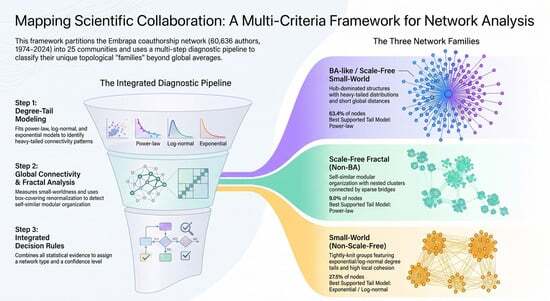
Collaboration networks are frequently studied as empirical instances of complex social systems, yet standardized methodological frameworks for consistently identifying heterogeneous mesoscopic structural regimes remain limited. This study proposes an integrated multi-criteria classification framework and demonstrates its application to the structural characterization of communities extracted from a large-scale scientific collaboration network. The framework combines community detection, classical network metrics, statistical modeling of weighted degree tails, small-world diagnostics, information-entropy measures, and fractal analysis based on the Song–Havlin–Makse box-covering renormalization framework. As an empirical application, the methodology is applied to the giant coauthorship component of Embrapa’s scientific production (1974–2024), derived from the Brazilian Agricultural Research Database (BDPA), comprising 60,636 nodes. The weighted Louvain algorithm partitions the network into 25 major communities, which are evaluated through an integrated classification protocol combining the Akaike Information Criterion model selection, Kolmogorov–Smirnov goodness-of-fit tests, small-worldness diagnostics, and fractal scaling analysis. The proposed framework identifies three network families, namely Barabási–Albert (BA-like)/scale-free small-world, scale-free fractal (non-BA) and small-world (non-scale-free), while explicitly distinguishing supported and ambiguous classifications according to the overall consistency of the statistical and structural evidence. The results demonstrate that distinct mesoscopic structural regimes coexist within the same connected collaboration system, highlighting the usefulness of the proposed reproducible multi-criteria framework for comparative topological characterization across complex collaboration networks.Collaboration networks are frequently studied as empirical instances of complex social systems, yet standardized methodological frameworks for consistently identifying heterogeneous mesoscopic structural regimes remain limited. This study proposes an integrated multi-criteria classification framework and demonstrates its application to the structural characterization of communities extracted from a large-scale scientific collaboration network. The framework combines community detection, classical network metrics, statistical modeling of weighted degree tails, small-world diagnostics, information-entropy measures, and fractal analysis based on the Song–Havlin–Makse box-covering renormalization framework. As an empirical application, the methodology is applied to the giant coauthorship component of Embrapa’s scientific production (1974–2024), derived from the Brazilian Agricultural Research Database (BDPA), comprising 60,636 nodes. The weighted Louvain algorithm partitions the network into 25 major communities, which are evaluated through an integrated classification protocol combining the Akaike Information Criterion model selection, Kolmogorov–Smirnov goodness-of-fit tests, small-worldness diagnostics, and fractal scaling analysis. The proposed framework identifies three network families, namely Barabási–Albert (BA-like)/scale-free small-world, scale-free fractal (non-BA) and small-world (non-scale-free), while explicitly distinguishing supported and ambiguous classifications according to the overall consistency of the statistical and structural evidence. The results demonstrate that distinct mesoscopic structural regimes coexist within the same connected collaboration system, highlighting the usefulness of the proposed reproducible multi-criteria framework for comparative topological characterization across complex collaboration networks.
Read the full article at: www.mdpi.com

 Klaus M. Frahm, Leonardo Ermann, and Dima L. Shepelyansky