Category: Papers

Self-organization in Slovenian public spending

Jelena Joksimović , Matjaž Perc and Zoran Levnajić

Roy. Soc. Open Science August 2023 Volume 10 Issue 8

Private businesses are often entrusted with public contracts, wherein public money is allocated to a private company. This process raises concerns about transparency, even in the most developed democracies. But are there any regularities guiding this process? Do all private companies benefit equally from the state budgets? Here, we tackle these questions focusing on the case of Slovenia, which keeps excellent records of this kind of public spending. We examine a dataset detailing every transfer of public money to the private sector from January 2003 to May 2020. During this time, Slovenia has conducted business with no less than 248 989 private companies. We find that the cumulative distribution of money received per company can be reasonably well explained by a power-law or lognormal fit. We also show evidence for the first-mover advantage, and determine that companies receive new funding in a way that is roughly linear over time. These results indicate that, despite all human factors involved, Slovenian public spending is at least to some extent regulated by emergent self-organizing principles.

Read the full article at: royalsocietypublishing.org

Emergence and retention of a collective memory in cockroaches

Calvo Martín M, Rodriguez Palacio E, Deneubourg J-L, Nicolis SC

PLoS ONE 18(7): e0287845

The stability of collective decisions-making in social systems is crucial as it can lead to counterintuitive phenomena such as collective memories, where an initial choice is challenged by environmental changes. Many social species face the challenge to perform collective decisions under variable conditions. In this study, we focused on situations where isolated individuals and groups of the American cockroach (Periplaneta americana) had to choose between two shelters with different luminosities that were inverted during the experiment. The darker shelter was initially preferred, but only groups that reached a consensus within that shelter maintain their choice after the light inversion, while isolated individuals and small groups lacked site fidelity. Our mathematical model, incorporating deterministic and probabilistic elements, sheds light on the significance interactions and their stochasticity in the emergence and retention of a collective memory.

Read the full article at: journals.plos.org

Coherent movement of error-prone individuals through mechanical coupling

Pratissoli, F., Reina, A., Kaszubowski Lopes, Y. et al.

Nature Communications 14, 4063 (2023).

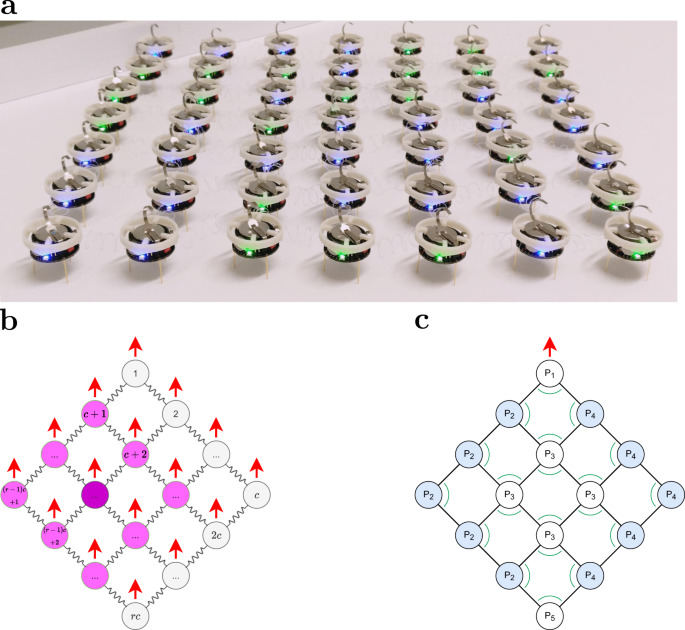
We investigate how reliable movement can emerge in aggregates of highly error-prone individuals. The individuals—robotic modules—move stochastically using vibration motors. By coupling them via elastic links, soft-bodied aggregates can be created. We present distributed algorithms that enable the aggregates to move and deform reliably. The concept and algorithms are validated through formal analysis of the elastic couplings and experiments with aggregates comprising up to 49 physical modules—among the biggest soft-bodied aggregates to date made of autonomous modules. The experiments show that aggregates with elastic couplings can shrink and stretch their bodies, move with a precision that increases with the number of modules, and outperform aggregates with no, or rigid, couplings. Our findings demonstrate that mechanical couplings can play a vital role in reaching coherent motion among individuals with exceedingly limited and error-prone abilities, and may pave the way for low-power, stretchable robots for high-resolution monitoring and manipulation. In biology, individuals are known to achieve higher navigation accuracy when moving in a group compared to single animals. The authors show that simple self-propelled robotic modules that are incapable of accurate motion as individuals can achieve accurate group navigation once coupled via deformable elastic links.

Read the full article at: www.nature.com

Collective behavior from surprise minimization

Conor Heins, Beren Millidge, Lancelot da Costa, Richard Mann, Karl Friston, Iain Couzin
Collective motion is ubiquitous in nature; groups of animals, such as fish, birds, and ungulates appear to move as a whole, exhibiting a rich behavioral repertoire that ranges from directed movement to milling to disordered swarming. Typically, such macroscopic patterns arise from decentralized, local interactions among constituent components (e.g., individual fish in a school). Preeminent models of this process describe individuals as self-propelled particles, subject to self-generated motion and ‘social forces’ such as short-range repulsion and long-range attraction or alignment. However, organisms are not particles; they are probabilistic decision-makers. Here, we introduce an approach to modelling collective behavior based on active inference. This cognitive framework casts behavior as the consequence of a single imperative: to minimize surprise. We demonstrate that many empirically-observed collective phenomena, including cohesion, milling and directed motion, emerge naturally when considering behavior as driven by active Bayesian inference — without explicitly building behavioral rules or goals into individual agents. Furthermore, we show that active inference can recover and generalize the classical notion of social forces as agents attempt to suppress prediction errors that conflict with their expectations. By exploring the parameter space of the belief-based model, we reveal non-trivial relationships between the individual beliefs and group properties like polarization and the tendency to visit different collective states. We also explore how individual beliefs about uncertainty determine collective decision-making accuracy. Finally, we show how agents can update their generative model over time, resulting in groups that are collectively more sensitive to external fluctuations and encode information more robustly.

Read the full article at: arxiv.org