
Category: Papers

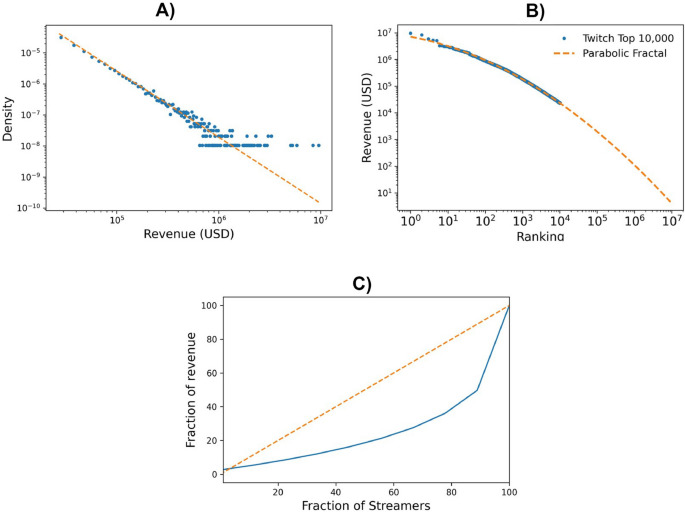
Monetization in online streaming platforms: an exploration of inequalities in Twitch.tv

A. Houssard, F. Pilati, M. Tartari, P. L. Sacco & R. Gallotti
Scientific Reports volume 13, Article number: 1103 (2023)

The live streaming platform Twitch underwent in recent years an impressive growth in terms of viewership and content diversity. The platform has been the object of several studies showcasing how streamers monetize their content via a peculiar system centered around para-sociality and community dynamics. Nonetheless, due to scarcity of data, lots is still unknown about the platform-wide relevance of this explanation as well as its effect on inequalities across streamers. In this paper, thanks to the recent availability of data showcasing the top 10,000 streamers revenue between 2019 and 2021, as well as viewership data from different sources, we characterized the popularity and audience monetization dynamics of the platform. Using methods from social physics and econometrics, we analyzed audience building and retention dynamics and linked them to observed inequalities. We found a high level of inequality across the platform, as well as an ability of top streamers to diversify their revenue sources, through audience renewal and diversification in monetization systems. Our results demonstrate that, even if the platform design and affordance favor monetization for smaller creators catering to specific niches, its non-algorithmic design still leaves room for classical choice biases allowing a few streamers to emerge, retain and renew a massive audience.

Read the full article at: www.nature.com

Implementation of Lenia as a Reaction-Diffusion System

Hiroki Kojima, Takashi Ikegami

The relationship between reaction-diffusion (RD) systems, characterized by continuous spatiotemporal states, and cellular automata (CA), marked by discrete spatiotemporal states, remains poorly understood. This paper delves into this relationship through an examination of a recently developed CA known as Lenia. We demonstrate that asymptotic Lenia, a variant of Lenia, can be comprehensively described by differential equations, and, unlike the original Lenia, it is independent of time-step ticks. Further, we establish that this formulation is mathematically equivalent to a generalization of the kernel-based Turing model (KT model). Stemming from these insights, we establish that asymptotic Lenia can be replicated by an RD system composed solely of diffusion and spatially local reaction terms, resulting in the simulated asymptotic Lenia based on an RD system, or “RD Lenia”. However, our RD Lenia cannot be construed as a chemical system since the reaction term fails to satisfy mass-action kinetics.

Read the full article at: arxiv.org

The spatiotemporal signature of cherry blossom flowering across Japan revealed via analysis of social network site images

Moataz Medhat ElQadi, Adrian G. Dyer, Carolyn Vlasveld, Alan Dorin

Flora

Volume 304, July 2023, 152311

Understanding how changing climatic conditions are impacting flowering plants typically requires intensive effort and expense to sample a local site regularly over long periods of time. The logistics of organising detailed surveys of an extensive area to provide a wider perspective are even more inhibitive. Data on flower bloom patterns across areas stretching hundreds or thousands of kilometres, and with a temporal resolution down to 1 or 2 weeks, is nevertheless very valuable, should it be feasible to collect. To understand the potential for contemporary data to record such flowering patterns, we studied Japan, a country where cherry (Sakura, 桜) flower viewing (Hanami) is a national cultural practice stretching back hundreds of years, and in which contemporary citizens and visitors commonly photograph blossoms to share on social network sites (SNS). We employed the big data this activity creates, within an iEcology framework, by collecting images from the SNS Flickr over the decade 2008–2018. We developed a custom filtering pipeline to validate this extracted data against established databases of historical flowering times. Our results reveal unprecedented detail of the spatiotemporal pattern over which cherry blossoms seasonally sweep from southern to northern Japan during a 12 week period. They also were sufficiently sensitive to reveal a subtle out of peak season bloom. This novel approach and data source therefore provides a simultaneously broad and detailed perspective that communicates the seasonal ecological phenomenon of cherry tree flowering.

Read the full article at: www.sciencedirect.com

Anomalous Self-Organization in Active Piles

Morteza Nattagh-Najafi, Mohammad Nabil, Rafsun Hossain Mridha and Seyed Amin Nabavizadeh

Entropy 2023, 25(6), 861

Inspired by recent observations on active self-organized critical (SOC) systems, we designed an active pile (or ant pile) model with two ingredients: beyond-threshold toppling and under-threshold active motions. By including the latter component, we were able to replace the typical power-law distribution for geometric observables with a stretched exponential fat-tailed distribution, where the exponent and decay rate are dependent on the activity’s strength (𝜁). This observation helped us to uncover a hidden connection between active SOC systems and 𝛼-stable Levy systems. We demonstrate that one can partially sweep 𝛼-stable Levy distributions by changing 𝜁. The system undergoes a crossover towards Bak–Tang–Weisenfeld (BTW) sandpiles with a power-law behavior (SOC fixed point) below a crossover point 𝜁<𝜁∗≈0.1.

Read the full article at: www.mdpi.com

Self-Replication, Spontaneous Mutations, and Exponential Genetic Drift in Neural Cellular Automata

Lana Sinapayen

This paper reports on patterns exhibiting self-replication with spontaneous, inheritable mutations and exponential genetic drift in Neural Cellular Automata. Despite the models not being explicitly trained for mutation or inheritability, the descendant patterns exponentially drift away from ancestral patterns, even when the automaton is deterministic. While this is far from being the first instance of evolutionary dynamics in a cellular automaton, it is the first to do so by exploiting the power and convenience of Neural Cellular Automata, arguably increasing the space of variations and the opportunity for Open Ended Evolution.

Read the full article at: arxiv.org