
Category: Papers

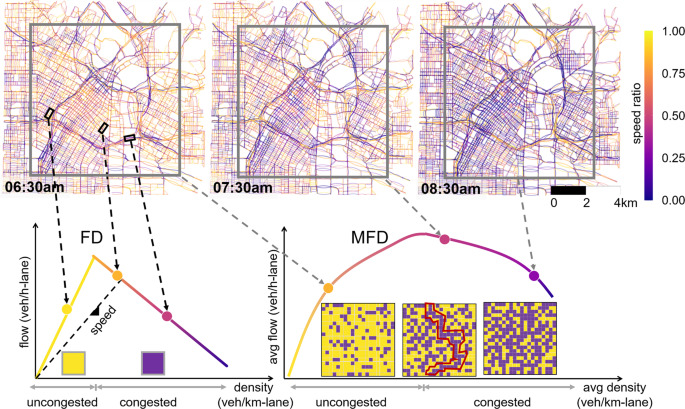
Understanding congestion propagation by combining percolation theory with the macroscopic fundamental diagram

Lukas Ambühl, Monica Menendez & Marta C. González
Communications Physics volume 6, Article number: 26 (2023)

The science of cities aims to model urban phenomena as aggregate properties that are functions of a system’s variables. Following this line of research, this study seeks to combine two well-known approaches in network and transportation science: (i) The macroscopic fundamental diagram (MFD), which examines the characteristics of urban traffic flow at the network level, including the relationship between flow, density, and speed. (ii) Percolation theory, which investigates the topological and dynamical aspects of complex networks, including traffic networks. Combining these two approaches, we find that the maximum number of congested clusters and the maximum MFD flow occur at the same moment, precluding network percolation (i.e. traffic collapse). These insights describe the transition of the average network flow from the uncongested phase to the congested phase in parallel with the percolation transition from sporadic congested links to a large, congested cluster of links. These results can help to better understand network resilience and the mechanisms behind the propagation of traffic congestion and the resulting traffic collapse.

Read the full article at: www.nature.com

Homophily-Based Social Group Formation in a Spin Glass Self-Assembly Framework

Jan Korbel, Simon D. Lindner, Tuan Minh Pham, Rudolf Hanel, and Stefan Thurner
Phys. Rev. Lett. 130, 057401

Homophily, the tendency of humans to attract each other when sharing similar features, traits, or opinions, has been identified as one of the main driving forces behind the formation of structured societies. Here we ask to what extent homophily can explain the formation of social groups, particularly their size distribution. We propose a spin-glass-inspired framework of self-assembly, where opinions are represented as multidimensional spins that dynamically self-assemble into groups; individuals within a group tend to share similar opinions (intragroup homophily), and opinions between individuals belonging to different groups tend to be different (intergroup heterophily). We compute the associated nontrivial phase diagram by solving a self-consistency equation for “magnetization” (combined average opinion). Below a critical temperature, there exist two stable phases: one ordered with nonzero magnetization and large clusters, the other disordered with zero magnetization and no clusters. The system exhibits a first-order transition to the disordered phase. We analytically derive the group-size distribution that successfully matches empirical group-size distributions from online communities.

Read the full article at: link.aps.org

The circular economy

A sustainable future requires preservation of the world’s finite resources, which often means the waste from one process loops back and becomes the input for another. Advanced technologies and techniques are helping an array of industries to make reuse and recycling more central to their operations. 

Read the full Outlook at: www.nature.com

Scaling up our understanding of tipping points

Sonia Kéfi, Camille Saade, Eric L. Berlow, Juliano S. Cabral and Emanuel A. Fronhofer

Philosophical Transactions of the Royal Society B-Biological Sciences; Vol.: 377; Issue: 1857; Article No.: 20210386

Anthropogenic activities are increasingly affecting ecosystems across the globe. Meanwhile, empirical and theoretical evidence suggest that natural systems can exhibit abrupt collapses in response to incremental increases in the stressors, sometimes with dramatic ecological and economic consequences. These catastrophic shifts are faster and larger than expected from the changes in the stressors and happen once a tipping point is crossed. The primary mechanisms that drive ecosystem responses to perturbations lie in their architecture of relationships, i.e. how species interact with each other and with the physical environment and the spatial structure of the environment. Nonetheless, existing theoretical work on catastrophic shifts has so far largely focused on relatively simple systems that have either few species and/or no spatial structure. This work has laid a critical foundation for understanding how abrupt responses to incremental stressors are possible, but it remains difficult to predict (let alone manage) where or when they are most likely to occur in more complex real-world settings. Here, we discuss how scaling up our investigations of catastrophic shifts from simple to more complex—species rich and spatially structured—systems could contribute to expanding our understanding of how nature works and improve our ability to anticipate the effects of global change on ecological systems.

Read the full article at: royalsocietypublishing.org