Category: Papers

Self-organisation, (M, R)–systems and enactive cognitive science

Tomasz Korbak

Adaptive Behavior 31(1)

The notion of self-organisation plays a major role in enactive cognitive science. In this paper, I review several formal models of self-organisation that various approaches in modern cognitive science rely upon. I then focus on Rosen’s account of self-organisation as closure to efficient cause and his argument that models of systems closed to efficient cause – (M, R) systems – are uncomputable. Despite being sometimes relied on by enactivists this argument is problematic it rests on assumptions unacceptable for enactivists: that living systems can be modelled as time-invariant and material-independent. I then argue that there exists a simple and philosophically appealing reparametrisation of (M, R)–systems that accounts for the temporal dimensions of life but renders Rosen’s argument invalid.

Read the full article at: journals.sagepub.com

Phase-separation physics underlies new theory for the resilience of patchy ecosystems

Koen Siteur, Quan-Xing Liu, Vivi Rottschäfer, Tjisse van der Heide, Max Rietkerk, Arjen Doelman, Christoffer Boström, and Johan van de Koppel

PNAS 120 (2) e2202683120

Human-induced environmental changes push ecosystems worldwide toward their limits. Therefore, there is a growing need for indicators to assess the resilience of ecosystems against external changes and disturbances. We highlight a novel class of spatial patterns in ecosystems for which resilience indicators are lacking and introduce a new indicator framework for these ecosystems, akin to the physics of phase separation. Our work suggests that aerial imagery can be used to monitor patchy ecosystems and highlights a link between physics and ecosystem resilience.

Read the full article at: www.pnas.org

There’s Plenty of Room Right Here: Biological Systems as Evolved, Overloaded, Multi-scale Machines

Joshua Bongard, Michael Levin
The applicability of computational models to the biological world is an active topic of debate. We argue that a useful path forward results from abandoning hard boundaries between categories and adopting an observer-dependent, pragmatic view. Such a view dissolves the contingent dichotomies driven by human cognitive biases (e.g., tendency to oversimplify) and prior technological limitations in favor of a more continuous, gradualist view necessitated by the study of evolution, developmental biology, and intelligent machines. Efforts to re-shape living systems for biomedical or bioengineering purposes require prediction and control of their function at multiple scales. This is challenging for many reasons, one of which is that living systems perform multiple functions in the same place at the same time. We refer to this as “polycomputing” – the ability of the same substrate to simultaneously compute different things. This ability is an important way in which living things are a kind of computer, but not the familiar, linear, deterministic kind; rather, living things are computers in the broad sense of computational materials as reported in the rapidly-growing physical computing literature. We argue that an observer-centered framework for the computations performed by evolved and designed systems will improve the understanding of meso-scale events, as it has already done at quantum and relativistic scales. Here, we review examples of biological and technological polycomputing, and develop the idea that overloading of different functions on the same hardware is an important design principle that helps understand and build both evolved and designed systems. Learning to hack existing polycomputing substrates, as well as evolve and design new ones, will have massive impacts on regenerative medicine, robotics, and computer engineering.

Read the full article at: arxiv.org

The theoretical foundations of enaction: Precariousness

Randall D.Beer, Ezequiel A.Di Paolo

Biosystems
Volume 223, January 2023, 104823

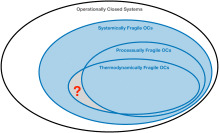
Enaction is an increasingly influential approach to cognition that grew out of Maturana and Varela’s earlier work on autopoiesis and the biology of cognition. As with any relatively new scientific discipline, the enactive approach would benefit greatly from a careful analysis of its theoretical foundations. Here we initiate such an analysis for one of the core concepts of enaction, precariousness. Specifically, we consider three types of fragility: systemic, processual and thermodynamic. Using a glider in the Game of Life as a toy model, we illustrate each of these fragilities and examine the relationships between them. We also argue that each type of fragility is characterized by which aspects of a system are hardwired into its definition from the outset and which aspects are emergent and hence vulnerable to disintegration without ongoing maintenance.

Read the full article at: www.sciencedirect.com