Category: Papers

Phase Transitions and Criticality in the Collective Behavior of Animals — Self-organization and biological function

Pawel Romanczuk, Bryan C. Daniels
Collective behaviors exhibited by animal groups, such as fish schools, bird flocks, or insect swarms are fascinating examples of self-organization in biology. Concepts and methods from statistical physics have been used to argue theoretically about the potential consequences of collective effects in such living systems. In particular, it has been proposed that such collective systems should operate close to a phase transition, specifically a (pseudo-)critical point, in order to optimize their capability for collective computation. In this chapter, we will first review relevant phase transitions exhibited by animal collectives, pointing out the difficulties of applying concepts from statistical physics to biological systems. Then we will discuss the current state of research on the “criticality hypothesis”, including methods for how to measure distance from criticality and specific functional consequences for animal groups operating near a phase transition. We will highlight the emerging view that de-emphasizes the optimality of being exactly at a critical point and instead explores the potential benefits of living systems being able to tune to an optimal distance from criticality. We will close by laying out future challenges for studying collective behavior at the interface of physics and biology.

Read the full article at: arxiv.org

Data-driven identification of post-acute SARS-CoV-2 infection subphenotypes

Hao Zhang, Chengxi Zang, Zhenxing Xu, Yongkang Zhang, Jie Xu, Jiang Bian, Dmitry Morozyuk, Dhruv Khullar, Yiye Zhang, Anna S. Nordvig, Edward J. Schenck, Elizabeth A. Shenkman, Russell L. Rothman, Jason P. Block, Kristin Lyman, Mark G. Weiner, Thomas W. Carton, Fei Wang & Rainu Kaushal 

Nature Medicine (2022)

The post-acute sequelae of SARS-CoV-2 infection (PASC) refers to a broad spectrum of symptoms and signs that are persistent, exacerbated or newly incident in the period after acute SARS-CoV-2 infection. Most studies have examined these conditions individually without providing evidence on co-occurring conditions. In this study, we leveraged the electronic health record data of two large cohorts, INSIGHT and OneFlorida+, from the national Patient-Centered Clinical Research Network. We created a development cohort from INSIGHT and a validation cohort from OneFlorida+ including 20,881 and 13,724 patients, respectively, who were SARS-CoV-2 infected, and we investigated their newly incident diagnoses 30–180 days after a documented SARS-CoV-2 infection. Through machine learning analysis of over 137 symptoms and conditions, we identified four reproducible PASC subphenotypes, dominated by cardiac and renal (including 33.75% and 25.43% of the patients in the development and validation cohorts); respiratory, sleep and anxiety (32.75% and 38.48%); musculoskeletal and nervous system (23.37% and 23.35%); and digestive and respiratory system (10.14% and 12.74%) sequelae. These subphenotypes were associated with distinct patient demographics, underlying conditions before SARS-CoV-2 infection and acute infection phase severity. Our study provides insights into the heterogeneity of PASC and may inform stratified decision-making in the management of PASC conditions.

Read the full article at: www.nature.com

A biology-inspired recurrent oscillator network for computations in high-dimensional state space

Felix Effenberger, Pedro Carvalho, Igor Dubinin, Wolf Singer

Biological neuronal networks have the propensity to oscillate. However, it is unclear whether these oscillations are a mere byproduct of neuronal interactions or serve computational purposes. Therefore, we implemented hallmark features of the cerebral cortex in recurrent neuronal networks (RNNs) simulated in silico and examined their performance on common pattern recognition tasks after training with a gradient-based learning rule. We find that by configuring network nodes as damped harmonic oscillators (DHOs), performance is substantially improved over non-oscillating architectures and that the introduction of heterogeneous nodes, conduction delays, and network modularity further improved performance. We furthermore provide a proof of concept of how unsupervised Hebbian learning can work in such networks. Analyses of network activity illustrate how the nonlinear dynamics of coupled DHOs drive performance, and provide plausible a posteriori explanations for a number of physiological phenomena whose function so far has been elusive.

Read the full article at: www.biorxiv.org

Measuring exposure to misinformation from political elites on Twitter

Mohsen Mosleh & David G. Rand
Nature Communications volume 13, Article number: 7144 (2022)

Misinformation can come directly from public figures and organizations (referred to here as “elites”). Here, we develop a tool for measuring Twitter users’ exposure to misinformation from elites based on the public figures and organizations they choose to follow. Using a database of professional fact-checks by PolitiFact, we calculate falsity scores for 816 elites based on the veracity of their statements. We then assign users an elite misinformation-exposure score based on the falsity scores of the elites they follow on Twitter. Users’ misinformation-exposure scores are negatively correlated with the quality of news they share themselves, and positively correlated with estimated conservative ideology. Additionally, we analyze the co-follower, co-share, and co-retweet networks of 5000 Twitter users and find an ideological asymmetry: estimated ideological extremity is associated with more misinformation exposure for users estimated to be conservative but not for users estimated to be liberal. Finally, we create an open-source R library and an Application Programming Interface (API) making our elite misinformation-exposure estimation tool openly available to the community. Misinformation online can be shared by major political figures and organizations. Here, the authors developed a method to measure exposure to information from these sources on Twitter, and show how exposure relates to the quality of the content people share and their political ideology.

Read the full article at: www.nature.com

Statistical inference links data and theory in network science

Leto Peel, Tiago P. Peixoto & Manlio De Domenico 
Nature Communications volume 13, Article number: 6794 (2022)

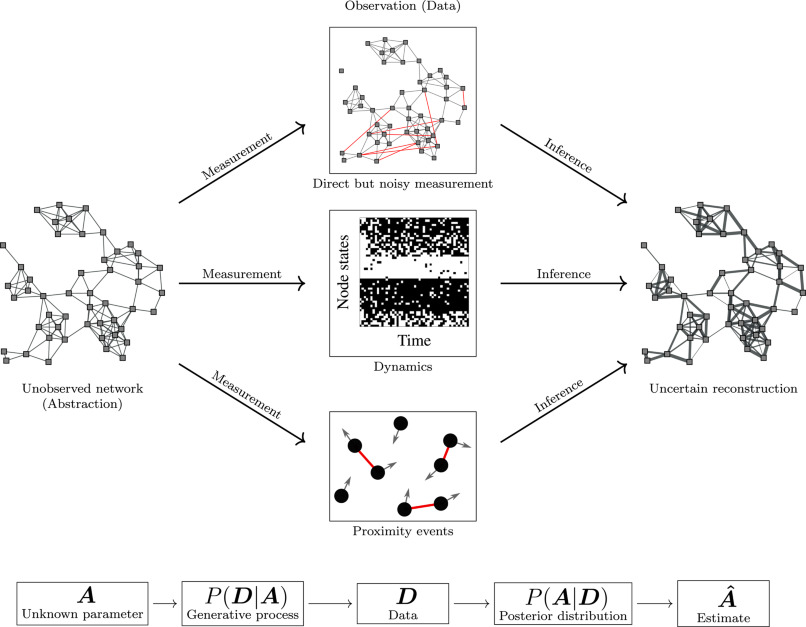
The number of network science applications across many different fields has been rapidly increasing. Surprisingly, the development of theory and domain-specific applications often occur in isolation, risking an effective disconnect between theoretical and methodological advances and the way network science is employed in practice. Here we address this risk constructively, discussing good practices to guarantee more successful applications and reproducible results. We endorse designing statistically grounded methodologies to address challenges in network science. This approach allows one to explain observational data in terms of generative models, naturally deal with intrinsic uncertainties, and strengthen the link between theory and applications.

Read the full article at: www.nature.com