Category: Papers

THE BACKBONE OF THE FINANCIAL INTERACTION NETWORK USING A MAXIMUM ENTROPY DISTRIBUTION

MAURICIO A. VALLE and FELIPE URBINA

Advances in Complex SystemsVol. 25, No. 04, 2250006 (2022)

We modeled the stocks of the financial system as a set of many interacting like spins derived from binary daily returns. From the empirical observation of these returns, we used a Boltzmann machine to infer a distribution of states equivalent to a maximum entropy distribution. This model describes the interaction couplings between each stock pair in the system, which can be considered a complete network with 𝑁(𝑁−1)/2 couplings. We then engage in a coupling removal process to find a critical graph that can describe the observed states of the system with the minimum number of edges. We interpret the critical graph as the backbone of the system, and it allows us to evaluate the importance of markets in their relation to others in the system. We also found that the structure of this critical graph is highly variable over time and appears to be dependent on the level of entropy of the system.

Read the full article at: www.worldscientific.com
Observing many researchers using the same data and hypothesis reveals a hidden universe of uncertainty

Nate Breznau, et al.

PNAS 119 (44) e2203150119

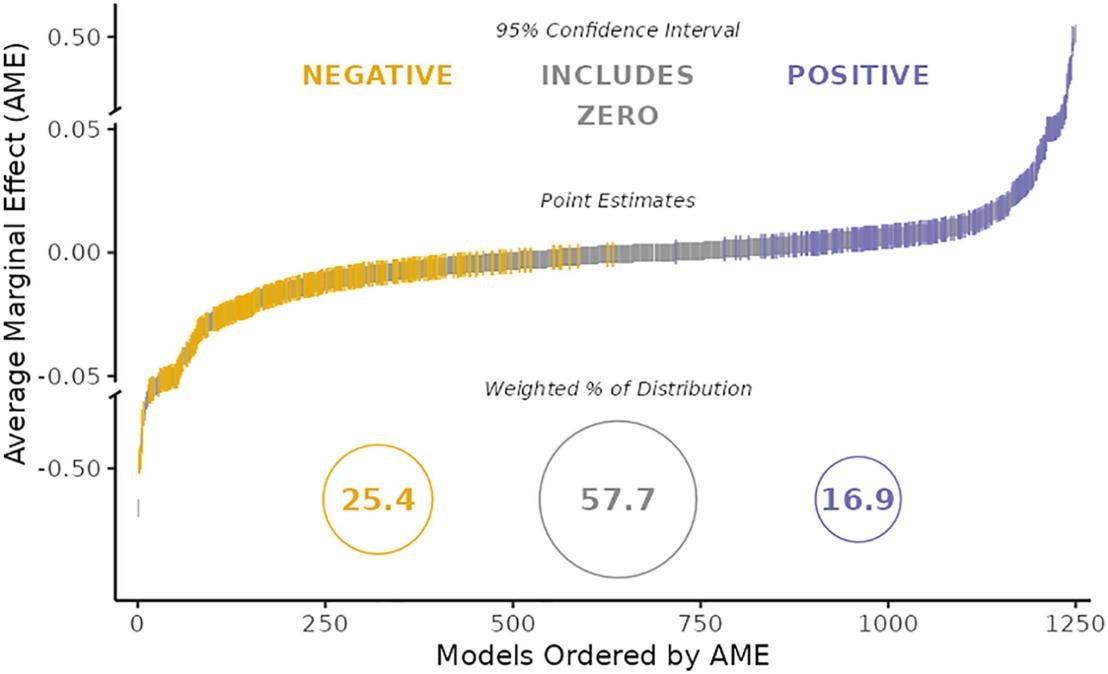
Will different researchers converge on similar findings when analyzing the same data? Seventy-three independent research teams used identical cross-country survey data to test a prominent social science hypothesis: that more immigration will reduce public support for government provision of social policies. Instead of convergence, teams’ results varied greatly, ranging from large negative to large positive effects of immigration on social policy support. The choices made by the research teams in designing their statistical tests explain very little of this variation; a hidden universe of uncertainty remains. Considering this variation, scientists, especially those working with the complexities of human societies and behavior, should exercise humility and strive to better account for the uncertainty in their work.

Read the full article at: www.pnas.org

Struggling with change: The fragile resilience of collectives

Struggling with change: The fragile resilience of collectives

Frank Schweitzer, Christian Zingg, Giona Casiraghi
Collectives form non-equilibrium social structures characterised by a volatile dynamics. Individuals join or leave. Social relations change quickly. Therefore, differently from engineered or ecological systems, a resilient reference state cannot be defined. We propose a novel resilience measure combining two dimensions: robustness and adaptivity. We demonstrate how they can be quantified using data from a software developer collective. Our analysis reveals a resilience life cycle, i.e., stages of increasing resilience are followed by stages of decreasing resilience. We explain the reasons for these observed dynamics and provide a formal model to reproduce them. The resilience life cycle allows distinguishing between short-term resilience, given by a sequence of resilient states, and long-term resilience, which requires collectives to survive through different cycles.

Read the full article at: arxiv.org

Modelling brain dynamics by Boolean networks

Francesca Bertacchini, Carmelo Scuro, Pietro Pantano & Eleonora Bilotta 
Scientific Reports volume 12, Article number: 16543 (2022)

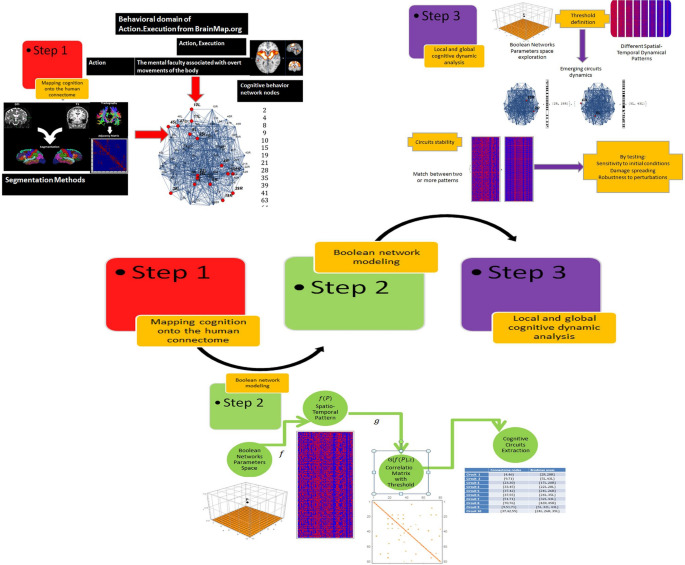
Understanding the relationship between brain architecture and brain function is a central issue in neuroscience. We modeled realistic spatio-temporal patterns of brain activity on a human connectome with a Boolean networks model with the aim of computationally replicating certain cognitive functions as they emerge from the standardization of many fMRI studies, identified as patterns of human brain activity. Results from the analysis of simulation data, carried out for different parameters and initial conditions identified many possible paths in the space of parameters of these network models, with normal (ordered asymptotically constant patterns), chaotic (oscillating or disordered) but also highly organized configurations, with countless spatial–temporal patterns. We interpreted these results as routes to chaos, permanence of the systems in regimes of complexity, and ordered stationary behavior, associating these dynamics to cognitive processes. The most important result of this work is the study of emergent neural circuits, i.e., configurations of areas that synchronize over time, both locally and globally, determining the emergence of computational analogues of cognitive processes, which may or may not be similar to the functioning of biological brain. Furthermore, results put in evidence the creation of how the brain creates structures of remote communication. These structures have hierarchical organization, where each level allows for the emergence of brain organizations which behave at the next superior level. Taken together these results allow the interplay of dynamical and topological roots of the multifaceted brain dynamics to be understood.

Read the full article at: www.nature.com

Macroscopic properties of buyer-seller networks in online marketplaces

Alberto Bracci, Jörn Boehnke, Abeer ElBahrawy, Nicola Perra, Alexander Teytelboym, Andrea Baronchelli

PNAS Nexus, pgac201

Online marketplaces are the main engines of legal and illegal e-commerce, yet their empirical properties are poorly understood due to the absence of large-scale data. We analyze two comprehensive datasets containing 245M transactions (16B USD) that took place on online marketplaces between 2010 and 2021, covering 28 dark web marketplaces, i.e., unregulated markets whose main currency is Bitcoin, and 144 product markets of one popular regulated e-commerce platform. We show that transactions in online marketplaces exhibit strikingly similar patterns despite significant differences in language, lifetimes, products, regulation, and technology. Specifically, we find remarkable regularities in the distributions of transaction amounts, number of transactions, inter-event times and time between first and last transactions. We show that buyer behavior is affected by the memory of past interactions and use this insight to propose a model of network formation reproducing our main empirical observations. Our findings have implications for understanding market power on online marketplaces as well as inter-marketplace competition , and provide empirical foundation for theoretical economic models of online marketplaces.

Read the full article at: academic.oup.com