Category: Papers

Untangling the network effects of productivity and prominence among scientists

Weihua Li, Sam Zhang, Zhiming Zheng, Skyler J. Cranmer & Aaron Clauset
Nature Communications volume 13, Article number: 4907 (2022)

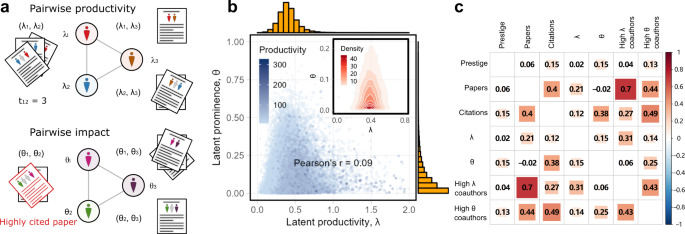
While inequalities in science are common, most efforts to understand them treat scientists as isolated individuals, ignoring the network effects of collaboration. Here, we develop models that untangle the network effects of productivity defined as paper counts, and prominence referring to high-impact publications, of individual scientists from their collaboration networks. We find that gendered differences in the productivity and prominence of mid-career researchers can be largely explained by differences in their coauthorship networks. Hence, collaboration networks act as a form of social capital, and we find evidence of their transferability from senior to junior collaborators, with benefits that decay as researchers age. Collaboration network effects can also explain a large proportion of the productivity and prominence advantages held by researchers at prestigious institutions. These results highlight a substantial role of social networks in driving inequalities in science, and suggest that collaboration networks represent an important form of unequally distributed social capital that shapes who makes what scientific discoveries.

Read the full article at: www.nature.com

Temporal, structural, and functional heterogeneities extend criticality and antifragility in random Boolean networks

Amahury Jafet López-Díaz, Fernanda Sánchez-Puig, Carlos Gershenson
Most models of complex systems have been homogeneous, i.e., all elements have the same properties (spatial, temporal, structural, functional). However, most natural systems are heterogeneous: few elements are more relevant, larger, stronger, or faster than others. In homogeneous systems, criticality — a balance between change and stability, order and chaos — is usually found for a very narrow region in the parameter space, close to a phase transition. Using random Boolean networks — a general model of discrete dynamical systems — we show that heterogeneity — in time, structure, and function — can broaden additively the parameter region where criticality is found. Moreover, parameter regions where antifragility is found are also increased with heterogeneity. However, maximum antifragility is found for particular parameters in homogeneous networks. Our work suggests that the “optimal” balance between homogeneity and heterogeneity is non-trivial, context-dependent, and in some cases, dynamic.

Read the full article at: arxiv.org

What can we know about that which we cannot even imagine?

David H. Wolpert
In this essay I will consider a sequence of questions, ending with one about the breadth and depth of the epistemic limitations of our our science and mathematics. I will then suggest a possible way to circumvent such limitations. I begin by considering questions about the biological function of intelligence. This will lead into questions concerning human language, perhaps the most important cognitive prosthesis we have ever developed. While it is traditional to rhapsodize about the perceptual power provided by human language, I will emphasize how horribly limited – and therefore limiting – it is. This will lead to questions of whether human mathematics, being so deeply grounded in our language, is also deeply limited. I will then combine all of this into a partial, sort-of, sideways answer to the guiding question of this essay: what we can ever discern about all that we cannot even conceive of?

Read the full article at: arxiv.org

Optimal transport and control of active drops

Suraj Shankar, Vidya Raju, and L. Mahadevan

PNAS

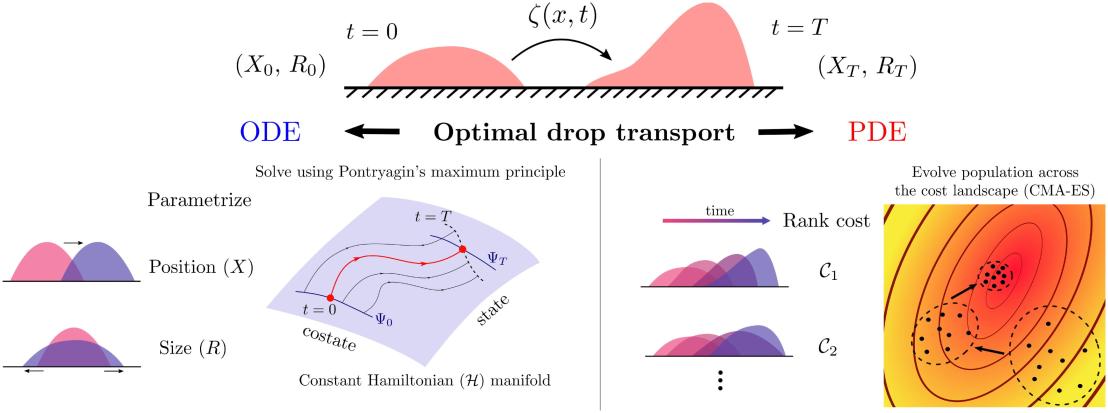
Transportation, in its broadest sense, is an important task in many fields, including engineering, physics, biology, and economics, and a great deal is known about optimal and efficient strategies to move matter, energy, and information around. But can we craft similar optimal protocols to transport autonomously moving (active) matter, such as self-propelled drops or migrating cells? We develop an optimal control framework to transport active fluid drops with the least amount of energy dissipated, by manipulating the spatio-temporal profile of its internal active stresses. By combining numerical solutions and analytical insight, we uncover simple principles and characteristic trade-offs that govern the optimal policies, suggesting general strategies for optimal transportation in a wide variety of synthetic and biological active systems.

Read the full article at: www.pnas.org