Category: Papers

Nutrient concentrations in food display universal behaviour

Giulia Menichetti & Albert-László Barabási 

Nature Food volume 3, pages375–382 (2022)

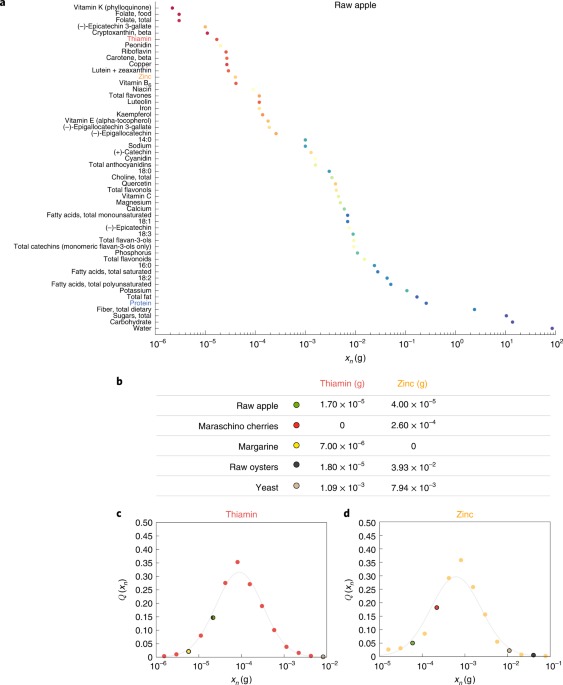
Extensive programmes around the world endeavour to measure and catalogue the composition of food. Here we analyse the nutrient content of the full US food supply and show that the concentration of each nutrient follows a universal single-parameter scaling law that accurately captures the eight orders of magnitude in nutrient content variability. We show that the universality is rooted in the biochemical constraints obeyed by the metabolic pathways responsible for nutrient modulation, allowing us to confirm the empirically observed scaling law and to predict its variability in agreement with the data. We propose that the natural nutrient variability in food can be quantitatively formalized. This provides a mathematical rationale for imputing missing values in food composition databases and paves the way towards a quantitative understanding of the impact of food processing on nutrient balance and health effects.

Read the full article at: www.nature.com
The emergence of polarization in coevolving networks

Jiazhen Liu, Shengda Huang, Nathan Aden, Neil Johnson, Chaoming Song
Polarization is a ubiquitous phenomenon in social systems. Empirical studies show substantial evidence for opinion polarization across social media. Recent modeling works show qualitatively that polarization emerges in coevolving networks by integrating reinforcing mechanisms and network evolution. However, a quantitative and comprehensive theoretical framework capturing generic mechanisms governing polarization remains unaddressed. In this paper, we discover a universal scaling law for opinion distributions, characterized by a set of scaling exponents. These exponents classify social systems into polarization and depolarization phases. We find two generic mechanisms governing the polarization dynamics, and propose a coevolving framework that counts for opinion dynamics and network evolution simultaneously. We show analytically three different phases including polarization, partial polarization, and depolarization, and the corresponding phase diagram. In the polarized phase, our theory predicts that a bi-polarized community structure emerges naturally from the coevolving dynamics. These theoretical predictions are in line with observations in empirical datasets. Our theory not only accounts for the empirically observed scaling laws but also allows us to quantitatively predict scaling exponents.

Read the full article at: arxiv.org

Group mixing drives inequality in face-to-face gatherings

Marcos Oliveira, Fariba Karimi, Maria Zens, Johann Schaible, Mathieu Génois & Markus Strohmaier
Communications Physics volume 5, Article number: 127 (2022)

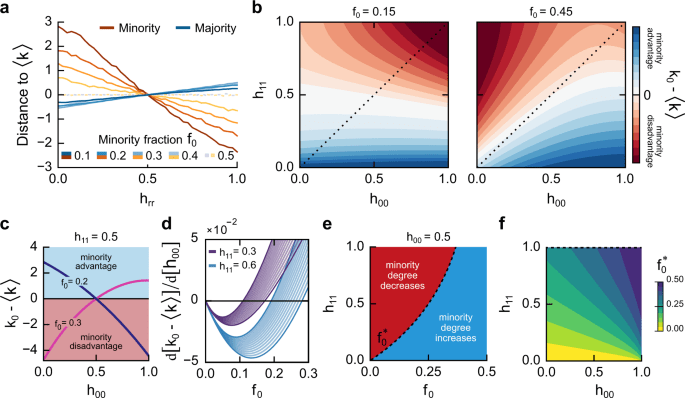
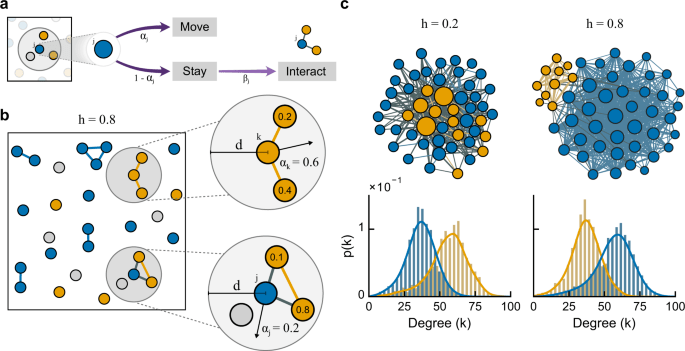
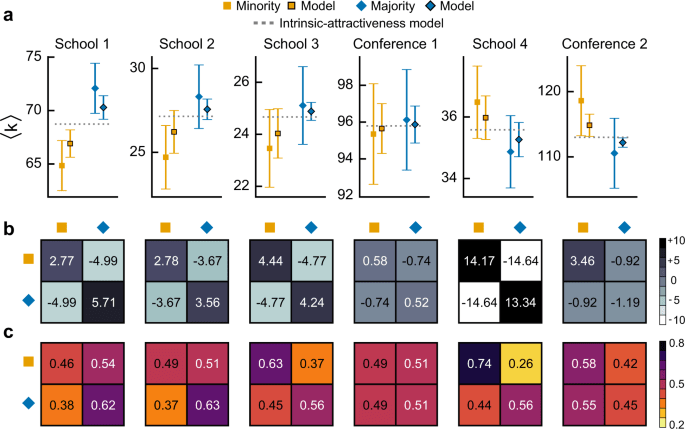
Uncovering how inequality emerges from human interaction is imperative for just societies. Here we show that the way social groups interact in face-to-face situations can enable the emergence of disparities in the visibility of social groups. These disparities translate into members of specific social groups having fewer social ties than the average (i.e., degree inequality). We characterize group degree inequality in sensor-based data sets and present a mechanism that explains these disparities as the result of group mixing and group-size imbalance. We investigate how group sizes affect this inequality, thereby uncovering the critical size and mixing conditions in which a critical minority group emerges. If a minority group is larger than this critical size, it can be a well-connected, cohesive group; if it is smaller, minority cohesion widens inequality. Finally, we expose group under-representation in degree rankings due to mixing dynamics and propose a way to reduce such biases. The emergence of inequality in social interactions can depend on a number of factors, among which the intrinsic attractiveness of individuals, but also group size the presence of pre-formed social ties. Here, the authors propose “social attractiveness” as a mechanism to account for the emergence of inequality in face-to-face social dynamics and show this reproduces real-world gathering data, predicting the existence of a critical group size for the minority group below which higher cohesion among its members leads to higher inequality.

Read the full article at: www.nature.com
Searching for Life, Mindful of Lyfe’s Possibilities

Searching for Life, Mindful of Lyfe’s Possibilities

by Michael L. Wong, Stuart Bartlett, Sihe Chen, and Louisa Tierney

We are embarking on a new age of astrobiology, one in which numerous interplanetary missions and telescopes will be designed, built, and launched with the explicit goal of finding evidence for life beyond Earth. Such a profound aim warrants caution and responsibility when interpreting and disseminating results. Scientists must take care not to overstate (or over-imply) confidence in life detection when evidence is lacking, or only incremental advances have been made. Recently, there has been a call for the community to create standards of evidence for the detection and reporting of biosignatures. In this perspective, we wish to highlight a critical but often understated element to the discussion of biosignatures: Life detection studies are deeply entwined with and rely upon our (often preconceived) notions of what life is, the origins of life, and habitability. Where biosignatures are concerned, these three highly related questions are frequently relegated to a low priority, assumed to be already solved or irrelevant to the question of life detection. Therefore, our aim is to bring to the fore how these other major astrobiological frontiers are central to searching for life elsewhere and encourage astrobiologists to embrace the reality that all of these science questions are interrelated and must be furthered together rather than separately. Finally, in an effort to be more inclusive of life as we do not know it, we propose tentative criteria for a more general and expansive characterization of habitability that we call genesity.

Read the full article at: www.mdpi.com

The evolution and development of consciousness: the subject-object emergence hypothesis

John E. Stewart

Biosystems, Volume 217, July 2022, 104687

A strategy for investigating consciousness that has proven very productive has focused on comparing brain processes that are accompanied by consciousness with processes that are not. But comparatively little attention has been given to a related strategy that promises to be even more fertile. This strategy exploits the fact that as individuals develop, new classes of brain processes can transition from operating ‘in the dark’ to becoming conscious. It has been suggested that these transitions occur when a new class of brain processes becomes object to a new, emergent, higher-level subject. Similar transitions are likely to have occurred during evolution. An evolutionary/developmental research strategy sets out to identify the nature of the transitions in brain processes that shift them from operating in the dark to ‘lighting up’. The paper begins the application of this strategy by extrapolating the sequence of transitions back towards its origin. The goal is to reconstruct a minimally-complex, subject-object subsystem that would be capable of giving rise to consciousness and providing adaptive benefits. By focusing on reconstructing a subsystem that is simple and understandable, this approach avoids the homunculus fallacy. The reconstruction suggests that the emergence of such a minimally-complex subsystem was driven by its capacity to coordinate body-environment interactions in real time e.g. hand-eye coordination. Conscious processing emerged initially because of its central role in organising real-time sensorimotor coordination. The paper goes on to identify and examine a number of subsequent major transitions in consciousness, including the emergence of capacities for conscious mental modelling. Each transition is driven by its potential to solve adaptive challenges that cannot be overcome at lower levels. The paper argues that mental modelling arose out of a pre-existing capacity to use simulations of motor actions to anticipate the consequences of the actions. As the capacity developed, elements of the simulations could be changed, and the consequences of these changes could be ‘thought through’ consciously. This enabled alternative motor responses to be evaluated. The paper goes on to predict significant new major transitions in consciousness.

Read the full article at: www.sciencedirect.com