
Category: Papers

Evaluation of science advice during the COVID-19 pandemic in Sweden 

Nele Brusselaers, David Steadson, Kelly Bjorklund, Sofia Breland, Jens Stilhoff Sörensen, Andrew Ewing, Sigurd Bergmann & Gunnar Steineck 
Humanities and Social Sciences Communications volume 9, Article number: 91 (2022)

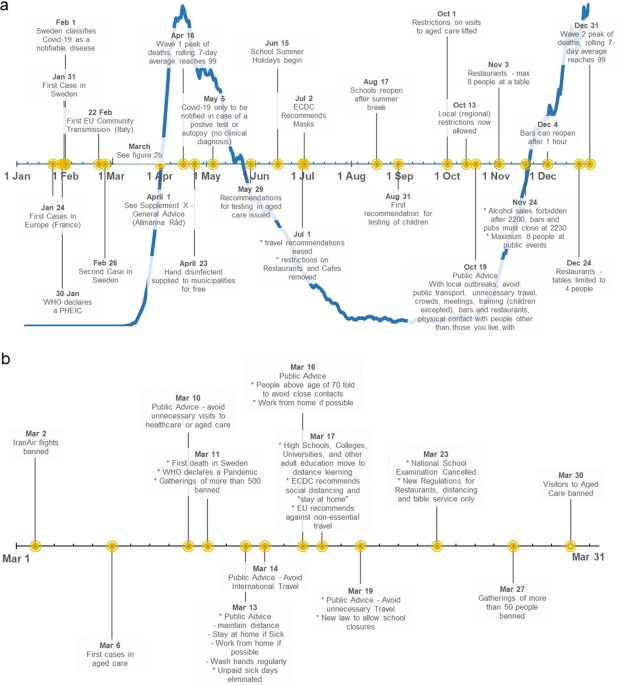
Sweden was well equipped to prevent the pandemic of COVID-19 from becoming serious. Over 280 years of collaboration between political bodies, authorities, and the scientific community had yielded many successes in preventive medicine. Sweden’s population is literate and has a high level of trust in authorities and those in power. During 2020, however, Sweden had ten times higher COVID-19 death rates compared with neighbouring Norway. In this report, we try to understand why, using a narrative approach to evaluate the Swedish COVID-19 policy and the role of scientific evidence and integrity. We argue that that scientific methodology was not followed by the major figures in the acting authorities—or the responsible politicians—with alternative narratives being considered as valid, resulting in arbitrary policy decisions. In 2014, the Public Health Agency merged with the Institute for Infectious Disease Control; the first decision by its new head (Johan Carlson) was to dismiss and move the authority’s six professors to Karolinska Institute. With this setup, the authority lacked expertise and could disregard scientific facts. The Swedish pandemic strategy seemed targeted towards “natural” herd-immunity and avoiding a societal shutdown. The Public Health Agency labelled advice from national scientists and international authorities as extreme positions, resulting in media and political bodies to accept their own policy instead. The Swedish people were kept in ignorance of basic facts such as the airborne SARS-CoV-2 transmission, that asymptomatic individuals can be contagious and that face masks protect both the carrier and others. Mandatory legislation was seldom used; recommendations relying upon personal responsibility and without any sanctions were the norm. Many elderly people were administered morphine instead of oxygen despite available supplies, effectively ending their lives. If Sweden wants to do better in future pandemics, the scientific method must be re-established, not least within the Public Health Agency. It would likely make a large difference if a separate, independent Institute for Infectious Disease Control is recreated. We recommend Sweden begins a self-critical process about its political culture and the lack of accountability of decision-makers to avoid future failures, as occurred with the COVID-19 pandemic.

Read the full article at: www.nature.com
Measurement in the Age of Information

Forrest Webler and Marilyne Andersen

Information 2022, 13(3), 111

Information is the resolution of uncertainty and manifests itself as patterns. Although complex, most observable phenomena are not random and instead are associated with deterministic, chaotic systems. The underlying patterns and symmetries expressed from these phenomena determine their information content and compressibility. While some patterns, such as the existence of Fourier modes, are easy to extract, advances in machine learning have enabled more comprehensive methods in feature extraction, most notably in their ability to elicit non-linear relationships. Herein we review methods concerned with the encoding and reconstruction of natural signals and how they might inform the discovery of useful transform bases. Additionally, we illustrate the efficacy of data-driven bases over generic ones in encoding information whilst discussing these developments in the context of “fourth paradigm” metrology. Toward this end, we propose that existing metrological standards and norms may need to be redefined within the context of a data-rich world.

Read the full article at: www.mdpi.com

Temporal Heterogeneity Improves Speed and Convergence in Genetic Algorithms

Yoshio Martinez, Katya Rodriguez, Carlos Gershenson
Genetic algorithms have been used in recent decades to solve a broad variety of search problems. These algorithms simulate natural selection to explore a parameter space in search of solutions for a broad variety of problems. In this paper, we explore the effects of introducing temporal heterogeneity in genetic algorithms. In particular, we set the crossover probability to be inversely proportional to the individual’s fitness, i.e., better solutions change slower than those with a lower fitness. As case studies, we apply heterogeneity to solve the N-Queens and Traveling Salesperson problems. We find that temporal heterogeneity consistently improves search without having prior knowledge of the parameter space.

Read the full article at: arxiv.org

A global synchronization theorem for oscillators on a random graph

Martin Kassabov, Steven H. Strogatz, Alex Townsend
Consider n identical Kuramoto oscillators on a random graph. Specifically, consider \ER random graphs in which any two oscillators are bidirectionally coupled with unit strength, independently and at random, with probability 0≤p≤1. We say that a network is globally synchronizing if the oscillators converge to the all-in-phase synchronous state for almost all initial conditions. Is there a critical threshold for p above which global synchrony is extremely likely but below which it is extremely rare? It is suspected that a critical threshold exists and is close to the so-called connectivity threshold, namely, p∼log(n)/n for n≫1. Ling, Xu, and Bandeira made the first progress toward proving a result in this direction: they showed that if p≫log(n)/n1/3, then \ER networks of Kuramoto oscillators are globally synchronizing with high probability as n→∞. Here we improve that result by showing that p≫log2(n)/n suffices. Our estimates are explicit: for example, we can say that there is more than a 99.9996% chance that a random network with n=106 and p>0.01117 is globally synchronizing.

Read the full article at: arxiv.org

Connectogram – A graph-based time dependent representation for sounds

İlker Türker, Serkan Aksu

Applied Acoustics
Volume 191, 30 March 2022, 108660

We propose a novel time-graph representation method for sounds and time series.
Quantized amplitude levels serve as nodes, while neighborhood of these nodes in time domain define connections.
Applying various undersampling rates, a multilayer graph representation is achieved, further composed as RGB images.
Flattened graph representations from each time frame are tiled to compose a time-graph representation.
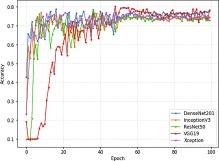
The proposed representation improves classification accuracy when used in combination with mel-spectrograms.

Read the full article at: www.sciencedirect.com