
Category: Papers

Evolution of resistance to COVID-19 vaccination with dynamic social distancing

Gabriela Lobinska, Ady Pauzner, Arne Traulsen, Yitzhak Pilpel & Martin A. Nowak 
Nature Human Behaviour volume 6, pages193–206 (2022)

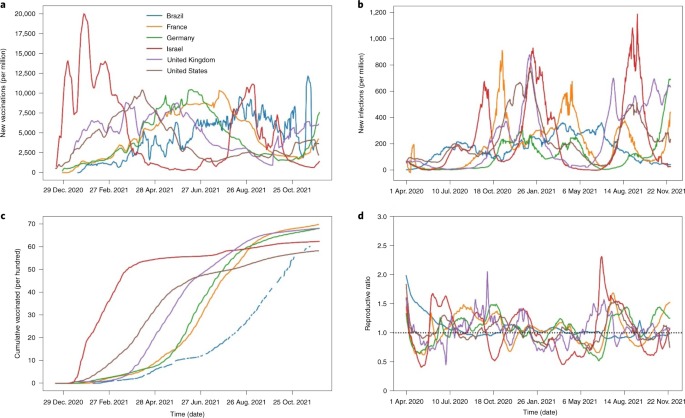
The greatest hope for a return to normalcy following the COVID-19 pandemic is worldwide vaccination. Yet, a relaxation of social distancing that allows increased transmissibility, coupled with selection pressure due to vaccination, will probably lead to the emergence of vaccine resistance. We analyse the evolutionary dynamics of COVID-19 in the presence of dynamic contact reduction and in response to vaccination. We use infection and vaccination data from six different countries. We show that under slow vaccination, resistance is very likely to appear even if social distancing is maintained. Under fast vaccination, the emergence of mutants can be prevented if social distancing is maintained during vaccination. We analyse multiple human factors that affect the evolutionary potential of the virus, including the extent of dynamic social distancing, vaccination campaigns, vaccine design, boosters and vaccine hesitancy. We provide guidelines for policies that aim to minimize the probability of emergence of vaccine-resistant variants.

Read the full article at: www.nature.com
Advancing mathematics by guiding human intuition with AI

Alex Davies, Petar Veličković, Lars Buesing, Sam Blackwell, Daniel Zheng, Nenad Tomašev, Richard Tanburn, Peter Battaglia, Charles Blundell, András Juhász, Marc Lackenby, Geordie Williamson, Demis Hassabis & Pushmeet Kohli 
Nature volume 600, pages70–74 (2021)

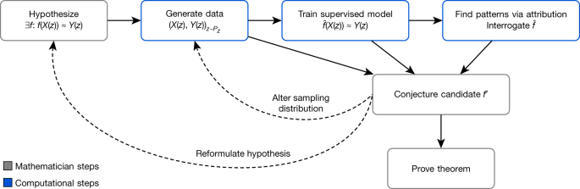
The practice of mathematics involves discovering patterns and using these to formulate and prove conjectures, resulting in theorems. Since the 1960s, mathematicians have used computers to assist in the discovery of patterns and formulation of conjectures, most famously in the Birch and Swinnerton-Dyer conjecture, a Millennium Prize Problem. Here we provide examples of new fundamental results in pure mathematics that have been discovered with the assistance of machine learning—demonstrating a method by which machine learning can aid mathematicians in discovering new conjectures and theorems. We propose a process of using machine learning to discover potential patterns and relations between mathematical objects, understanding them with attribution techniques and using these observations to guide intuition and propose conjectures. We outline this machine-learning-guided framework and demonstrate its successful application to current research questions in distinct areas of pure mathematics, in each case showing how it led to meaningful mathematical contributions on important open problems: a new connection between the algebraic and geometric structure of knots, and a candidate algorithm predicted by the combinatorial invariance conjecture for symmetric groups4. Our work may serve as a model for collaboration between the fields of mathematics and artificial intelligence (AI) that can achieve surprising results by leveraging the respective strengths of mathematicians and machine learning.

Read the full article at: www.nature.com
Reintroducing Pierre Teilhard de Chardin to Modern Evolutionary Science

David Sloan Wilson

Pierre Teilhard Chardin (1881-1955) developed an evolutionary worldview that was both spiritual and consistent with the scientific knowledge of his day. He has been largely forgotten by modern evolutionary scientists but remains widely read by those who are inspired by his vision of conscious evolution leading to a planetary superorganism. This working paper examines the major tenets of Teilhard’s vision from a modern evolutionary perspective in an effort to integrate “hard” evolutionary science with conscious efforts to manage cultural change.

Read the full article at: humanenergy.io

How to fix democracy to fix health care

Vittoradolfo Tambone, Paola Frati, Francesco De Micco, Giampaolo Ghilardi, Vittorio Fineschi

The Lancet

Globally, we are seeing a side-effect of COVID-19: political violence.1 This effect usually shows itself in three steps: denial of scientific evidence, judgement of the intentions of political decision makers as a conspiracy, and civil disobedience and street violence.
This dynamic embodies violence on an intellectual, institutional, and physical level. Intellectual violence tends to break the trust between the scientific world and public opinion, institutional violence aims to divide politics from society, and physical violence shatters civil coexistence. In other words, it is the best strategy to destroy the idea of basic democracy, as recalled by Josiah Ober.2

Read the full article at: www.thelancet.com