
Category: Papers

Socio-Economic Impact of the Covid-19 Pandemic in the U.S.

Jonathan Barlow and Irena Vodenska

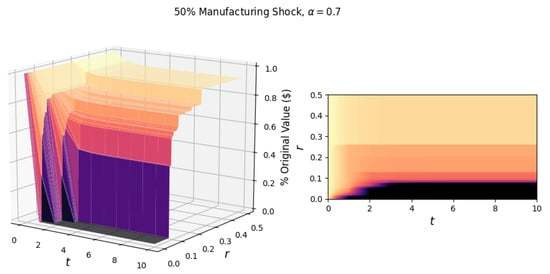
This paper proposes a dynamic cascade model to investigate the systemic risk posed by sector-level industries within the U.S. inter-industry network. We then use this model to study the effect of the disruptions presented by Covid-19 on the U.S. economy. We construct a weighted digraph G = (V,E,W) using the industry-by-industry total requirements table for 2018, provided by the Bureau of Economic Analysis (BEA). We impose an initial shock that disrupts the production capacity of one or more industries, and we calculate the propagation of production shortages with a modified Cobb–Douglas production function. For the Covid-19 case, we model the initial shock based on the loss of labor between March and April 2020 as reported by the Bureau of Labor Statistics (BLS). The industries within the network are assigned a resilience that determines the ability of an industry to absorb input losses, such that if the rate of input loss exceeds the resilience, the industry fails, and its outputs go to zero. We observed a critical resilience, such that, below this critical value, the network experienced a catastrophic cascade resulting in total network collapse. Lastly, we model the economic recovery from June 2020 through March 2021 using BLS data.

Read the full article at: www.mdpi.com
Dynamics of Disruption in Science and Technology

Michael Park, Erin Leahey, Russell Funk

Although the number of new scientific discoveries and technological
inventions has increased dramatically over the past century, there have also
been concerns of a slowdown in the progress of science and technology. We
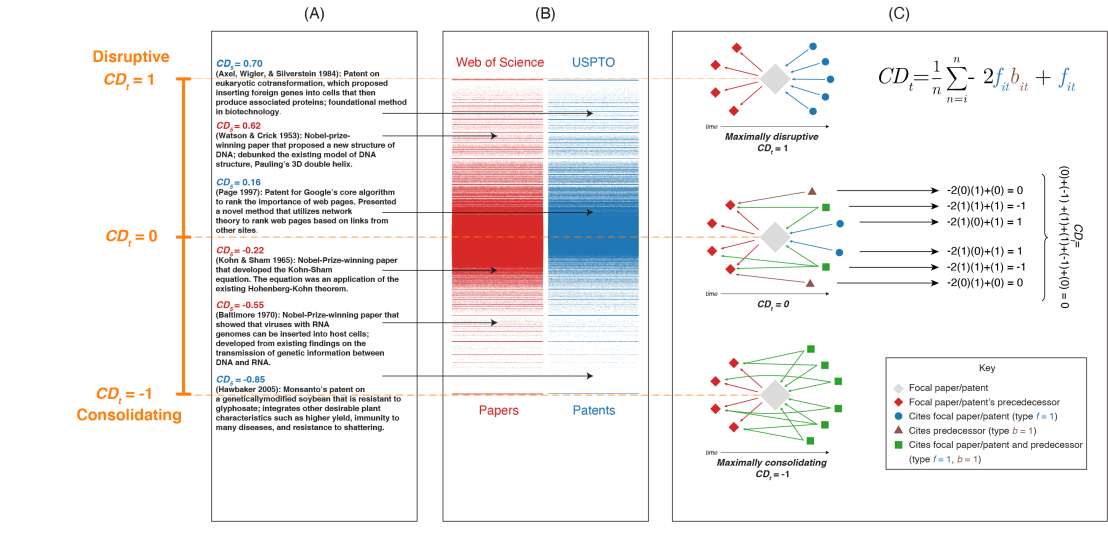
analyze 25 million papers and 4 million patents across 6 decades and find that
science and technology are becoming less disruptive of existing knowledge, a
pattern that holds nearly universally across fields. We link this decline in
disruptiveness to a narrowing in the utilization of existing knowledge.
Diminishing quality of published science and changes in citation practices are
unlikely to be responsible for this trend, suggesting that this pattern
represents a fundamental shift in science and technology.

Read the full article at: arxiv.org

Extracting real social interactions from social media: a debate of COVID-19 policies in Mexico

Alberto García-Rodríguez, Tzipe Govezensky, Carlos Gershenson, Gerardo G. Naumis, Rafael A. Barrio
A study of the dynamical formation of networks of friends and enemies in social media, in this case Twitter, is presented. We characterise the single node properties of such networks, as the clustering coefficient and the degree, to investigate the structure of links. The results indicate that the network is made from three kinds of nodes: one with high clustering coefficient but very small degree, a second group has zero clustering coefficient with variable degree, and finally, a third group in which the clustering coefficient as a function of the degree decays as a power law. This third group represents ∼2% of the nodes and is characteristic of dynamical networks with feedback. This part of the lattice seemingly represents strongly interacting friends in a real social network.

Read the full article at: arxiv.org

Thermodynamic Efficiency of Interactions in Self-Organizing Systems

Ramil Nigmatullin and Mikhail Prokopenko

Entropy 2021, 23(6), 757

The emergence of global order in complex systems with locally interacting components is most striking at criticality, where small changes in control parameters result in a sudden global reorganization. We study the thermodynamic efficiency of interactions in self-organizing systems, which quantifies the change in the system’s order per unit of work carried out on (or extracted from) the system. We analytically derive the thermodynamic efficiency of interactions for the case of quasi-static variations of control parameters in the exactly solvable Curie–Weiss (fully connected) Ising model, and demonstrate that this quantity diverges at the critical point of a second-order phase transition. This divergence is shown for quasi-static perturbations in both control parameters—the external field and the coupling strength. Our analysis formalizes an intuitive understanding of thermodynamic efficiency across diverse self-organizing dynamics in physical, biological, and social domains.

Read the full article at: www.mdpi.com

Towards an engineering theory of evolution

Simeon D. Castle, Claire S. Grierson & Thomas E. Gorochowski
Nature Communications volume 12, Article number: 3326 (2021)

Biological technologies are fundamentally unlike any other because biology evolves. Bioengineering therefore requires novel design methodologies with evolution at their core. Knowledge about evolution is currently applied to the design of biosystems ad hoc. Unless we have an engineering theory of evolution, we will neither be able to meet evolution’s potential as an engineering tool, nor understand or limit its unintended consequences for our biological designs. Here, we propose the evotype as a helpful concept for engineering the evolutionary potential of biosystems, or other self-adaptive technologies, potentially beyond the realm of biology. Effective biological engineering requires the acknowledgement of evolution and its consideration during the design process. In this perspective, the authors present the concept of the evotype to reason about and shape the evolutionary potential of natural and engineered biosystems.

Read the full article at: www.nature.com