
Category: Papers

The universal visitation law of human mobility

Markus Schläpfer, Lei Dong, Kevin O’Keeffe, Paolo Santi, Michael Szell, Hadrien Salat, Samuel Anklesaria, Mohammad Vazifeh, Carlo Ratti & Geoffrey B. West
Nature volume 593, pages 522–527 (2021)

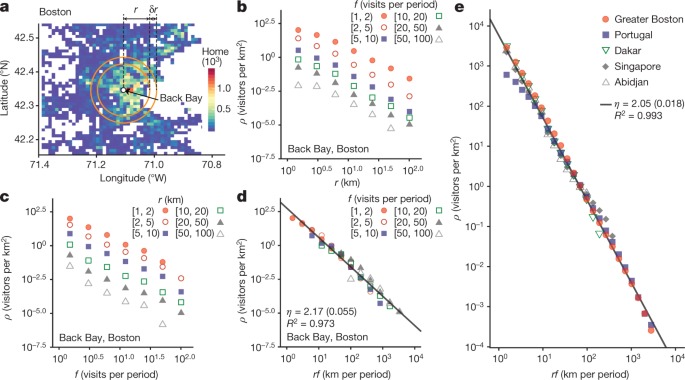
Human mobility impacts many aspects of a city, from its spatial structure to its response to an epidemic. It is also ultimately key to social interactions, innovation and productivity. However, our quantitative understanding of the aggregate movements of individuals remains incomplete. Existing models—such as the gravity law or the radiation model—concentrate on the purely spatial dependence of mobility flows and do not capture the varying frequencies of recurrent visits to the same locations. Here we reveal a simple and robust scaling law that captures the temporal and spatial spectrum of population movement on the basis of large-scale mobility data from diverse cities around the globe. According to this law, the number of visitors to any location decreases as the inverse square of the product of their visiting frequency and travel distance. We further show that the spatio-temporal flows to different locations give rise to prominent spatial clusters with an area distribution that follows Zipf’s law. Finally, we build an individual mobility model based on exploration and preferential return to provide a mechanistic explanation for the discovered scaling law and the emerging spatial structure. Our findings corroborate long-standing conjectures in human geography (such as central place theory and Weber’s theory of emergent optimality) and allow for predictions of recurrent flows, providing a basis for applications in urban planning, traffic engineering and the mitigation of epidemic diseases.

Read the full article at: www.nature.com
Artificial life: sustainable self-replicating systems

Carlos Gershenson, Jitka Cejkova
Nature has found one method of organizing living matter, but maybe there are also other options — not yet discovered — on how to create life. To study the life as it could be is the objective of an interdisciplinary field called Artificial Life (commonly abbreviated as ALife). The word “artificial” refers to the fact that humans are involved in the creation process. The results might be completely unlike natural forms of life, not only because of their chemical composition, but even some computer programs exhibiting life-like behaviours interest ALife researchers.

Read the full article at: arxiv.org

Identifying molecules as biosignatures with assembly theory and mass spectrometry

Stuart M. Marshall, Cole Mathis, Emma Carrick, Graham Keenan, Geoffrey J. T. Cooper, Heather Graham, Matthew Craven, Piotr S. Gromski, Douglas G. Moore, Sara. I. Walker & Leroy Cronin 

Nature Communications volume 12, Article number: 3033 (2021)

The search for alien life is hard because we do not know what signatures are unique to life. We show why complex molecules found in high abundance are universal biosignatures and demonstrate the first intrinsic experimentally tractable measure of molecular complexity, called the molecular assembly index (MA). To do this we calculate the complexity of several million molecules and validate that their complexity can be experimentally determined by mass spectrometry. This approach allows us to identify molecular biosignatures from a set of diverse samples from around the world, outer space, and the laboratory, demonstrating it is possible to build a life detection experiment based on MA that could be deployed to extraterrestrial locations, and used as a complexity scale to quantify constraints needed to direct prebiotically plausible processes in the laboratory. Such an approach is vital for finding life elsewhere in the universe or creating de-novo life in the lab.

Read the full article at: www.nature.com

Controlling COVID-19 via test-trace-quarantine

Cliff C. Kerr, Dina Mistry, Robyn M. Stuart, Katherine Rosenfeld, Gregory R. Hart, Rafael C. Núñez, Jamie A. Cohen, Prashanth Selvaraj, Romesh G. Abeysuriya, Michał Jastrzębski, Lauren George, Brittany Hagedorn, Jasmina Panovska-Griffiths, Meaghan Fagalde, Jeffrey Duchin, Michael Famulare & Daniel J. Klein
Nature Communications volume 12, Article number: 2993 (2021)

Initial COVID-19 containment in the United States focused on limiting mobility, including school and workplace closures. However, these interventions have had enormous societal and economic costs. Here, we demonstrate the feasibility of an alternative control strategy, test-trace-quarantine: routine testing of primarily symptomatic individuals, tracing and testing their known contacts, and placing their contacts in quarantine. We perform this analysis using Covasim, an open-source agent-based model, which has been calibrated to detailed demographic, mobility, and epidemiological data for the Seattle region from January through June 2020. With current levels of mask use and schools remaining closed, we find that high but achievable levels of testing and tracing are sufficient to maintain epidemic control even under a return to full workplace and community mobility and with low vaccine coverage. The easing of mobility restrictions in June 2020 and subsequent scale-up of testing and tracing programs through September provided real-world validation of our predictions. Although we show that test-trace-quarantine can control the epidemic in both theory and practice, its success is contingent on high testing and tracing rates, high quarantine compliance, relatively short testing and tracing delays, and moderate to high mask use. Thus, in order for test-trace-quarantine to control transmission with a return to high mobility, strong performance in all aspects of the program is required. Initial COVID-19 containment in the United States focused on limiting mobility, including school and workplace closures, with enormous societal and economic costs. Here, the authors demonstrate the feasibility of a test-trace-quarantine strategy using an agent-based model and detailed data on the Seattle region.

Read the full article at: www.nature.com

Synthetic living machines: A new window on life

Mo R. Ebrahimkhani & Michael Levin

iScience Volume 24, Issue 5, 21 May 2021, 102505

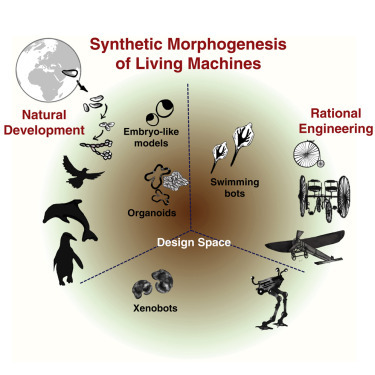
Increased control of biological growth and form is an essential gateway to transformative medical advances. Repairing of birth defects, restoring lost or damaged organs, normalizing tumors, all depend on understanding how cells cooperate to make specific, functional large-scale structures. Despite advances in molecular genetics, significant gaps remain in our understanding of the meso-scale rules of morphogenesis. An engineering approach to this problem is the creation of novel synthetic living forms, greatly extending available model systems beyond evolved plant and animal lineages. Here, we review recent advances in the emerging field of synthetic morphogenesis, the bioengineering of novel multicellular living bodies. Emphasizing emergent self-organization, tissue-level guided self-assembly, and active functionality, this work is the essential next generation of synthetic biology. Aside from useful living machines for specific functions, the rational design and analysis of new, coherent anatomies will greatly increase our understanding of foundational questions in evolutionary developmental and cell biology.

Read the full article at: www.sciencedirect.com