
Category: Papers

Modern theories of human evolution foreshadowed by Darwin’s Descent of Man

Peter J. Richerson, Sergey Gavrilets, Frans B. M. de Waal
Science 21 May 2021:
Vol. 372, Issue 6544, eaba3776
Charles Darwin’s The Descent of Man, published 150 years ago, laid the grounds for scientific studies into human origins and evolution. Three of his insights have been reinforced by modern science. The first is that we share many characteristics (genetic, developmental, physiological, morphological, cognitive, and psychological) with our closest relatives, the anthropoid apes. The second is that humans have a talent for high-level cooperation reinforced by morality and social norms. The third is that we have greatly expanded the social learning capacity that we see already in other primates. Darwin’s emphasis on the role of culture deserves special attention because during an increasingly unstable Pleistocene environment, cultural accumulation allowed changes in life history; increased cognition; and the appearance of language, social norms, and institutions.

Read the full article at: science.sciencemag.org
Emergence in artificial life

Carlos Gershenson
Concepts similar to emergence have been used since antiquity, but we lack an agreed definition of emergence. Still, emergence has been identified as one of the features of complex systems. Most would agree on the statement “life is complex”. Thus, understanding emergence and complexity should benefit the study of living systems. It can be said that life emerges from the interactions of complex molecules. But how useful is this to understand living systems? Artificial life (ALife) has been developed in recent decades to study life using a synthetic approach: build it to understand it. ALife systems are not so complex, be them soft (simulations), hard (robots), or wet (protocells). Then, we can aim at first understanding emergence in ALife, for then using this knowledge in biology. I argue that to understand emergence and life, it becomes useful to use information as a framework. In a general sense, emergence can be defined as information that is not present at one scale but is present at another scale. This perspective avoids problems of studying emergence from a materialistic framework, and can be useful to study self-organization and complexity.

Read the full article at: arxiv.org

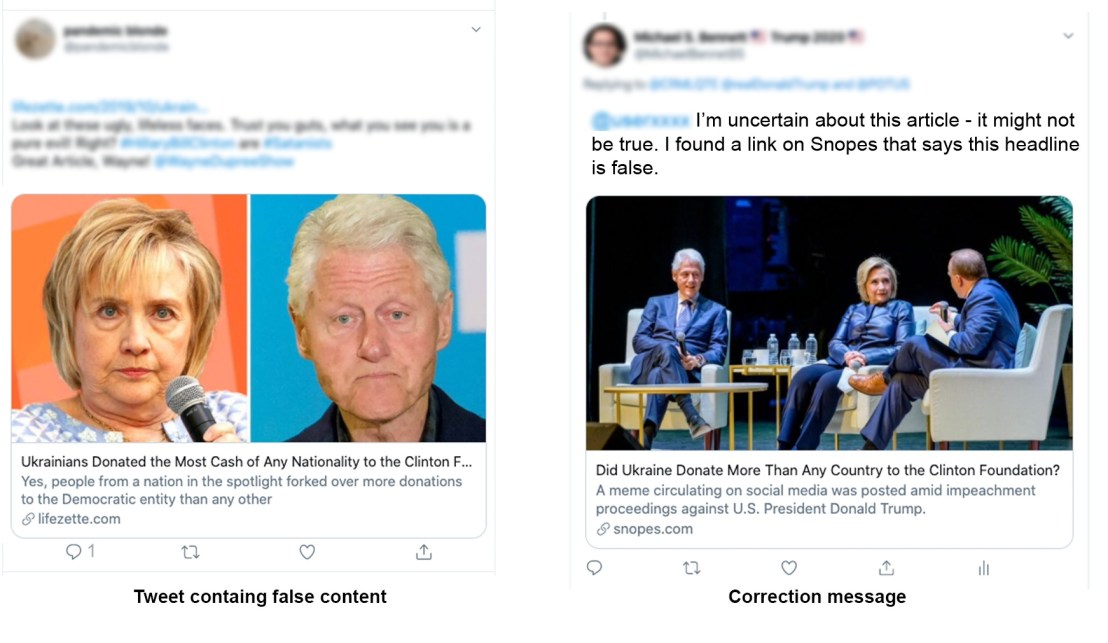
Perverse Downstream Consequences of Debunking: Being Corrected by Another User for Posting False Political News Increases Subsequent Sharing of Low Quality, Partisan, and Toxic Content in a Twitter…

Mohsen Mosleh, Cameron Martel, Dean Eckles, David Rand

A prominent approach to combating online misinformation is to debunk false content. Here we investigate downstream consequences of social corrections on users’ subsequent sharing of other content. Being corrected might make users more attentive to accuracy, thus improving their subsequent sharing. Alternatively, corrections might not improve subsequent sharing – or even backfire – by making users feel defensive, or by shifting their attention away from accuracy (e.g., towards various social factors). We identified N=2,000 users who shared false political news on Twitter, and replied to their false tweets with links to fact-checking websites. We find causal evidence that being corrected decreases the quality, and increases the partisan slant and language toxicity, of the users’ subsequent retweets (but has no significant effect on primary tweets). This suggests that being publicly corrected by another user shifts one’s attention away from accuracy – presenting an important challenge for social correction approaches.

https://dl.acm.org/doi/10.1145/3411764.3445642

Figure 1

Network medicine framework for identifying drug-repurposing opportunities for COVID-19 | PNAS

Deisy Morselli Gysi, Ítalo do Valle, Marinka Zitnik, Asher Ameli, Xiao Gan, Onur Varol, Susan Dina Ghiassian, J. J. Patten, Robert A. Davey, Joseph Loscalzo, and Albert-László Barabási

PNAS May 11, 2021 118 (19) e2025581118;

The COVID-19 pandemic has highlighted the importance of prioritizing approved drugs to treat severe acute respiratory syndrome coronavirus 2 (SARS-CoV-2) infections. Here, we deployed algorithms relying on artificial intelligence, network diffusion, and network proximity to rank 6,340 drugs for their expected efficacy against SARS-CoV-2. We experimentally screened 918 drugs, allowing us to evaluate the performance of the existing drug-repurposing methodologies, and used a consensus algorithm to increase the accuracy of the predictions. Finally, we screened in human cells the top-ranked drugs, identifying six drugs that reduced viral infection, four of which could be repurposed to treat COVID-19. The developed strategy has significance beyond COVID-19, allowing us to identify drug-repurposing candidates for neglected diseases.

Read the full article at: www.pnas.org

The Fail West – Uncharted Territories

Soon, over 1.5 million people will have died of COVID in Western countries.
1.5 million futile, needless deaths. 1.5 million wasted lives.
Meanwhile, in a block of Asia-Pacific countries with a population over twice as big, they lost 18,000 people. 

(…)

Within 1-2 months, we knew most of the crucial knowledge needed to control the epidemic. Governments must reckon with their incapacity to apply these learnings.

Read the full article at: unchartedterritories.substack.com