Category: Papers

Economics in Nouns and Verbs

W. Brian Arthur

Standard economic theory uses mathematics as its main means of understanding,
and this brings clarity of reasoning and logical power. But there is a
drawback: algebraic mathematics restricts economic modeling to what can be
expressed only in quantitative nouns, and this forces theory to leave out
matters to do with process, formation, adjustment, creation and nonequilibrium.
For these we need a different means of understanding, one that allows verbs as
well as nouns. Algorithmic expression is such a means. It allows verbs
(processes) as well as nouns (objects and quantities). It allows fuller
description in economics, and can include heterogeneity of agents, actions as
well as objects, and realistic models of behavior in ill-defined situations.
The world that algorithms reveal is action-based as well as object-based,
organic, possibly ever-changing, and not fully knowable. But it is strangely
and wonderfully alive.

Read the full article at: arxiv.org
Avoiding the bullies: The resilience of cooperation among unequals

Foley M, Smead R, Forber P, Riedl C (2021) Avoiding the bullies: The resilience of cooperation among unequals. PLoS Comput Biol 17(4): e1008847.

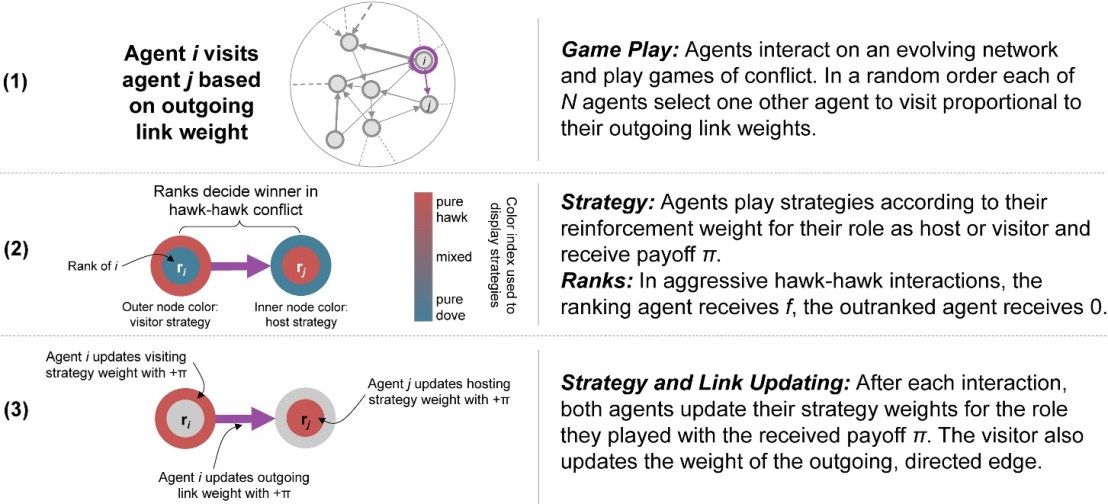
Individuals often differ in their ability to resolve conflicts in their favor, and this can lead to the emergence of hierarchies and dominant alphas. Such social structures present a serious risk of destabilizing cooperative social interactions or norms. Why work together to find food when a more aggressive or stronger individual can take all of it? In this paper we use game theory and agent-based modeling to investigate how cooperative behavior evolves in the presence of powerful bullies who have no incentive to cooperate. We show that when individuals can choose their interaction partners, bullies do not always destabilize cooperation. Instead, cooperative norms survive as individuals learn to avoid dominant individuals who become isolated in the population. When competitive ability itself depends dynamically on past success, complex cycles of coupled network-strategy-rank changes emerge: effective collaborators gain popularity and thus power, adopt aggressive behavior, get isolated, then lose power. Our results have important implications: in our modeled scenario the rich do not always get richer, the dominance of bullies can be broken, and inequality in accrued resources can be eliminated. Thus, our work provides new insight into potential sources of, and strategies for avoiding, resource inequality.

Read the full article at: journals.plos.org

Cells Form Into ‘Xenobots’ on Their Own

Embryonic cells can self-assemble into new living forms that don’t resemble the bodies they usually generate, challenging old ideas of what defines an organism.

Read the full article at: www.quantamagazine.org

See Also: 

A cellular platform for the development of synthetic living machines
Douglas Blackiston, Emma Lederer, Sam Kriegman, Simon Garnier, Joshua Bongard, Michael Levin

Science Robotics 31 Mar 2021:
Vol. 6, Issue 52, eabf1571

Emergence of Polarized Ideological Opinions in Multidimensional Topic Spaces

Fabian Baumann, Philipp Lorenz-Spreen, Igor M. Sokolov, and Michele Starnini
Phys. Rev. X 11, 011012 (2021)

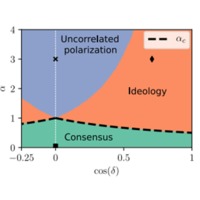
By embedding opinions in a nonorthogonal topic space, a new model shows that a reinforcement mechanism driven by homophilic social interactions reproduces extreme and correlated opinion states found in surveys.

Read the full article at: link.aps.org

Random Networks with Quantum Boolean Functions

Mario Franco, Octavio Zapata, David A. Rosenblueth,  and Carlos Gershenson

Mathematics 2021, 9(8), 792

We propose quantum Boolean networks, which can be classified as deterministic reversible asynchronous Boolean networks. This model is based on the previously developed concept of quantum Boolean functions. A quantum Boolean network is a Boolean network where the functions associated with the nodes are quantum Boolean functions. We study some properties of this novel model and, using a quantum simulator, we study how the dynamics change in function of connectivity of the network and the set of operators we allow. For some configurations, this model resembles the behavior of reversible Boolean networks, while for other configurations a more complex dynamic can emerge. For example, cycles larger than 2N were observed. Additionally, using a scheme akin to one used previously with random Boolean networks, we computed the average entropy and complexity of the networks. As opposed to classic random Boolean networks, where “complex” dynamics are restricted mainly to a connectivity close to a phase transition, quantum Boolean networks can exhibit stable, complex, and unstable dynamics independently of their connectivity.

Read the full article at: www.mdpi.com