Category: Papers

Isotopy and energy of physical networks

Yanchen Liu, Nima Dehmamy & Albert-László Barabási 
Nature Physics (2020)


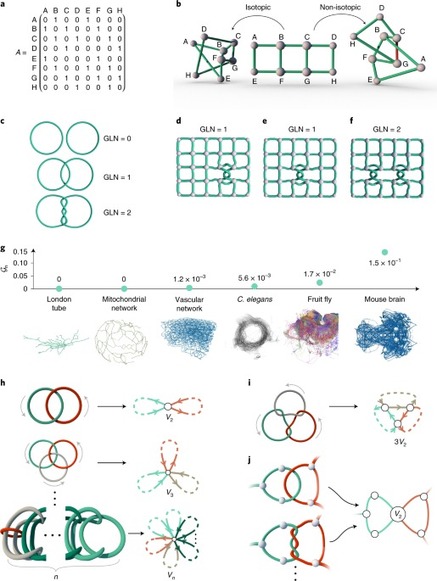
While the structural characteristics of a network are uniquely determined by its adjacency matrix in physical networks, such as the brain or the vascular system, the network’s three-dimensional layout also affects the system’s structure and function. We lack, however, the tools to distinguish physical networks with identical wiring but different geometrical layouts. To address this need, here we introduce the concept of network isotopy, representing different network layouts that can be transformed into one another without link crossings, and show that a single quantity, the graph linking number, captures the entangledness of a layout, defining distinct isotopy classes. We find that a network’s elastic energy depends linearly on the graph linking number, indicating that each local tangle offers an independent contribution to the total energy. This finding allows us to formulate a statistical model for the formation of tangles in physical networks. We apply the developed framework to a diverse set of real physical networks, finding that the mouse connectome is more entangled than expected based on optimal wiring.

Source: www.nature.com
Capitalism After the Pandemic

Mariana Mazzucato

Foreign Affairs


After the 2008 financial crisis, governments across the world injected over $3 trillion into the financial system. The goal was to unfreeze credit markets and get the global economy working again. But instead of supporting the real economy—the part that involves the production of actual goods and services—the bulk of the aid ended up in the financial sector. Governments bailed out the big investment banks that had directly contributed to the crisis, and when the economy got going again, it was those companies that reaped the rewards of the recovery. Taxpayers, for their part, were left with a global economy that was just as broken, unequal, and carbon-intensive as before. “Never let a good crisis go to waste,” goes a popular policymaking maxim. But that is exactly what happened.

Source: www.foreignaffairs.com

Visualization of dynamic structure in flocking behavior

Daichi Saito, Norihiro Maruyama, Yasuhiro Hashimoto & Takashi Ikegami
Artificial Life and Robotics (2020)


The flock structures produced by individuals, e.g., animals, self-organize and change their complexity over time. Although flock structures are often characterized by the spatial alignment of each element, this study focuses on their dynamic and hierarchical nature, temporal variations, and meta-structures. In hierarchical systems, sometimes, the upper structure is unchanged, whereas the lower components change constantly over time. Current clustering methods aim to capture the static and mono-layer features of complex patterning. To detect and track dynamic and hierarchical objects, a new clustering technique is required. Hence, in this study, we improve the generative topographic mapping (GTM) method to visualize such dynamic hierarchical structures as they continuously change over time. Using examples from our recent studies on the large-scale Boids model, we confirm that the newly developed method can capture the complex flocking objects as well as track the merging and collapsing events of objects.

Source: link.springer.com

Lessons from New Zealand’s COVID-19 outbreak response

Alexis Robert

The Lancet


In the absence of a vaccine for severe acute respiratory syndrome coronavirus 2 (SARS-CoV-2), or of highly effective pharmaceutical treatments for COVID-19, countries have implemented a large range of non-pharmaceutical interventions to control the spread of the virus.1 These interventions differ in their level of stringency (ie, the severity of the measures) and their ultimate objective (eg, prevent health systems being overwhelmed, suppress incidence to low levels, or reduce incidence to zero and keep it there). With many countries facing epidemic resurgence, evaluating the impact of different strategies implemented in the early phases of the pandemic is crucial for developing an effective long-term response.
New Zealand adopted a set of non-pharmaceutical interventions aiming to bring COVID-19 incidence to zero

Source: www.thelancet.com