
Category: Papers

Swarm Intelligence and Cyber-Physical Systems: Concepts, Challenges and Future Trends 

Melanie Schranz, Gianni A.Di Caro, Thomas Schmickl, Wilfried Elmenreich, Farshad Arvin, Ahmet Şekercioğlu, Micha Sende

Swarm and Evolutionary Computation


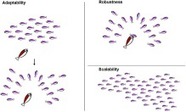
Swarm Intelligence (SI) is a popular multi-agent framework that has been originally inspired by swarm behaviors observed in natural systems, such as ant and bee colonies. In a system designed after swarm intelligence, each agent acts autonomously, reacts on dynamic inputs, and, implicitly or explicitly, works collaboratively with other swarm members without a central control. The system as a whole is expected to exhibit global patterns and behaviors. Although well-designed swarms can show advantages in adaptability, robustness, and scalability, it must be noted that SI system haven’t really found their way from lab demonstrations to real-world applications, so far. This is particularly true for embodied SI, where the agents are physical entities, such as in swarm robotics scenarios. In this paper, we start from these observations, outline different definitions and characterizations, and then discuss present challenges in the perspective of future use of swarm intelligence. These include application ideas, research topics, and new sources of inspiration from biology, physics, and human cognition. To motivate future applications of swarms, we make use of the notion of cyber-physical systems (CPS). CPSs are a way to encompass the large spectrum of technologies including robotics, internet of things (IoT), Systems on Chip (SoC), embedded systems, and so on. Thereby, we give concrete examples for visionary applications and their challenges representing the physical embodiment of swarm intelligence in autonomous driving and smart traffic, emergency response, environmental monitoring, electric energy grids, space missions, medical applications, and human networks. We do not aim to provide new solutions for the swarm intelligence or CPS community, but rather build a bridge between these two communities. This allows us to view the research problems of swarm intelligence from a broader perspective and motivate future research activities in modeling, design, validation/verification, and human-in-the-loop concepts.

Source: www.sciencedirect.com

An automated pipeline for the discovery of conspiracy and conspiracy theory narrative frameworks: Bridgegate, Pizzagate and storytelling on the web

Timothy R. Tangherlini, Shadi Shahsavari, Behnam Shahbazi, Ehsan Ebrahimzadeh, Vwani Roychowdhury


Although a great deal of attention has been paid to how conspiracy theories circulate on social media and their factual counterpart conspiracies, there has been little computational work done on describing their narrative structures. We present an automated pipeline for the discovery and description of the generative narrative frameworks of conspiracy theories on social media, and actual conspiracies reported in the news media. We base this work on two separate repositories of posts and news articles describing the well-known conspiracy theory Pizzagate from 2016, and the New Jersey conspiracy Bridgegate from 2013. We formulate a graphical generative machine learning model where nodes represent actors/actants, and multi-edges and self-loops among nodes capture context-specific relationships. Posts and news items are viewed as samples of subgraphs of the hidden narrative network. The problem of reconstructing the underlying structure is posed as a latent model estimation problem. We automatically extract and aggregate the actants and their relationships from the posts and articles. We capture context specific actants and interactant relationships by developing a system of supernodes and subnodes. We use these to construct a network, which constitutes the underlying narrative framework. We show how the Pizzagate framework relies on the conspiracy theorists’ interpretation of "hidden knowledge" to link otherwise unlinked domains of human interaction, and hypothesize that this multi-domain focus is an important feature of conspiracy theories. While Pizzagate relies on the alignment of multiple domains, Bridgegate remains firmly rooted in the single domain of New Jersey politics. We hypothesize that the narrative framework of a conspiracy theory might stabilize quickly in contrast to the narrative framework of an actual one, which may develop more slowly as revelations come to light.

Source: arxiv.org

Socio-economic, built environment, and mobility conditions associated with crime: a study of multiple cities

Marco De Nadai, Yanyan Xu, Emmanuel Letouzé, Marta C. González & Bruno Lepri 
Scientific Reports volume 10, Article number: 13871 (2020)


Nowadays, 23% of the world population lives in multi-million cities. In these metropolises, criminal activity is much higher and violent than in either small cities or rural areas. Thus, understanding what factors influence urban crime in big cities is a pressing need. Seminal studies analyse crime records through historical panel data or analysis of historical patterns combined with ecological factor and exploratory mapping. More recently, machine learning methods have provided informed crime prediction over time. However, previous studies have focused on a single city at a time, considering only a limited number of factors (such as socio-economical characteristics) and often at large in a single city. Hence, our understanding of the factors influencing crime across cultures and cities is very limited. Here we propose a Bayesian model to explore how violent and property crimes are related not only to socio-economic factors but also to the built environmental (e.g. land use) and mobility characteristics of neighbourhoods. To that end, we analyse crime at small areas and integrate multiple open data sources with mobile phone traces to compare how the different factors correlate with crime in diverse cities, namely Boston, Bogotá, Los Angeles and Chicago. We find that the combined use of socio-economic conditions, mobility information and physical characteristics of the neighbourhood effectively explain the emergence of crime, and improve the performance of the traditional approaches. However, we show that the socio-ecological factors of neighbourhoods relate to crime very differently from one city to another. Thus there is clearly no “one fits all” model.

Source: www.nature.com

Managing News Overload (MNO): The COVID-19 Infodemic

Sameera Tahira Ahmed

Information 2020, 11(8), 375


A crucial area in which information overload is experienced is news consumption. Ever increasing sources and formats are becoming available through a combination of traditional and new (digital) media, including social media. In such an information and media rich environment, understanding how people access and manage news during a global health epidemic like COVID-19 becomes even more important. The designation of the current situation as an infodemic has raised concerns about the quality, accuracy and impact of information. Instances of misinformation are commonplace due, in part, to the speed and pervasive nature of social media and messaging applications in particular. This paper reports on data collected using media diaries from 15 university students in the United Arab Emirates documenting their news consumption in April 2020. Faced with a potentially infinite amount of information and news, participants demonstrate how they are managing news overload (MNO) using a number of complementary strategies. Results show that while consumption patterns vary, all diaries indicate that users’ ability to navigate the news landscape in a way that fulfils their needs is influenced by news sources; platform reliability and verification; sharing activity; and engagement with news.

Source: www.mdpi.com

The evolution of universal adaptations of life is driven by universal properties of matter: energy, entropy, and interaction

Irun R. Cohen, Assaf Marron


The evolution of multicellular eukaryotes expresses two sorts of adaptations: local adaptations like fur or feathers, which characterize species in particular environments, and universal adaptations like microbiomes or sexual reproduction, which characterize most multicellulars in any environment. We reason that the mechanisms driving the universal adaptations of multicellulars should themselves be universal, and propose a mechanism based on properties of matter and systems: energy, entropy, and interaction. Energy from the sun, earth and beyond creates new arrangements and interactions. Metabolic networks channel some of this energy to form cooperating, interactive arrangements. Entropy, used here as a term for all forces that dismantle ordered structures (rather than as a physical quantity), acts as a selective force. Entropy selects for arrangements that resist it long enough to replicate, and dismantles those that do not. Interactions, energy-charged and dynamic, restrain entropy and enable survival and propagation of integrated living systems. This fosters survival-of-the-fitted – those entities that resist entropic destruction – and not only of the fittest – the entities with the greatest reproductive success. The “unit” of evolution is not a discrete entity, such as a gene, individual, or species; what evolves are collections of related interactions at multiple scales. Survival-of-the-fitted explains universal adaptations, including resident microbiomes, sexual reproduction, continuous diversification, programmed turnover, seemingly wasteful phenotypes, altruism, co-evolving environmental niches, and advancing complexity. Indeed survival-of-the-fittest may be a particular case of the survival-of-the-fitted mechanism, promoting local adaptations that express reproductive advantages in addition to resisting entropy. Survival-of-the-fitted accounts for phenomena that have been attributed to neutral evolution: in the face of entropy, there is no neutrality; all variations are challenged by ubiquitous energy and entropy, retaining those that are “fit enough”. We propose experiments to test predictions of the survival-of-the-fitted theory, and discuss implications for the wellbeing of humans and the biosphere.

Source: f1000research.com