Category: Papers

Landmark Computer Science Proof Cascades Through Physics and Math

In 1935, Albert Einstein, working with Boris Podolsky and Nathan Rosen, grappled with a possibility revealed by the new laws of quantum physics: that two particles could be entangled, or correlated, even across vast distances.

The very next year, Alan Turing formulated the first general theory of computing and proved that there exists a problem that computers will never be able to solve.

These two ideas revolutionized their respective disciplines. They also seemed to have nothing to do with each other. But now a landmark proof has combined them while solving a raft of open problems in computer science, physics and mathematics.

Source: www.quantamagazine.org

The effect of human mobility and control measures on the COVID-19 epidemic in China

Moritz U.G. Kraemer, Chia-Hung Yang, Bernardo Gutierrez, Chieh-Hsi Wu, Brennan Klein, David M. Pigott, open COVID-19 data working group, Louis du Plessis, Nuno R Faria, Ruoran Li, William P. Hanage, John S Brownstein, Maylis Layan, Alessandro Vespignani, Huaiyu Tian, Christopher Dye, Simon Cauchemez, Oliver Pybus, Samuel V Scarpino


The ongoing COVID-19 outbreak has expanded rapidly throughout China. Major behavioral, clinical, and state interventions are underway currently to mitigate the epidemic and prevent the persistence of the virus in human populations in China and worldwide. It remains unclear how these unprecedented interventions, including travel restrictions, have affected COVID-19 spread in China. We use real-time mobility data from Wuhan and detailed case data including travel history to elucidate the role of case importation on transmission in cities across China and ascertain the impact of control measures. Early on, the spatial distribution of COVID-19 cases in China was well explained by human mobility data. Following the implementation of control measures, this correlation dropped and growth rates became negative in most locations, although shifts in the demographics of reported cases are still indicative of local chains of transmission outside Wuhan. This study shows that the drastic control measures implemented in China have substantially mitigated the spread of COVID-19.

Source: www.medrxiv.org

Advanced Control and Optimization for Complex Energy Systems

Chun Wei, Xiaoqing Bai, and Taesic Kim

Editorial | Open Access

Complexity Volume 2020 |Article ID 5908102


The application of renewable energies such as wind and solar has become an inevitable choice for many countries in order to achieve sustainable and healthy economic development [1]. However, due to the intermittent characteristics of renewable energy, the issue with integrating a larger proportion of renewable energy into the grid becomes prominent. Currently, an energy system with weak coordination capability seriously affects the flexibility of power system operation [2]. As a result, this has led to the development of an effective way to integrate high-proportion renewable energy by developing multienergy systems including wind, solar, thermal, and energy storage to allow for the integration and coordination of different energy resources [3]. The major challenge of the multienergy system is its complexity with multispatial and multitemporal scales. Compared with the traditional power system, control and optimization of the complex energy system become more difficult in terms of modeling, operation, and planning [4, 5]. The main purpose of the complex energy system is to coordinate the operation with various distributed energy resources (DERs), energy storage systems, and power grids to ensure its reliability, while reducing the operating costs and achieving the optimal economic benefits.

Source: www.hindawi.com

See Also: Special Issue

Theme issue ‘Unifying the essential concepts of biological networks: biological insights and philosophical foundations’

Compiled and edited by Daniel Kostić, Claus C. Hilgetag and Marc Tittgemeyer

Philosophical Transactions of the Royal Society B: Biological Sciences: Vol 375, No 1796


Over the last decades, network-based approaches have become highly popular in diverse areas of biology. While these approaches continue to grow very rapidly, some of their conceptual and methodological aspects still require a programmatic foundation. In order to unify and systematize network approaches across biological sciences, this theme issue brings together scientists working in many diverse areas of biological sciences as well as philosophers working on foundational issues of network explanations and modelling, who together aim to develop universally applicable norms of network explanations, as well as systematize network concepts, such as levels and hierarchies.

Source: royalsocietypublishing.org

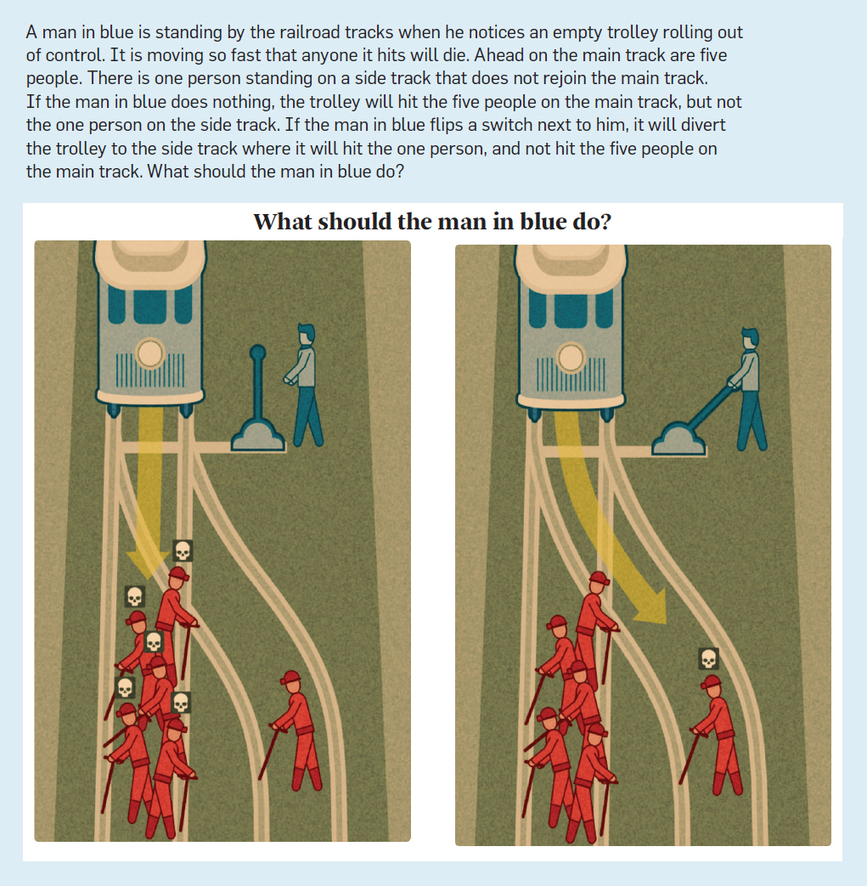
Crowdsourcing Moral Machines

Edmond Awad, Sohan Dsouza, Jean-François Bonnefon, Azim Shariff, Iyad Rahwan
Communications of the ACM, March 2020, Vol. 63 No. 3, Pages 48-55
10.1145/3339904


Robots and other artificial intelligence (AI) systems are transitioning from performing well-defined tasks in closed environments to becoming significant physical actors in the real world. No longer confined within the walls of factories, robots will permeate the urban environment, moving people and goods around, and performing tasks alongside humans. Perhaps the most striking example of this transition is the imminent rise of automated vehicles (AVs). AVs promise numerous social and economic advantages. They are expected to increase the efficiency of transportation, and free up millions of person-hours of productivity. Even more importantly, they promise to drastically reduce the number of deaths and injuries from traffic accidents.12,30 Indeed, AVs are arguably the first human-made artifact to make autonomous decisions with potential life-and-death consequences on a broad scale. This marks a qualitative shift in the consequences of design choices made by engineers.

Source: cacm.acm.org