Category: Papers

The effect of travel restrictions on the spread of the 2019 novel coronavirus (2019-nCoV) outbreak

Matteo Chinazzi, Jessica T. Davis, Marco Ajelli, Corrado Gioannini, Maria Litvinova, Stefano Merler, View ORCID ProfileAna Pastore y Piontti, Luca Rossi, Kaiyuan Sun, Cécile Viboud, Xinyue Xiong, Hongjie Yu, M. Elizabeth Halloran, Ira M. Longini Jr., Alessandro Vespignani


Motivated by the rapid spread of a novel coronavirus (2019-nCoV) in Mainland China, we use a global metapopulation disease transmission model to project the impact of both domestic and international travel limitations on the national and international spread of the epidemic. The model is calibrated on the evidence of internationally imported cases before the implementation of the travel quarantine of Wuhan. By assuming a generation time of 7.5 days, the reproduction number is estimated to be 2.4 [90% CI 2.2-2.6]. The median estimate for number of cases before the travel ban implementation on January 23, 2020 is 58,956 [90% CI 40,759 – 87,471] in Wuhan and 3,491 [90% CI 1,924 – 7,360] in other locations in Mainland China. The model shows that as of January 23, most Chinese cities had already received a considerable number of infected cases, and the travel quarantine delays the overall epidemic progression by only 3 to 5 days. The travel quarantine has a more marked effect at the international scale, where we estimate the number of case importations to be reduced by 80% until the end of February. Modeling results also indicate that sustained 90% travel restrictions to and from Mainland China only modestly affect the epidemic trajectory unless combined with a 50% or higher reduction of transmission in the community.

Source: www.medrxiv.org

Global ecosystem thresholds driven by aridity

Aridity, which is increasing worldwide because of climate change, affects the structure and functioning of dryland ecosystems. Whether aridification leads to gradual (versus abrupt) and systemic (versus specific) ecosystem changes is largely unknown. We investigated how 20 structural and functional ecosystem attributes respond to aridity in global drylands. Aridification led to systemic and abrupt changes in multiple ecosystem attributes. These changes occurred sequentially in three phases characterized by abrupt decays in plant productivity, soil fertility, and plant cover and richness at aridity values of 0.54, 0.7, and 0.8, respectively. More than 20% of the terrestrial surface will cross one or several of these thresholds by 2100, which calls for immediate actions to minimize the negative impacts of aridification on essential ecosystem services for the more than 2 billion people living in drylands.

Source: science.sciencemag.org

Language Evolution in Swarm Robotics: A Perspective

Nicolas Cambier, Roman Miletitch, Vincent Frémont, Marco Dorigo, Eliseo Ferrante and Vito Trianni


While direct local communication is very important for the organization of robot swarms, so far it has mostly been used for relatively simple tasks such as signaling robots preferences or states. Inspired by the emergence of meaning found in natural languages, more complex communication skills could allow robot swarms to tackle novel situations in ways that may not be a priori obvious to the experimenter. This would pave the way for the design of robot swarms with higher autonomy and adaptivity. The state of the art regarding the emergence of communication for robot swarms has mostly focused on offline evolutionary approaches, which showed that signaling and communication can emerge spontaneously even when not explicitly promoted. However, these approaches do not lead to complex, language-like communication skills, and signals are tightly linked to environmental and/or sensory-motor states that are specific to the task for which communication was evolved. To move beyond current practice, we advocate an approach to emergent communication in robot swarms based on language games. Thanks to language games, previous studies showed that cultural self-organization—rather than biological evolution—can be responsible for the complexity and expressive power of language. We suggest that swarm robotics can be an ideal test-bed to advance research on the emergence of language-like communication. The latter can be key to provide robot swarms with additional skills to support self-organization and adaptivity, enabling the design of more complex collective behaviors.

Source: www.frontiersin.org

Self-reported willingness to share political news articles in online surveys correlates with actual sharing on Twitter

Mohsen Mosleh, Gordon Pennycook, David G. Rand 


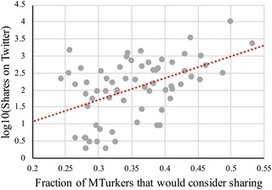
There is an increasing imperative for psychologists and other behavioral scientists to understand how people behave on social media. However, it is often very difficult to execute experimental research on actual social media platforms, or to link survey responses to online behavior in order to perform correlational analyses. Thus, there is a natural desire to use self-reported behavioral intentions in standard survey studies to gain insight into online behavior. But are such hypothetical responses hopelessly disconnected from actual sharing decisions? Or are online survey samples via sources such as Amazon Mechanical Turk (MTurk) so different from the average social media user that the survey responses of one group give little insight into the on-platform behavior of the other? Here we investigate these issues by examining 67 pieces of political news content. We evaluate whether there is a meaningful relationship between (i) the level of sharing (tweets and retweets) of a given piece of content on Twitter, and (ii) the extent to which individuals (total N = 993) in online surveys on MTurk reported being willing to share that same piece of content. We found that the same news headlines that were more likely to be hypothetically shared on MTurk were also shared more frequently by Twitter users, r = .44. For example, across the observed range of MTurk sharing fractions, a 20 percentage point increase in the fraction of MTurk participants who reported being willing to share a news headline on social media was associated with 10x as many actual shares on Twitter. We also found that the correlation between sharing and various features of the headline was similar using both MTurk and Twitter data. These findings suggest that self-reported sharing intentions collected in online surveys are likely to provide some meaningful insight into what content would actually be shared on social media.

Source: journals.plos.org