Category: Papers

Efficient sentinel surveillance strategies for preventing epidemics on networks

Ewan Colman, Petter Holme, Hiroki Sayama, Carlos Gershenson


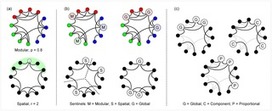
Surveillance plays a crucial role in preventing emerging infectious diseases from becoming epidemic. In circumstances where it is possible to monitor the infection status of certain people, transport hubs, or hospitals, early detection of the disease allows interventions to be implemented before most of the damage can occur, or at least its impact can be mitigated. This paper addresses the question of which nodes we should select in a network of individuals susceptible to some infectious disease in order to minimize the number of casualties. By simulating disease outbreaks on a collection of empirical and synthetic networks we show that the best strategy depends on topological characteristics of the network. For highly modular or spatially embedded networks it is better to place the sentinels on nodes distributed across different regions. However, if the degree heterogeneity is high, then a strategy that targets network hubs is preferred. We further consider the consequences of having an incomplete sample of the network and demonstrate that the value of new information diminishes as more data is collected. Finally we find further marginal improvements using two heuristics informed by known results in graph theory that exploit the fragmented structure of sparse network data.

Source: journals.plos.org

Networks

Network science is now a mature research field, whose growth was catalysed by the introduction of the ‘small world’ network model in 1998. Networks give mathematical descriptions of systems containing containing many interacting components, including power grids, neuronal networks and ecosystems. This collection brings together selected research, comments and review articles on how networks are structured (Layers & structure); how networks can describe healthy and disordered systems (Brain & disorders); how dynamics unfold on networks (Dynamics & spread); and community structures and resilience in networks (Community & resilience).

Source: www.nature.com

Active materials: minimal models of cognition?

Patrick McGivern

Adaptive Behavior


Work on minimal cognition raises a variety of questions concerning the boundaries of cognition. Many discussions of minimal cognition assume that the domain of minimal cognition is a subset of the domain of the living. In this article, I consider whether non-living ‘active materials’ ought to be included as instances of minimal cognition. I argue that seeing such cases as ‘minimal models’ of (minimal) cognition requires recognising them as members of a class of systems sharing the same basic features and exhibiting the same general patterns of behaviour. Minimal cognition in this sense is a very inclusive concept: rather than specifying some threshold level of cognition or a type of cognition found only in very simple systems, it is a concept of cognition associated with very minimal criteria that pick out only the most essential requirements for a system to exhibit cognitive behaviour.

Source: journals.sagepub.com

Thermodynamic efficiency of interactions in self-organizing systems

Ramil Nigmatullin, Mikhail Prokopenko


The emergence of global order in complex systems with locally interacting components is most striking at criticality, where small changes in control parameters result in a sudden global re-organization. We introduce a measure of thermodynamic efficiency of interactions in self-organizing systems, which quantifies the change in the system’s order per unit work carried out on (or extracted from) the system. We analytically derive the thermodynamic efficiency of interactions for the case of quasi-static variations of control parameters in the exactly solvable Curie-Weiss (fully connected) Ising model, and demonstrate that this quantity diverges at the critical point of a second order phase transition. This divergence is shown for quasi-static perturbations in both control parameters, the external field and the coupling strength. Our analysis formalizes an intuitive understanding of thermodynamic efficiency across diverse self-organizing dynamics in physical, biological and social domains.

Source: arxiv.org