
Researchers have discovered a surprising mathematical relationship in the brain’s representations of sensory information, with possible applications to AI research.
Source: www.quantamagazine.org
Networking the complexity community since 1999
Category: Papers
Researchers have discovered a surprising mathematical relationship in the brain’s representations of sensory information, with possible applications to AI research.
Source: www.quantamagazine.org
Influence maximization is the problem of finding the set of nodes of a network that maximizes the size of the outbreak of a spreading process occurring on the network. Solutions to this problem are important for strategic decisions in marketing and political campaigns. The typical setting consists in the identification of small sets of initial spreaders in very large networks. This setting makes the optimization problem computationally infeasible for standard greedy optimization algorithms that account simultaneously for information about network topology and spreading dynamics, leaving space only to heuristic methods based on the drastic approximation of relying on the geometry of the network alone. The literature on the subject is plenty of purely topological methods for the identification of influential spreaders in networks. However, it is unclear how far these methods are from being optimal. Here, we perform a systematic test of the performance of a multitude of heuristic methods for the identification of influential spreaders. We quantify the performance of the various methods on a corpus of 100 real-world networks; the corpus consists of networks small enough for the application of greedy optimization so that results from this algorithm are used as the baseline needed for the analysis of the performance of the other methods on the same corpus of networks. We find that relatively simple network metrics, such as adaptive degree or closeness centralities, are able to achieve performances very close to the baseline value, thus providing good support for the use of these metrics in large-scale problem settings. Also, we show that a further 2–5% improvement towards the baseline performance is achievable by hybrid algorithms that combine two or more topological metrics together. This final result is validated on a small collection of large graphs where greedy optimization is not applicable.
Systematic comparison between methods for the detection of influential spreaders in complex networks
Şirag Erkol, Claudio Castellano & Filippo Radicchi
Scientific Reports volume 9, Article number: 15095 (2019)
Source: www.nature.com
Microfluidic systems are now being designed with precision as miniaturized fluid manipulation devices that can execute increasingly complex tasks. However, their operation often requires numerous external control devices owing to the typically linear nature of microscale flows, which has hampered the development of integrated control mechanisms. Here we address this difficulty by designing microfluidic networks that exhibit a nonlinear relation between the applied pressure and the flow rate, which can be harnessed to switch the direction of internal flows solely by manipulating the input and/or output pressures. We show that these networks— implemented using rigid polymer channels carrying water—exhibit an experimentally supported fluid analogue of Braess’s paradox, in which closing an intermediate channel results in a higher, rather than lower, total flow rate. The harnessed behaviour is scalable and can be used to implement flow routing with multiple switches. These findings have the potential to advance the development of built-in control mechanisms in microfluidic networks, thereby facilitating the creation of portable systems and enabling novel applications in areas ranging from wearable healthcare technologies to deployable space systems.
Braess’s paradox and programmable behaviour in microfluidic networks
Daniel J. Case, Yifan Liu, István Z. Kiss, Jean-Régis Angilella & Adilson E. Motter
Nature (2019)
Source: www.nature.com
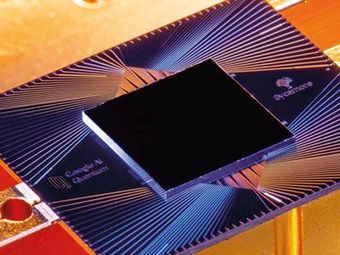
A programmable quantum computer has been reported to outperform the most powerful conventional computers in a specific task — a milestone in computing comparable in importance to the Wright brothers’ first flights.
Source: www.nature.com
Social behaviours emerge from the exchange of information among individuals—constrained by and reciprocally influencing the structure of information flows. The Internet radically transformed communication by democratizing broadcast capabilities and enabling easy and borderless formation of new acquaintances. However, actual information flows are heterogeneous and confined to self-organized echo-chambers. Of central importance to the future of society is understanding how existing physical segregation affects online social fragmentation. Here, we show that the virtual space is a reflection of the geographical space where physical interactions and proximity-based social learning are the main transmitters of ideas. We show that online interactions are segregated by income just as physical interactions are, and that physical separation reflects polarized behaviours beyond culture or politics. Our analysis is consistent with theoretical concepts suggesting polarization is associated with social exposure that reinforces within-group homogenization and between-group differentiation, and they together promote social fragmentation in mirrored physical and virtual spaces.
Segregation and polarization in urban areas
Alfredo J. Morales, Xiaowen Dong, Yaneer Bar-Yam and Alex ‘Sandy’ Pentland
Royal Society Open Science
Source: royalsocietypublishing.org

