Category: Papers

The Fair Reward Problem: The Illusion of Success and How to Solve It

Humanity has been fascinated by the pursuit of fortune since time immemorial, and many successful outcomes benefit from strokes of luck. But success is subject to complexity, uncertainty, and change — and at times becoming increasingly unequally distributed. This leads to tension and confusion over to what extent people actually get what they deserve (i.e. fairness/meritocracy). Moreover, in many fields, humans are overconfident and pervasively confuse luck for skill (I win, it is skill; I lose, it is bad luck). In some fields, there is too much risk-taking; in others, not enough. Where success derives in large part from luck — and especially where bailouts skew the incentives (heads, I win; tails, you lose) — it follows that luck is rewarded too much. This incentivizes a culture of gambling, while downplaying the importance of productive effort. And, short-term success is often rewarded, irrespective, and potentially at the detriment, of the long-term system fitness. However, much success is truly meritocratic, and the problem is to discern and reward based on merit. We call this the fair reward problem. To address this, we propose three different measures to assess merit: (i) raw outcome; (ii) risk-adjusted outcome, and (iii) prospective. We emphasize the need, in many cases, for the deductive prospective approach, which considers the potential of a system to adapt and mutate in novel futures. This is formalized within an evolutionary system, comprised of five processes, inter alia handling the exploration–exploitation trade-off. Several human endeavors — including finance, politics, and science — are analyzed through these lenses, and concrete solutions are proposed to support a prosperous and meritocratic society.


The Fair Reward Problem: The Illusion of Success and How to Solve It
Didier Sornette, Spencer Wheatley & Peter Cauwels

Advances in Complex Systems Vol. 22, No. 03, 1950005 (2019) 

Source: www.worldscientific.com

Memory formation in the absence of experience

Memory is coded by patterns of neural activity in distinct circuits. Therefore, it should be possible to reverse engineer a memory by artificially creating these patterns of activity in the absence of a sensory experience. In olfactory conditioning, an odor conditioned stimulus (CS) is paired with an unconditioned stimulus (US; for example, a footshock), and the resulting CS–US association guides future behavior. Here we replaced the odor CS with optogenetic stimulation of a specific olfactory glomerulus and the US with optogenetic stimulation of distinct inputs into the ventral tegmental area that mediate either aversion or reward. In doing so, we created a fully artificial memory in mice. Similarly to a natural memory, this artificial memory depended on CS–US contingency during training, and the conditioned response was specific to the CS and reflected the US valence. Moreover, both real and implanted memories engaged overlapping brain circuits and depended on basolateral amygdala activity for expression.


Memory formation in the absence of experience
Gisella Vetere, Lina M. Tran, Sara Moberg, Patrick E. Steadman, Leonardo Restivo, Filomene G. Morrison, Kerry J. Ressler, Sheena A. Josselyn & Paul W. Frankland 
Nature Neuroscience volume 22, pages 933–940 (2019)

Source: www.nature.com

Inception…

Social media usage reveals how regions recover after natural disaster

The challenge of nowcasting and forecasting the effect of natural disasters (e.g. earthquakes, floods, hurricanes) on assets, people and society is of primary importance for assessing the ability of such systems to recover from extreme events. Traditional disaster recovery estimates, such as surveys and interviews, are usually costly, time consuming and do not scale. Here we present a methodology to indirectly estimate the post-emergency recovery status (‘downtime’) of small businesses in urban areas looking at their online posting activity on social media. Analysing the time series of posts before and after an event, we quantify the downtime of small businesses for three natural disasters occurred in Nepal, Puerto Rico and Mexico. A convenient and reliable method for nowcasting the post-emergency recovery status of economic activities could help local governments and decision makers to better target their interventions and distribute the available resources more effectively.


Social media usage reveals how regions recover after natural disaster
Robert Eyre, Flavia De Luca, Filippo Simini

Source: arxiv.org

The Neuroscience of Reality

  • The reality we perceive is not a direct reflection of the external objective world.
  • Instead it is the product of the brain’s predictions about the causes of incoming sensory signals.
  • The property of realness that accompanies our perceptions may serve to guide our behavior so that we respond appropriately to the sources of sensory signals.


The Neuroscience of Reality

Anil Seth

Scientific American

Source: www.scientificamerican.com

Interactional and Informational Attention on Twitter

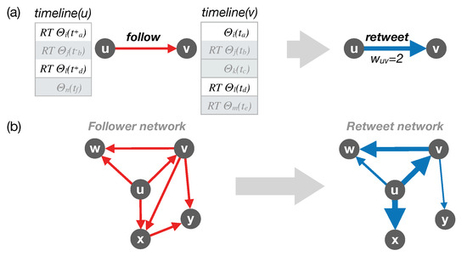
Twitter may be considered to be a decentralized social information processing platform whose users constantly receive their followees’ information feeds, which they may in turn dispatch to their followers. This decentralization is not devoid of hierarchy and heterogeneity, both in terms of activity and attention. In particular, we appraise the distribution of attention at the collective and individual level, which exhibits the existence of attentional constraints and focus effects. We observe that most users usually concentrate their attention on a limited core of peers and topics, and discuss the relationship between interactional and informational attention processes—all of which, we suggest, may be useful to refine influence models by enabling the consideration of differential attention likelihood depending on users, their activity levels, and peers’ positions.


Interactional and Informational Attention on Twitter
Agathe Baltzer, Márton Karsai, and Camille Roth
Information 2019, 10(8), 250

Source: www.mdpi.com