
Category: Papers

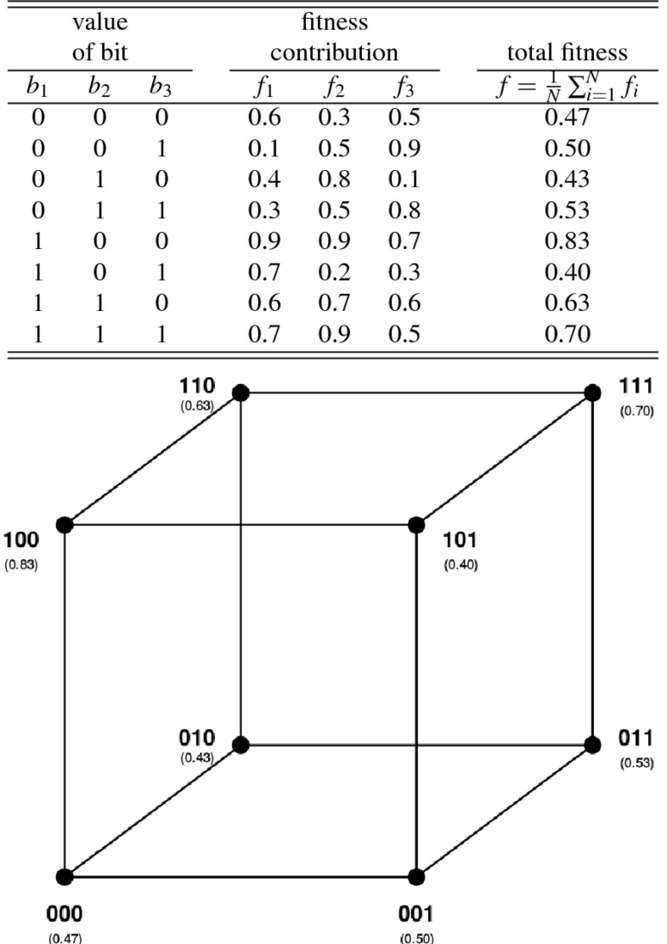
Average Fitness Differences on NK Landscapes

The average fitness difference between adjacent sites in a fitness landscape is an important descriptor that impacts in particular the dynamics of selection/mutation processes on the landscape. Of particular interest is its connection to the error threshold phenomenon. We show here that this parameter is intimately tied to the ruggedness through the landscape’s amplitude spectrum. For the NK model, a surprisingly simple analytical estimate explains simulation data with high precision.


Average Fitness Differences on NK Landscapes
Wim Hordijk, Stuart A. Kauffman, Peter F. Stadler

Theory in Biosciences

Source: link.springer.com

Localist plasticity identified by mutual information

The issue of memory is difficult for standard neural network models. Ubiquitous synaptic plasticity introduces the problem of interference, which limits pattern recall and introduces conflation errors. We present a lognormal recurrent neural network, load patterns into it (MNIST), and test the resulting neural representation for information content by an output classifier. We identify neurons, which ‘compress’ the pattern information into their own adjacency network, and by stimulating these achieve recall. Learning is limited to intrinsic plasticity and output synapses of these pattern neurons (localist plasticity), which prevents interference.

Our first experiments show that this form of storage and recall is possible, with the caveat of a ‘lossy’ recall similar to human memory. Comparing our results with a standard Gaussian network model, we notice that this effect breaks down for the Gaussian model.


Localist plasticity identified by mutual information

Gabriele Scheler, Johann Schumann

Source: www.biorxiv.org

Exploration of the chemical space and its three historical regimes

We found that the number of new chemical compounds has grown exponentially with a 4.4% annual production rate from 1800 to 2015 not even affected by World Wars. There are three distinct growth regimes: proto-organic, organic, and organometallic, with decreasing variability in the production of compounds over time. Contrary to the belief that organic synthesis developed only after 1828, synthesis had been a key provider of new compounds already at the beginning of the 19th century. By 1900, it became the established tool to report new compounds. We found that chemists are conservative when selecting starting materials and that despite the growing production of new compounds, most of them belong to a restricted set of chemical compositions.


Exploration of the chemical space and its three historical regimes

Eugenio J. Llanos, Wilmer Leal, Duc H. Luu, Jürgen Jost, Peter F. Stadler, and Guillermo Restrepo
PNAS

Source: www.pnas.org

Quantifying the sensing power of vehicle fleets

Attaching sensors to crowd-sourced vehicles could provide a cheap and accurate way to monitor air pollution, road quality, and other aspects of a city’s health. But in order for so-called drive-by sensing to be practically useful, the sensor-equipped vehicle fleet needs to have large “sensing power”—that is, it needs to cover a large fraction of a city’s area during a given reference period. Here, we provide an analytic description of the sensing power of taxi fleets, which agrees with empirical data from nine major cities. Our results show taxis’ sensing power is unexpectedly large—in Manhattan; just 10 random taxis cover one-third of street segments daily, which certifies that drive-by sensing can be readily implemented in the real world.


Quantifying the sensing power of vehicle fleets
Kevin P. O’Keeffe, Amin Anjomshoaa, Steven H. Strogatz, Paolo Santi, and Carlo Ratti
PNAS

Source: www.pnas.org

Advances in Complex Systems and Their Applications to Cybersecurity

Cybersecurity is one of the fastest growing and largest technology sectors and is increasingly being recognized as one of the major issues in many industries, so companies are increasing their security budgets in order to guarantee the security of their processes. Successful menaces to the security of information systems could lead to safety, environmental, production, and quality problems.

One of the most harmful issues of attacks and intrusions is the ever-changing nature of attack technologies and strategies, which increases the difficulty of protecting computer systems. As a result, advanced systems are required to deal with the ever-increasing complexity of attacks in order to protect systems and information.

This special issue received several contributions, 5 of which have been accepted for publication.


Complexity
Volume 2019, Article ID 3261453, 2 pages
https://doi.org/10.1155/2019/3261453
Editorial
Advances in Complex Systems and Their Applications to Cybersecurity
Fernando Sánchez Lasheras, Danilo Comminiello, and Alicja Krzemień

Source: www.hindawi.com