
Category: Papers

Human information processing in complex networks

Humans communicate using systems of interconnected stimuli or concepts — from language and music to literature and science — yet it remains unclear how, if at all, the structure of these networks supports the communication of information. Although information theory provides tools to quantify the information produced by a system, traditional metrics do not account for the inefficient and biased ways that humans process this information. Here we develop an analytical framework to study the information generated by a system as perceived by a human observer. We demonstrate experimentally that this perceived information depends critically on a system’s network topology. Applying our framework to several real networks, we find that they communicate a large amount of information (having high entropy) and do so efficiently (maintaining low divergence from human expectations). Moreover, we show that such efficient communication arises in networks that are simultaneously heterogeneous, with high-degree hubs, and clustered, with tightly-connected modules — the two defining features of hierarchical organization. Together, these results suggest that many real networks are constrained by the pressures of information transmission, and that these pressures select for specific structural features.


Human information processing in complex networks

Christopher W. Lynn, Lia Papadopoulos, Ari E. Kahn, Danielle S. Bassett

Source: arxiv.org
Interacting contagions are indistinguishable from social reinforcement

From fake news to innovative technologies, many contagions spread via a process of social reinforcement, where multiple exposures are distinct from prolonged exposure to a single source. Contrarily, biological agents such as Ebola or measles are typically thought to spread as simple contagions. Here, we demonstrate that interacting simple contagions are indistinguishable from complex contagions. In the social context, our results highlight the challenge of identifying and quantifying mechanisms, such as social reinforcement, in a world where an innumerable amount of ideas, memes and behaviors interact. In the biological context, this parallel allows the use of complex contagions to effectively quantify the non-trivial interactions of infectious diseases.


Interacting contagions are indistinguishable from social reinforcement

Laurent Hébert-Dufresne, Samuel V. Scarpino, Jean-Gabriel Young

Source: arxiv.org

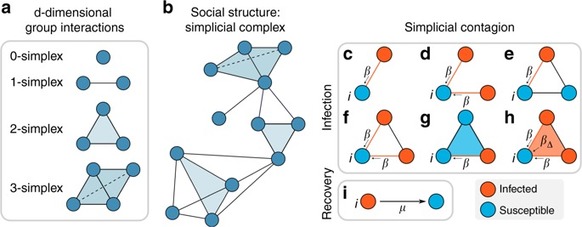
Simplicial models of social contagion

Complex networks have been successfully used to describe the spread of diseases in populations of interacting individuals. Conversely, pairwise interactions are often not enough to characterize social contagion processes such as opinion formation or the adoption of novelties, where complex mechanisms of influence and reinforcement are at work. Here we introduce a higher-order model of social contagion in which a social system is represented by a simplicial complex and contagion can occur through interactions in groups of different sizes. Numerical simulations of the model on both empirical and synthetic simplicial complexes highlight the emergence of novel phenomena such as a discontinuous transition induced by higher-order interactions. We show analytically that the transition is discontinuous and that a bistable region appears where healthy and endemic states co-exist. Our results help explain why critical masses are required to initiate social changes and contribute to the understanding of higher-order interactions in complex systems.


Simplicial models of social contagion
Iacopo Iacopini, Giovanni Petri, Alain Barrat & Vito Latora
Nature Communications 10, Article number: 2485 (2019)

Source: www.nature.com

An Overview of Open-Ended Evolution: Editorial Introduction to the Open-Ended Evolution II Special Issue

Nature’s spectacular inventiveness, reflected in the enormous diversity of form and function displayed by the biosphere, is a feature of life that distinguishes living most strongly from nonliving. It is, therefore, not surprising that this aspect of life should become a central focus of artificial life. We have known since Darwin that the diversity is produced dynamically, through the process of evolution; this has led life’s creative productivity to be called Open-Ended Evolution (OEE) in the field. This article introduces the second of two special issues on current research in OEE and provides an overview of the contents of both special issues. Most of the work was presented at a workshop on open-ended evolution that was held as a part of the 2018 Conference on Artificial Life in Tokyo, and much of it had antecedents in two previous workshops on open-ended evolution at artificial life conferences in Cancun and York. We present a simplified categorization of OEE and summarize progress in the field as represented by the articles in this special issue.


An Overview of Open-Ended Evolution: Editorial Introduction to the Open-Ended Evolution II Special Issue
Norman Packard, Mark A. Bedau, Alastair Channon, Takashi Ikegami,
Artificial Life
Volume 25 | Issue 2 | Spring 2019 p.93-103

Source: www.mitpressjournals.org

Technology seems open-ended, and it is not living… or is it?

What is the Entropy of a Social Organization?

We quantify a social organization’s potentiality, that is its ability to attain different configurations. The organization is represented as a network in which nodes correspond to individuals and (multi-)edges to their multiple interactions. Attainable configurations are treated as realizations from a network ensemble. To encode interaction preferences between individuals, we choose the generalized hypergeometric ensemble of random graphs, which is described by a closed-form probability distribution. From this distribution we calculate Shannon entropy as a measure of potentiality. This allows us to compare different organizations as well different stages in the development of a given organization. The feasibility of the approach is demonstrated using data from 3 empirical and 2 synthetic systems.


What is the Entropy of a Social Organization?
Christian Zingg, Giona Casiraghi, Giacomo Vaccario, Frank Schweitzer

Source: arxiv.org