
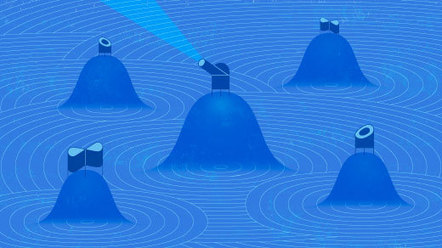
Scientists seek a single description of reality. But modern physics allows for many different descriptions, many equivalent to one another, connected through a vast landscape of mathematical possibility.
Source: www.quantamagazine.org
Networking the complexity community since 1999
Category: Papers
Scientists seek a single description of reality. But modern physics allows for many different descriptions, many equivalent to one another, connected through a vast landscape of mathematical possibility.
Source: www.quantamagazine.org
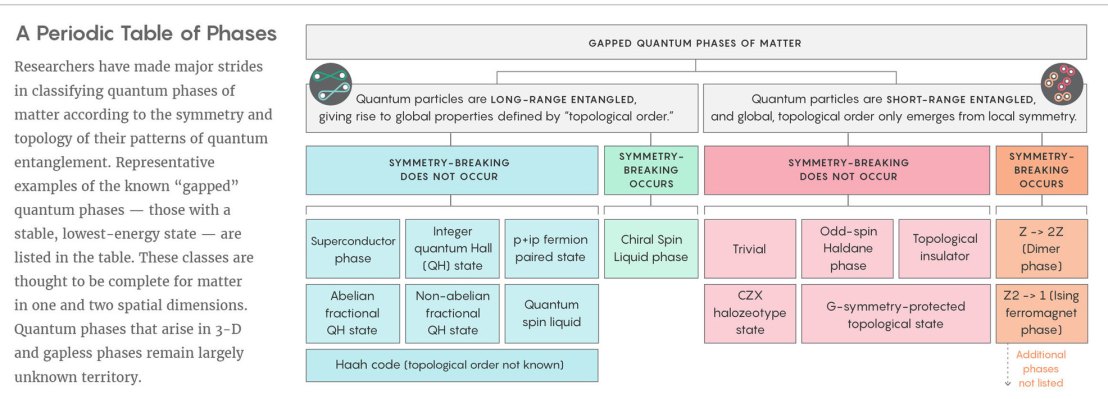
Led by dozens of top theorists, with input from mathematicians, researchers have already classified a huge swath of phases that can arise in one or two spatial dimensions by relating them to topology: the math that describes invariant properties of shapes like the sphere and the torus. They’ve also begun to explore the wilderness of phases that can arise near absolute zero in 3-D matter.
Source: www.quantamagazine.org
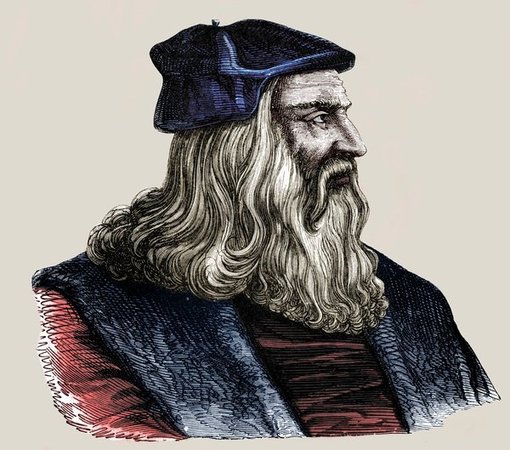
Leonardo’s thinking was interdisciplinary. When he injected wax into the brain or into the heart to make casts of the inner workings of the body, he was borrowing the “lost wax” technique familiar to sculptors. When he studied friction and invented roller bearings and ball bearings he reasoned that frictional resistance differs according to the nature of the surfaces in contact, and increases in direct proportion to load, and he even estimated (for the first time) a coefficient of friction. But he went further to realize its relevance not just to machines but to the movements of tendons over bones; to the creation of heat by the heart; and to the production of voice by the friction of air on the vocal cords.
Source: blogs.scientificamerican.com
Past studies have shown that faculty at prestigious universities tend to be more productive and prominent than faculty at less prestigious universities. This pattern is usually attributed to a competitive job market that selects inherently productive faculty into prestigious positions. Here, we test the extent to which, instead, faculty’s work environments drive their productivity. Using comprehensive data on an entire field of research, we use a matched-pair experimental design to isolate the effects of training at, versus working in, prestigious environments. We find that faculty’s work environments, not selection effects, drive their productivity and prominence, establishing that where a researcher works serves as a mechanism for cumulative advantage, locking in past success via job placement and thereby facilitating future success.
Productivity, prominence, and the effects of academic environment
Samuel F. Way, Allison C. Morgan, Daniel B. Larremore, and Aaron Clauset
PNAS
Source: www.pnas.org
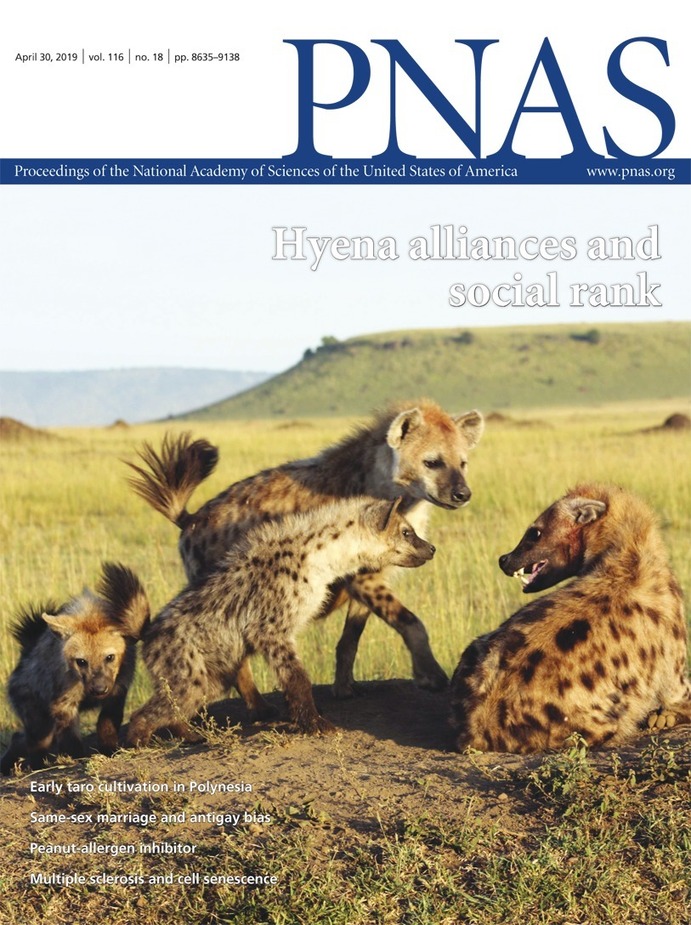
What forces produce and maintain social inequality, and why do society members tolerate this inequality? The “One Percent” clearly benefit from having high status, but low-status individuals have strong incentive to challenge the established pecking order and try to improve their position. This conundrum is particularly striking in the societies of many primates and spotted hyenas, where females who are born to low-status mothers rarely manage to improve their position. Here we find that females who are strongly allied with their group-mates are more likely to improve their status, and that upward social mobility is often achieved with support from their closest allies. This suggests that, much like some animals compete physically for status, these species compete through social alliances.
Social alliances improve rank and fitness in convention-based societies
Eli D. Strauss and Kay E. Holekamp
PNAS April 30, 2019 116 (18) 8919-8924
Source: www.pnas.org

