
Category: Papers

The necessity of extended autopoiesis

The theory of autopoiesis holds that an organism can be defined as a network of processes. However, an organism also has a physical body. The relationship between these two things—network and body—has been raised in this issue of Adaptive Behaviour, with reference to an extended interpretation of autopoiesis. This perspective holds that the network and the body are distinct things, and that the network should be thought of as extending beyond the boundaries of the body. The relationship between body and network is subtle, and I revisit it here from the extended perspective. I conclude that from an organism = network perspective, the body is a biological solution to the problem of maintaining both the distinctness of an organism, separate from but engaged with its environment and other organisms, and its distinctiveness as a particular individual.


The necessity of extended autopoiesis
Nathaniel Virgo
Adaptive Behavior

https://doi.org/10.1177/1059712319841557

Source: journals.sagepub.com
Towards a quantitative model of epidemics during conflicts 

Epidemics may both contribute to and arise as a result of conflict. The effects of conflict on infectious diseases are complex and there have been confounding observations of both increase and decrease in disease outbreaks during and after conflicts. However there is no unified mathematical model that explains all these counter-intuitive observations. There is an urgent need for a quantitative framework for modelling conflicts and epidemics. We introduce a set of mathematical models to understand the role of conflicts in epidemics. Our mathematical framework has the potential to explain the counterintuitive observations and the complex role of human conflicts in epidemics. Our work suggests that aid and peacekeeping organizations should take an integrated approach that combines public health measures, socio-economic development, and peacekeeping in the conflict zone. Our approach exemplifies the role of non-linear thinking in complex systems like human societies. We view our work as a step towards a quantitative model of disease spread in conflicts.


Banerjee S. 2019. Towards a quantitative model of epidemics during conflicts. PeerJ Preprints 7:e27651v1 https://doi.org/10.7287/peerj.preprints.27651v1

Source: peerj.com

How Efficiency Shapes Human Language

We review recent research on the burgeoning topic of how language structure is shaped by principles of efficiency for communication and learning.
Work in this area has infused long-standing ideas in linguistics and psychology with new precision and methodological rigor by bringing together information theory, newly available datasets, controlled experimentation, and computational modeling.
We review a number of studies that focus on phenomena ranging from the lexicon through syntactic processes, and which deploy formal tools from information theory and probability theory to understand how and why language works the way that it does.
These studies show how a pervasive pressure for efficient usage guides the form of natural language and suggest a rich future for language research in connecting linguistics to cognitive psychology and mathematical theories of communication.


How Efficiency Shapes Human Language

Edward Gibson, et al.

Trends in Cognitive Science

Source: www.cell.com

Topical Alignment in Online Social Systems

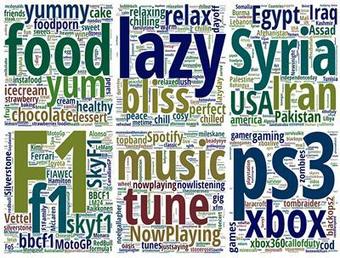
Understanding the dynamics of social interactions is crucial to comprehend human behavior. The emergence of online social media has enabled access to data regarding people relationships at a large scale. Twitter, specifically, is an information oriented network, with users sharing and consuming information. In this work, we study whether users tend to be in contact with people interested in similar topics, i.e., if they are topically aligned. To do so, we propose an approach based on the use of hashtags to extract information topics from Twitter messages and model users’ interests. Our results show that, on average, users are connected with other users similar to them. Furthermore, we show that topical alignment provides interesting information that can eventually allow inferring users’ connectivity. Our work, besides providing a way to assess the topical similarity of users, quantifies topical alignment among individuals, contributing to a better understanding of how complex social systems are structured.


Topical Alignment in Online Social Systems

Felipe Maciel Cardoso, Sandro Meloni, André Santanchè, and Yamir Moreno

Front. Phys., 17 April 2019 | https://doi.org/10.3389/fphy.2019.00058

Source: www.frontiersin.org

Information as a construction

The purpose of this review paper is to outline the constructivist approach to the notion of information from two perspectives. The first perspective explores the role of ‘constructed’ information in the ‘constructivist niche’ – a common name for the appropriate viewpoints in different science fields, such as cognitive and neuroscience, psychology, cybernetics and biology of cognition. The second perspective considers library and information science (LIS) papers in which information is treated as a constructed entity. This paper assumed the origin of the notion of information to be a construction as defined in the ‘constructivist niche’ that is based upon communication theory and cybernetics. Conversely, the origin of the notion of information as a construction as per LIS can be found in Bateson’s definition of information as a ‘difference which makes the difference,‘ as well as in the 1970s LIS definition wherein information is associated with the direction of a cognitive viewpoint, as in a ‘cognitive turn’. The study showed that ‘information as a construction‘, except in a few cases, did not play a significant role in the constructivist theories nor in LIS. LIS researchers reduce the concept of information to a subjective, socially-constructed entity which inherently results in different interpretations.


Information as a construction
Boris Bosancic, Marta Matijevic

Journal of Librarianship and Information Science

Source: journals.sagepub.com