
Category: Papers

A Self-Organizing Grouping Approach for Ship Traffic Scheduling in Restricted One-Way Waterway

Ship scheduling optimization is one of the most effective ways to eliminate the bottlenecks of waterway transportation, especially in restricted one-way waterways. In this study, a novel scheduling model called self-organizing grouping is proposed to minimize two types of delay time, which are the waiting time and the extra navigation time caused by speed reduction. The proposed model schedules ships in an iterative way based on the distributed scheduling mode. To alleviate the impact of local scheduling on the overall traffic efficiency, a grouping method is proposed, in which the ships are divided into different groups based on their arrival time interval. Moreover, the ships in the same group are scheduled to minimize the interferences among them by incorporating a grouping improvement strategy. The strategy is used to deal with the influence of ships with very small speed. Experiments are carried out by comparing the proposed model with the first-come-first-serve model and the ship self-organizing cooperation model. Simulation results show that the delay time is reduced by 25%‐30% and approximately by 5% compared with that from the two models, respectively. Such advantage also exists for different combinations of ship traffic parameters. In addition, long-distance sailing with limited speed can be avoided using the proposed method, which is beneficial to relieve waterway traffic congestion.


A Self-Organizing Grouping Approach for Ship Traffic Scheduling in Restricted One-Way Waterway
Authors: Xin, Xuri; Liu, Kezhong; Zhang, Jinfen; Chen, Shuzhe; Wang, Hongbo; Cheng, Zhiyou
Source: Marine Technology Society Journal, Volume 53, Number 1, January/February 2019, pp. 83-96(14)
DOI: https://doi.org/10.4031/MTSJ.53.1.9

Source: www.ingentaconnect.com
A Multilayer Structure Facilitates the Production of Antifragile Systems in Boolean Network Models

Antifragility is a property to not only resist stress and but also to benefit from it. Even though antifragile dynamics are found in various real-world complex systems where multiple subsystems interact with each other, the attribute has not been quantitatively explored yet in those complex systems which can be regarded as multilayer networks. Here we study how the multilayer structure affects the antifragility of the whole system. By comparing single-layer and multilayer Boolean networks based on our recently proposed antifragility measure, we found that the multilayer structure facilitated the production of antifragile systems. Our measure and findings can be utilized for many applications from understanding properties of biological systems with multilayer structures to designing more antifragile engineered systems.


A Multilayer Structure Facilitates the Production of Antifragile Systems in Boolean Network Models
Hyobin Kim, Omar K. Pineda, Carlos Gershenson

Source: arxiv.org

Spatial Structure Can Decrease Symbiotic Cooperation

Mutualisms occur when at least two species provide a net fitness benefit to each other. These types of interactions are ubiquitous in nature, with more being discovered regularly. Mutualisms are vital to humankind: Pollinators and soil microbes are critical in agriculture, bacterial microbiomes regulate our health, and domesticated animals provide us with food and companionship. Many hypotheses exist on how mutualisms evolve; however, they are difficult to evaluate without bias, due to the fragile and idiosyncratic systems most often investigated. Instead, we have created an artificial life simulation, Symbulation, which we use to examine mutualism evolution based on (1) the probability of vertical transmission (symbiont being passed to offspring) and (2) the spatial structure of the environment. We found that spatial structure can lead to less mutualism at intermediate vertical transmission rates. We provide evidence that this effect is due to the ability of quasi species to purge parasites, reducing the diversity of available symbionts. Our simulation is easily extended to test many additional hypotheses about the evolution of mutualism and serves as a general model to quantitatively compare how different environments affect the evolution of mutualism.


Spatial Structure Can Decrease Symbiotic Cooperation
Anya E. Vostinar and Charles Ofria

Artificial Life

Source: www.mitpressjournals.org

Controlling systemic risk – network structures that minimize it and node properties to calculate it

Evaluation of systemic risk in networks of financial institutions in general requires information of inter-institution financial exposures. In the framework of Debt Rank algorithm, we introduce an approximate method of systemic risk evaluation which requires only node properties, such as total assets and liabilities, as inputs. We demonstrate that this approximation captures a large portion of systemic risk measured by Debt Rank. Furthermore, using Monte Carlo simulations, we investigate network structures that can amplify systemic risk. Indeed, while no topology in general sense is a priori more stable if the market is liquid, a larger complexity is detrimental for the overall stability. Here we find that the measure of scalar assortativity correlates well with level of systemic risk. In particular, network structures with high systemic risk are scalar assortative, meaning that risky banks are mostly exposed to other risky banks. Network structures with low systemic risk are scalar disassortative, with interactions of risky banks with stable banks.


Controlling systemic risk – network structures that minimize it and node properties to calculate it
Sebastian M. Krause, Hrvoje Štefančić, Vinko Zlatić, Guido Caldarelli

Source: arxiv.org

Large teams develop and small teams disrupt science and technology

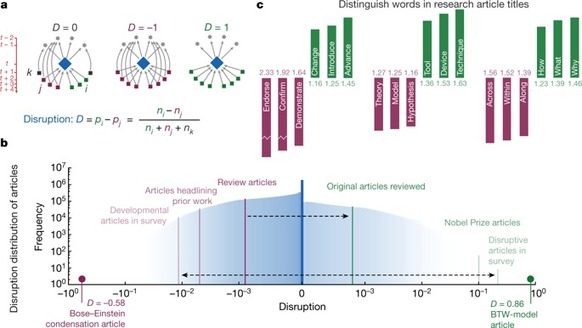
One of the most universal trends in science and technology today is the growth of large teams in all areas, as solitary researchers and small teams diminish in prevalence1,2,3. Increases in team size have been attributed to the specialization of scientific activities3, improvements in communication technology4,5, or the complexity of modern problems that require interdisciplinary solutions6,7,8. This shift in team size raises the question of whether and how the character of the science and technology produced by large teams differs from that of small teams. Here we analyse more than 65 million papers, patents and software products that span the period 1954–2014, and demonstrate that across this period smaller teams have tended to disrupt science and technology with new ideas and opportunities, whereas larger teams have tended to develop existing ones. Work from larger teams builds on more-recent and popular developments, and attention to their work comes immediately. By contrast, contributions by smaller teams search more deeply into the past, are viewed as disruptive to science and technology and succeed further into the future—if at all. Observed differences between small and large teams are magnified for higher-impact work, with small teams known for disruptive work and large teams for developing work. Differences in topic and research design account for a small part of the relationship between team size and disruption; most of the effect occurs at the level of the individual, as people move between smaller and larger teams. These results demonstrate that both small and large teams are essential to a flourishing ecology of science and technology, and suggest that, to achieve this, science policies should aim to support a diversity of team sizes.


Large teams develop and small teams disrupt science and technology
Lingfei Wu, Dashun Wang & James A. Evans 
Nature (2019)

Source: www.nature.com