
Category: Papers

Connecting empirical phenomena and theoretical models of biological coordination across scales

Coordination is ubiquitous in living systems. Existing theoretical models of coordination — from bacteria to brains — focus on either gross statistics in large-scale systems (N→∞) or detailed dynamics in small-scale systems (mostly N=2). Both approaches have proceeded largely independent of each other. The present work bridges this gap with a theoretical model of biological coordination that captures key experimental observations of mid-scale social coordination at multiple levels of description. It also reconciles in a single formulation two well-studied models of large- and small-scale biological coordination (Kuramoto and extended Haken-Kelso-Bunz). The model adds second-order coupling (from extended Haken-Kelso-Bunz) to the Kuramoto model. We show that second-order coupling is indispensable for reproducing empirically observed phenomena and gives rise to a phase transition from mono- to multi-stable coordination across scales. This mono-to-multistable transition connects the emergence and growth of behavioral complexity in small and large systems.


Connecting empirical phenomena and theoretical models of biological coordination across scales
Mengsen Zhang, Christopher Beetle, J. A. Scott Kelso, Emmanuelle Tognoli

Source: arxiv.org
Antifragility of Random Boolean Networks

Antifragility is a property that enhances the capability of a system in response to external perturbations. Although the concept has been applied in many areas, a practical measure of antifragility has not been developed yet. Here we propose a simply calculable measure of antifragility, based on the change of "satisfaction" before and after adding perturbations, and apply it to random Boolean networks (RBNs). Using the measure, we found that ordered RBNs are the most antifragile. Also, we demonstrate that seven biological systems are antifragile. Our measure and results can be used in various applications of Boolean networks (BNs) including creating antifragile engineering systems, identifying the genetic mechanism of antifragile biological systems, and developing new treatment strategies for various diseases.


Antifragility of Random Boolean Networks
Omar K. Pineda, Hyobin Kim, Carlos Gershenson

Source: arxiv.org

The universal decay of collective memory and attention

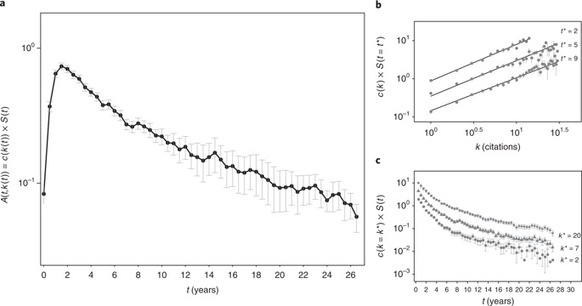
Collective memory and attention are sustained by two channels: oral communication (communicative memory) and the physical recording of information (cultural memory). Here, we use data on the citation of academic articles and patents, and on the online attention received by songs, movies and biographies, to describe the temporal decay of the attention received by cultural products. We show that, once we isolate the temporal dimension of the decay, the attention received by cultural products decays following a universal biexponential function. We explain this universality by proposing a mathematical model based on communicative and cultural memory, which fits the data better than previously proposed log-normal and exponential models. Our results reveal that biographies remain in our communicative memory the longest (20–30 years) and music the shortest (about 5.6 years). These findings show that the average attention received by cultural products decays following a universal biexponential function.


The universal decay of collective memory and attention
Cristian Candia, C. Jara-Figueroa, Carlos Rodriguez-Sickert, Albert-László Barabási & César A. Hidalgo 
Nature Human Behaviour (2018)

Source: www.nature.com

The chaperone effect in scientific publishing

Experience plays a critical role in crafting high-impact scientific work. This is particularly evident in top multidisciplinary journals, where a scientist is unlikely to appear as senior author if he or she has not previously published within the same journal. Here, we develop a quantitative understanding of author order by quantifying this “chaperone effect,” capturing how scientists transition into senior status within a particular publication venue. We illustrate that the chaperone effect has a different magnitude for journals in different branches of science, being more pronounced in medical and biological sciences and weaker in natural sciences. Finally, we show that in the case of high-impact venues, the chaperone effect has significant implications, specifically resulting in a higher average impact relative to papers authored by new principal investigators (PIs). Our findings shed light on the role played by experience in publishing within specific scientific journals, on the paths toward acquiring the necessary experience and expertise, and on the skills required to publish in prestigious venues.


The chaperone effect in scientific publishing
Vedran Sekara, Pierre Deville, Sebastian E. Ahnert, Albert-László Barabási, Roberta Sinatra, and Sune Lehmann
PNAS December 11, 2018 115 (50) 12603-12607

https://doi.org/10.1073/pnas.1800471115

Source: www.pnas.org

Macroscopic dynamics and the collapse of urban traffic

Stories of mega-jams that last tens of hours or even days appear not only in fiction but also in reality. In this context, it is important to characterize the collapse of the network, defined as the transition from a characteristic travel time to orders of magnitude longer for the same distance traveled. In this multicity study, we unravel this complex phenomenon under various conditions of demand and translate it to the travel time of the individual drivers. First, we start with the current conditions, showing that there is a characteristic time τ that takes a representative group of commuters to arrive at their destinations once their maximum density has been reached. While this time differs from city to city, it can be explained by Γ, defined as the ratio of the vehicle miles traveled to the total vehicle distance the road network can support per hour. Modifying Γ can improve τ and directly inform planning and infrastructure interventions. In this study we focus on measuring the vulnerability of the system by increasing the volume of cars in the network, keeping the road capacity and the empirical spatial dynamics from origins to destinations unchanged. We identify three states of urban traffic, separated by two distinctive transitions. The first one describes the appearance of the first bottlenecks and the second one the collapse of the system. This collapse is marked by a given number of commuters in each city and it is formally characterized by a nonequilibrium phase transition.

Macroscopic dynamics and the collapse of urban traffic
Luis E. Olmos, Serdar Çolak, Sajjad Shafiei, Meead Saberi, and Marta C. González
PNAS December 11, 2018 115 (50) 12654-12661

https://doi.org/10.1073/pnas.1800474115

Source: www.pnas.org