Category: Papers

The Effects of Remote Working on Scientific Collaboration and Impact

The Effects of Remote Working on Scientific Collaboration and Impact

Sara Venturini, Satyaki Sikdar, Martina Mazzarello, Francesco Rinaldi, Francesco Tudisco, Paolo Santi, Santo Fortunato, Carlo Ratti
The COVID-19 pandemic shifted academic collaboration from in-person to remote interactions. This study explores, for the first time, the effects on scientific collaborations and impact of such a shift, comparing research output before, during, and after the pandemic. Using large-scale bibliometric data, we track the evolution of collaboration networks and the resulting impact of research over time. Our findings are twofold: first, the geographic distribution of collaborations significantly shifted, with a notable increase in cross-border partnerships after 2020, indicating a reduction in the constraints of geographic proximity. Second, despite the expansion of collaboration networks, there was a concerning decline in citation impact, suggesting that the absence of spontaneous in-person interactions-which traditionally foster deep discussions and idea exchange-negatively affected research quality. As hybrid work models in academia gain traction, this study highlights the need for universities and research organizations to carefully consider the balance between remote and in-person engagement.

Read the full article at: arxiv.org

How malicious AI swarms can threaten democracy

Advances in artificial intelligence (AI) offer the prospect of manipulating beliefs and behaviors on a population-wide level (1). Large language models (LLMs) and autonomous agents (2) let influence campaigns reach unprecedented scale and precision. Generative tools can expand propaganda output without sacrificing credibility (3) and inexpensively create falsehoods that are rated as more human-like than those written by humans (3, 4). Techniques meant to refine AI reasoning, such as chain-of-thought prompting, can be used to generate more convincing falsehoods. Enabled by these capabilities, a disruptive threat is emerging: swarms of collaborative, malicious AI agents. Fusing LLM reasoning with multiagent architectures (2), these systems are capable of coordinating autonomously, infiltrating communities, and fabricating consensus efficiently. By adaptively mimicking human social dynamics, they threaten democracy. Because the resulting harms stem from design, commercial incentives, and governance, we prioritize interventions at multiple leverage points, focusing on pragmatic mechanisms over voluntary compliance.

DANIEL THILO SCHROEDER, MEEYOUNG CHA, ANDREA BARONCHELLI, NICK BOSTROM, NICHOLAS A. CHRISTAKIS, DAVID GARCIA, AMIT GOLDENBERG, YARA KYRYCHENKO, KEVIN LEYTON-BROWN, NINA LUTZ, GARY MARCUS, FILIPPO MENCZER, GORDON PENNYCOOK, DAVID G. RAND, MARIA RESSA, FRANK SCHWEITZER, DAWN SONG, CHRISTOPHER SUMMERFIELD, AUDREY TANG, JAY J. VAN BAVEL, SANDER VAN DER LINDEN, AND JONAS R. KUNST

SCIENCE 22 Jan 2026 Vol 391, Issue 6783 pp. 354-357

Read the full article at: www.science.org

The case against efficiency: friction in social media

Joshua Garland, Joe Bak-Coleman, Susan Benesch, Simon DeDeo, Renee DiResta, Jan Eissfeldt, Seungwoong Ha, John Irons, Chris Kempes, Juniper Lovato, Kristy Roschke, Paul E. Smaldino, Anna B. Stephenson, Thalia Wheatley & Valentina Semenova 

npj Complexity volume 3, Article number: 5 (2026)

Social media platforms frequently prioritize efficiency to maximize ad revenue and user engagement, often sacrificing deliberation, trust, and reflective, purposeful cognitive engagement in the process. This manuscript examines the potential of friction—design choices that intentionally slow user interactions—as an alternate approach. We present a case against efficiency as the dominant paradigm on social media and advocate for a complex systems approach to understanding and analyzing friction. Drawing from interdisciplinary literature, real-world examples, and industry experiments, we highlight the potential for friction to mitigate issues like polarization, disinformation, and toxic content without resorting to censorship. We propose a state space representation of friction to establish a multidimensional framework and language for analyzing the diverse forms and functions through which friction can be implemented. Additionally, we propose several experimental designs to examine the impact of friction on system dynamics, user behavior, and information ecosystems, each designed with complex systems solutions and perspectives in mind. Our case against efficiency underscores the critical role of friction in shaping digital spaces, challenging the relentless pursuit of efficiency and exploring the potential of thoughtful slowing.

Read the full article at: www.nature.com

Cognition spaces: natural, artificial, and hybrid

Ricard Solé, Luis F Seoane, Jordi Pla-Mauri, Michael Timothy Bennett, Michael E. Hochberg, Michael Levin
Cognitive processes are realized across an extraordinary range of natural, artificial, and hybrid systems, yet there is no unified framework for comparing their forms, limits, and unrealized possibilities. Here, we propose a cognition space approach that replaces narrow, substrate-dependent definitions with a comparative representation based on organizational and informational dimensions. Within this framework, cognition is treated as a graded capacity to sense, process, and act upon information, allowing systems as diverse as cells, brains, artificial agents, and human-AI collectives to be analyzed within a common conceptual landscape. We introduce and examine three cognition spaces — basal aneural, neural, and human-AI hybrid — and show that their occupation is highly uneven, with clusters of realized systems separated by large unoccupied regions. We argue that these voids are not accidental but reflect evolutionary contingencies, physical constraints, and design limitations. By focusing on the structure of cognition spaces rather than on categorical definitions, this approach clarifies the diversity of existing cognitive systems and highlights hybrid cognition as a promising frontier for exploring novel forms of complexity beyond those produced by biological evolution.

Read the full article at: arxiv.org

The software complexity of nations

Sándor Juhász, Johannes Wachs, Jermain Kaminski, César A. Hidalgo

Research Policy

Volume 55, Issue 3, April 2026, 105422

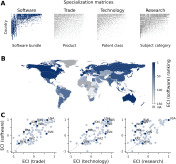
Despite the growing importance of the digital sector, research on economic complexity and its implications continues to rely mostly on administrative records—e.g. data on exports, patents, and employment—that have blind spots when it comes to the digital economy. In this paper we use data on the geography of programming languages used in open-source software to extend economic complexity ideas to the digital economy. We estimate a country’s software economic complexity index (ECIsoftware) and show that it complements the ability of measures of complexity based on trade, patents, and research to account for international differences in GDP per capita, income inequality, and emissions. We also show that open-source software follows the principle of relatedness, meaning that a country’s entries and exits in programming languages are partly explained by its current pattern of specialization. Together, these findings help extend economic complexity ideas and their policy implications to the digital economy.

Read the full article at: www.sciencedirect.com