Category: Papers

Autonomous agents modelling other agents: A comprehensive survey and open problems

Much research in artificial intelligence is concerned with the development of autonomous agents that can interact effectively with other agents. An important aspect of such agents is the ability to reason about the behaviours of other agents, by constructing models which make predictions about various properties of interest (such as actions, goals, beliefs) of the modelled agents. A variety of modelling approaches now exist which vary widely in their methodology and underlying assumptions, catering to the needs of the different sub-communities within which they were developed and reflecting the different practical uses for which they are intended. The purpose of the present article is to provide a comprehensive survey of the salient modelling methods which can be found in the literature. The article concludes with a discussion of open problems which may form the basis for fruitful future research.


Autonomous agents modelling other agents: A comprehensive survey and open problems
Stefano V.Albrecht, PeterStone

Artificial Intelligence
Volume 258, May 2018, Pages 66-95

Source: www.sciencedirect.com
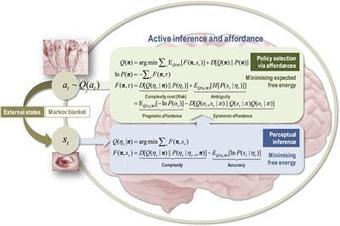
The Active Inference Approach to Ecological Perception: General Information Dynamics for Natural and Artificial Embodied Cognition

The emerging neurocomputational vision of humans as embodied, ecologically embedded, social agents—who shape and are shaped by their environment—offers a golden opportunity to revisit and revise ideas about the physical and information-theoretic underpinnings of life, mind, and consciousness itself. In particular, the active inference framework (AIF) makes it possible to bridge connections from computational neuroscience and robotics/AI to ecological psychology and phenomenology, revealing common underpinnings and overcoming key limitations. AIF opposes the mechanistic to the reductive, while staying fully grounded in a naturalistic and information-theoretic foundation, using the principle of free energy minimization. The latter provides a theoretical basis for a unified treatment of particles, organisms, and interactive machines, spanning from the inorganic to organic, non-life to life, and natural to artificial agents. We provide a brief introduction to AIF, then explore its implications for evolutionary theory, ecological psychology, embodied phenomenology, and robotics/AI research. We conclude the paper by considering implications for machine consciousness.


The Active Inference Approach to Ecological Perception: General Information Dynamics for Natural and Artificial Embodied Cognition
Adam Linson • Andy Clark • Subramanian Ramamoorthy • Karl Friston

Front. Robot. AI, 08 March 2018 | https://doi.org/10.3389/frobt.2018.00021

Source: www.frontiersin.org

The Emergence of Consensus: A Primer

The origin of population-scale coordination has puzzled philosophers and scientists for centuries. Recently, game theory, evolutionary approaches and complex systems science have provided quantitative insights on the mechanisms of social consensus. However, the literature is vast and widely scattered across fields, making it hard for the single researcher to navigate it. This short review aims to provide a compact overview of the main dimensions over which the debate has unfolded and to discuss some representative examples. It focuses on those situations in which consensus emerges ‘spontaneously’ in the absence of centralized institutions and covers topics that include the macroscopic consequences of the different microscopic rules of behavioural contagion, the role of social networks and the mechanisms that prevent the formation of a consensus or alter it after it has emerged. Special attention is devoted to the recent wave of experiments on the emergence of consensus in social systems.


The emergence of consensus: a primer
Andrea Baronchelli

RS Open Science
Published 21 February 2018.DOI: 10.1098/rsos.172189

Source: rsos.royalsocietypublishing.org

Not-so-distant reading: A dynamic network approach to literature

In this article we report about our efforts to develop and evaluate computational support tools for literary studies. We present a novel method and tool that allows interactive visual analytics of character occurrences in Victorian novels, and has been handed to humanities scholars and students for work with a number of novels from different authors. Our user study reveals insights about Victorian novels that are valuable for scholars in the digital humanities field, and informs UI as well as UX designers about how these domain experts interact with tools that leverage network science.


Not-so-distant reading: A dynamic network approach to literature

Markus Luczak-Roesch, Adam Grener, Emma Fenton

it – Information Technology
Published Online: 2018-02-28 | DOI: https://doi.org/10.1515/itit-2017-0023

Source: www.degruyter.com

Science of science

Identifying fundamental drivers of science and developing predictive models to capture its evolution are instrumental for the design of policies that can improve the scientific enterprise—for example, through enhanced career paths for scientists, better performance evaluation for organizations hosting research, discovery of novel effective funding vehicles, and even identification of promising regions along the scientific frontier. The science of science uses large-scale data on the production of science to search for universal and domain-specific patterns. Here, we review recent developments in this transdisciplinary field.

Science of science
Santo Fortunato, Carl T. Bergstrom, Katy Börner, James A. Evans, Dirk Helbing, Staša Milojević, Alexander M. Petersen, Filippo Radicchi, Roberta Sinatra, Brian Uzzi, Alessandro Vespignani, Ludo Waltman, Dashun Wang, Albert-László Barabási
Science 02 Mar 2018:
Vol. 359, Issue 6379, eaao0185
DOI: 10.1126/science.aao0185

Source: science.sciencemag.org