
Category: Papers

Horizontal transfer of code fragments between protocells can explain the origins of the genetic code without vertical descent

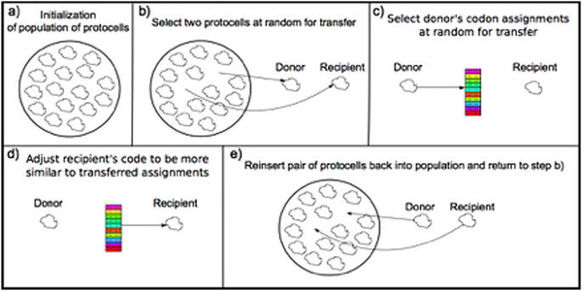
Theories of the origin of the genetic code typically appeal to natural selection and/or mutation of hereditable traits to explain its regularities and error robustness, yet the present translation system presupposes high-fidelity replication. Woese’s solution to this bootstrapping problem was to assume that code optimization had played a key role in reducing the effect of errors caused by the early translation system. He further conjectured that initially evolution was dominated by horizontal exchange of cellular components among loosely organized protocells (“progenotes”), rather than by vertical transmission of genes. Here we simulated such communal evolution based on horizontal transfer of code fragments, possibly involving pairs of tRNAs and their cognate aminoacyl tRNA synthetases or a precursor tRNA ribozyme capable of catalysing its own aminoacylation, by using an iterated learning model. This is the first model to confirm Woese’s conjecture that regularity, optimality, and (near) universality could have emerged via horizontal interactions alone.


Horizontal transfer of code fragments between protocells can explain the origins of the genetic code without vertical descent
Tom Froese, Jorge I. Campos, Kosuke Fujishima, Daisuke Kiga & Nathaniel Virgo
Scientific Reportsvolume 8, Article number: 3532 (2018)
doi:10.1038/s41598-018-21973-y

Source: www.nature.com
Convergence of marine megafauna movement patterns in coastal and open oceans

Understanding the key drivers of animal movement is crucial to assist in mitigating adverse impacts of anthropogenic activities on marine megafauna. We found that movement patterns of marine megafauna are mostly independent of their evolutionary histories, differing significantly from patterns for terrestrial animals. We detected a remarkable convergence in the distribution of speed and turning angles across organisms ranging from whales to turtles (epitome for the slowest animals on land but not at sea). Marine megafauna show a prevalence of movement patterns dominated by search behavior in coastal habitats compared with more directed, ballistic movement patterns when the animals move across the open ocean. The habitats through which they move will therefore need to be considered for effective conservation.


Convergence of marine megafauna movement patterns in coastal and open oceans

A. M. M. Sequeira, et al.

PNAS

Source: www.pnas.org

Why Self-Taught Artificial Intelligence Has Trouble With the Real World

Until very recently, the machines that could trounce champions were at least respectful enough to start by learning from human experience.

To beat Garry Kasparov at chess in 1997, IBM engineers made use of centuries of chess wisdom in their Deep Blue computer. In 2016, Google DeepMind’s AlphaGo thrashed champion Lee Sedol at the ancient board game Go after poring over millions of positions from tens of thousands of human games.

But now artificial intelligence researchers are rethinking the way their bots incorporate the totality of human knowledge. The current trend is: Don’t bother.

Source: www.quantamagazine.org

Artificial intelligence faces reproducibility crisis

The booming field of artificial intelligence (AI) is grappling with a replication crisis, much like the ones that have afflicted psychology, medicine, and other fields over the past decade. Just because algorithms are based on code doesn’t mean experiments are easily replicated. Far from it. Unpublished codes and a sensitivity to training conditions have made it difficult for AI researchers to reproduce many key results. That is leading to a new conscientiousness about research methods and publication protocols. Last week, at a meeting of the Association for the Advancement of Artificial Intelligence in New Orleans, Louisiana, reproducibility was on the agenda, with some teams diagnosing the problem—and one laying out tools to mitigate it.


Artificial intelligence faces reproducibility crisis
Matthew Hutson

Science  16 Feb 2018:
Vol. 359, Issue 6377, pp. 725-726
DOI: 10.1126/science.359.6377.725

Source: science.sciencemag.org

A Two Teraflop Swarm

We introduce the Xpuck swarm, a research platform with an aggregate raw processing power in excess of two teraflops. The swarm uses 16 e-puck robots augmented with custom hardware that uses the substantial CPU and GPU processing power available from modern mobile system-on-chip devices. The augmented robots, called Xpucks, have at least an order of magnitude greater performance than previous swarm robotics platforms. The platform enables new experiments that require high individual robot computation and multiple robots. Uses include online evolution or learning of swarm controllers, simulation for answering what-if questions about possible actions, distributed super-computing for mobile platforms, and real-world applications of swarm robotics that requires image processing, or SLAM. The teraflop swarm could also be used to explore swarming in nature by providing platforms with similar computational power as simple insects. We demonstrate the computational capability of the swarm by implementing a fast physics-based robot simulator and using this within a distributed island model evolutionary system, all hosted on the Xpucks.


A Two Teraflop Swarm
Simon Jones, Matthew Studley, Sabine Hauert, and Alan Winfield

Front. Robot. AI, 19 February 2018 | https://doi.org/10.3389/frobt.2018.00011

Source: www.frontiersin.org