Category: Papers

How often does the best team win? A unified approach to understanding randomness in North American sport

Statistical applications in sports have long centered on how to best separate signal (e.g. team talent) from random noise. However, most of this work has concentrated on a single sport, and the development of meaningful cross-sport comparisons has been impeded by the difficulty of translating luck from one sport to another. In this manuscript, we develop Bayesian state-space models using betting market data that can be uniformly applied across sporting organizations to better understand the role of randomness in game outcomes. These models can be used to extract estimates of team strength, the between-season, within-season, and game-to-game variability of team strengths, as well each team’s home advantage. We implement our approach across a decade of play in each of the National Football League (NFL), National Hockey League (NHL), National Basketball Association (NBA), and Major League Baseball (MLB), finding that the NBA demonstrates both the largest dispersion in talent and the largest home advantage, while the NHL and MLB stand out for their relative randomness in game outcomes. We conclude by proposing new metrics for judging competitiveness across sports leagues, both within the regular season and using traditional postseason tournament formats. Although we focus on sports, we discuss a number of other situations in which our generalizable models might be usefully applied.


How often does the best team win? A unified approach to understanding randomness in North American sport
Michael J. Lopez, Gregory J. Matthews, Benjamin S. Baumer

Source: arxiv.org
Intermediate Levels of Network Heterogeneity Provide the Best Evolutionary Outcomes

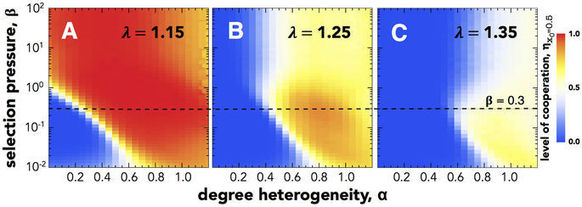
Complex networks impact the diffusion of ideas and innovations, the formation of opinions, and the evolution of cooperative behavior. In this context, heterogeneous structures have been shown to generate a coordination-like dynamics that drives a population towards a monomorphic state. In contrast, homogeneous networks tend to result in a stable co-existence of multiple traits in the population. These conclusions have been reached through the analysis of networks with either very high or very low levels of degree heterogeneity. In this paper, we use methods from Evolutionary Game Theory to explore how different levels of degree heterogeneity impact the fate of cooperation in structured populations whose individuals face the Prisoner’s Dilemma. Our results suggest that in large networks a minimum level of heterogeneity is necessary for a society to become evolutionary viable. Moreover, there is an optimal range of heterogeneity levels that maximize the resilience of the society facing an increasing number of social dilemmas. Finally, as the level of degree heterogeneity increases, the evolutionary dominance of either cooperators or defectors in a society increasingly depends on the initial state of a few influential individuals. Our findings imply that neither very unequal nor very equal societies offer the best evolutionary outcome.


Intermediate Levels of Network Heterogeneity Provide the Best Evolutionary Outcomes
Flávio L. Pinheiro & Dominik Hartmann
Scientific Reports volume 7, Article number: 15242 (2017)
doi:10.1038/s41598-017-15555-7

Source: www.nature.com

Metric clusters in evolutionary games on scale-free networks

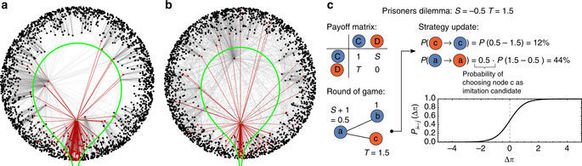
The evolution of cooperation in social dilemmas in structured populations has been studied extensively in recent years. Whereas many theoretical studies have found that a heterogeneous network of contacts favors cooperation, the impact of spatial effects in scale-free networks is still not well understood. In addition to being heterogeneous, real contact networks exhibit a high mean local clustering coefficient, which implies the existence of an underlying metric space. Here we show that evolutionary dynamics in scale-free networks self-organize into spatial patterns in the underlying metric space. The resulting metric clusters of cooperators are able to survive in social dilemmas as their spatial organization shields them from surrounding defectors, similar to spatial selection in Euclidean space. We show that under certain conditions these metric clusters are more efficient than the most connected nodes at sustaining cooperation and that heterogeneity does not always favor—but can even hinder—cooperation in social dilemmas.


Metric clusters in evolutionary games on scale-free networks
Kaj-Kolja Kleineberg
Nature Communications

volume 8, Article number: 1888 (2017)
doi:10.1038/s41467-017-02078-y

Source: www.nature.com

Individual ant workers show self-control

Often, the first option is not the best. Self-control can allow humans and animals to improve resource intake under such conditions. Self-control in animals is often investigated using intertemporal choice tasks—choosing a smaller reward immediately or a larger reward after a delay. However, intertemporal choice tasks may underestimate self-control, as test subjects may not fully understand the task. Vertebrates show much greater apparent self-control in more natural foraging contexts and spatial discounting tasks than in intertemporal choice tasks. However, little is still known about self-control in invertebrates. Here, we investigate self-control in the black garden ant Lasius niger. We confront individual workers with a spatial discounting task, offering a high-quality reward far from the nest and a poor-quality reward closer to the nest. Most ants (69%) successfully ignored the closer, poorer reward in favour of the further, better one. However, when both the far and the close rewards were of the same quality, most ants (83%) chose the closer feeder, indicating that the ants were indeed exercising self-control, as opposed to a fixation on an already known food source.


Individual ant workers show self-control
Stephanie Wendt, Tomer J. Czaczkes

Biology Letters

October 2017
Volume 13, issue 10

Source: rsbl.royalsocietypublishing.org

Morphology of travel routes and the organization of cities

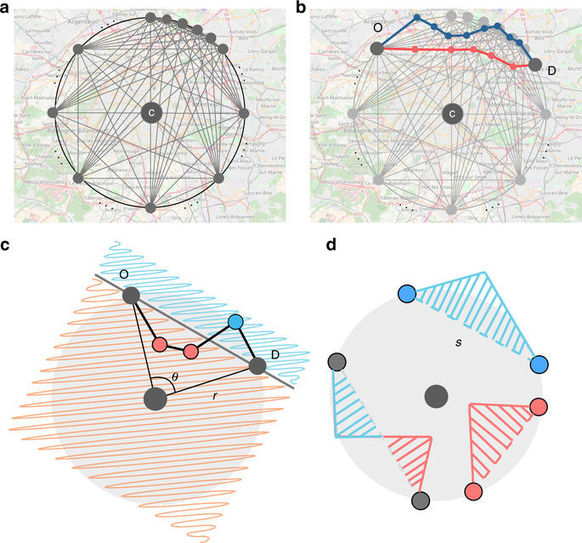
The city is a complex system that evolves through its inherent social and economic interactions. Mediating the movements of people and resources, urban street networks offer a spatial footprint of these activities. Of particular interest is the interplay between street structure and its functional usage. Here, we study the shape of 472,040 spatiotemporally optimized travel routes in the 92 most populated cities in the world, finding that their collective morphology exhibits a directional bias influenced by the attractive (or repulsive) forces resulting from congestion, accessibility, and travel demand. To capture this, we develop a simple geometric measure, inness, that maps this force field. In particular, cities with common inness patterns cluster together in groups that are correlated with their putative stage of urban development as measured by a series of socio-economic and infrastructural indicators, suggesting a strong connection between urban development, increasing physical connectivity, and diversity of road hierarchies.


Morphology of travel routes and the organization of cities
Minjin Lee, Hugo Barbosa, Hyejin Youn, Petter Holme & Gourab Ghoshal
Nature Communications volume 8, Article number: 2229 (2017)
doi:10.1038/s41467-017-02374-7

Source: www.nature.com