Category: Papers

To the Elites of the World

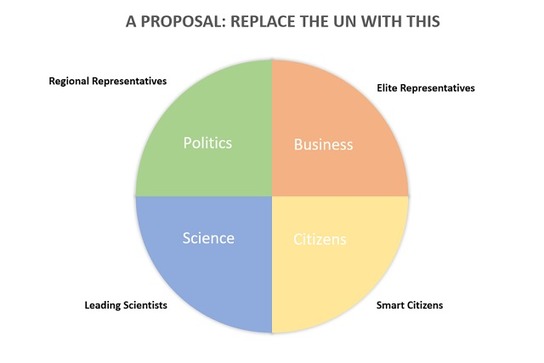
Faced with climate change, financial, economic and spending crisis, mass migration, terrorism, wars and cyber threats, it appears we are very close to global emergency. Given this state of affairs, we are running out of time to fix the problems of our planet. Here, we present what should be decided during the UN General Assembly on September 23 2017 and a reflexive preamble.

Source: futurict.blogspot.mx

When the Map Is Better Than the Territory

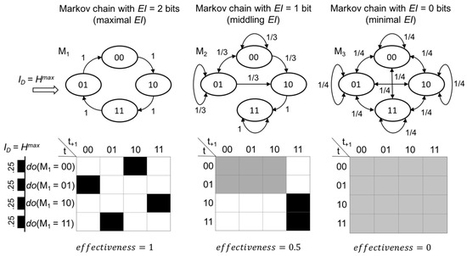
The causal structure of any system can be analyzed at a multitude of spatial and temporal scales. It has long been thought that while higher scale (macro) descriptions may be useful to observers, they are at best a compressed description and at worse leave out critical information and causal relationships. However, recent research applying information theory to causal analysis has shown that the causal structure of some systems can actually come into focus and be more informative at a macroscale. That is, a macroscale description of a system (a map) can be more informative than a fully detailed microscale description of the system (the territory). This has been called “causal emergence.” While causal emergence may at first seem counterintuitive, this paper grounds the phenomenon in a classic concept from information theory: Shannon’s discovery of the channel capacity. I argue that systems have a particular causal capacity, and that different descriptions of those systems take advantage of that capacity to various degrees. For some systems, only macroscale descriptions use the full causal capacity. These macroscales can either be coarse-grains, or may leave variables and states out of the model (exogenous, or “black boxed”) in various ways, which can improve the efficacy and informativeness via the same mathematical principles of how error-correcting codes take advantage of an information channel’s capacity. The causal capacity of a system can approach the channel capacity as more and different kinds of macroscales are considered. Ultimately, this provides a general framework for understanding how the causal structure of some systems cannot be fully captured by even the most detailed microscale description


When the Map Is Better Than the Territory
Erik P. Hoel

Entropy 2017, 19(5), 188; doi:10.3390/e19050188

Source: www.mdpi.com

Large-scale physical activity data reveal worldwide activity inequality

To be able to curb the global pandemic of physical inactivity and the associated 5.3 million deaths per year, we need to understand the basic principles that govern physical activity. However, there is a lack of large-scale measurements of physical activity patterns across free-living populations worldwide. Here we leverage the wide usage of smartphones with built-in accelerometry to measure physical activity at the global scale. We study a dataset consisting of 68 million days of physical activity for 717,527 people, giving us a window into activity in 111 countries across the globe. We find inequality in how activity is distributed within countries and that this inequality is a better predictor of obesity prevalence in the population than average activity volume. Reduced activity in females contributes to a large portion of the observed activity inequality. Aspects of the built environment, such as the walkability of a city, are associated with a smaller gender gap in activity and lower activity inequality. In more walkable cities, activity is greater throughout the day and throughout the week, across age, gender, and body mass index (BMI) groups, with the greatest increases in activity found for females. Our findings have implications for global public health policy and urban planning and highlight the role of activity inequality and the built environment in improving physical activity and health

 
Large-scale physical activity data reveal worldwide activity inequality
Tim Althoff, Rok Sosič, Jennifer L. Hicks, Abby C. King, Scott L. Delp & Jure Leskovec
Nature 547, 336–339 (20 July 2017) doi:10.1038/nature23018

Source: www.nature.com

Contagious disruptions and complexity traps in economic development

Poor economies not only produce less; they typically produce things that involve fewer inputs and fewer intermediate steps. Yet the supply chains of poor countries face more frequent disruptions—delivery failures, faulty parts, delays, power outages, theft, government failures—that systematically thwart the production process. To understand how these disruptions affect economic development, we model an evolving input–output network in which disruptions spread contagiously among optimizing agents. The key finding is that a poverty trap can emerge: agents adapt to frequent disruptions by producing simpler, less valuable goods, yet disruptions persist. Growing out of poverty requires that agents invest in buffers to disruptions. These buffers rise and then fall as the economy produces more complex goods, a prediction consistent with global patterns of input inventories. Large jumps in economic complexity can backfire. This result suggests why “big push” policies can fail, and it underscores the importance of reliability and of gradual increases in technological complexity.


Contagious disruptions and complexity traps in economic development
Charles D. Brummitt, Kenan Huremovic, Paolo Pin, Matthew H. Bonds, Fernando Vega-Redondo

Source: arxiv.org

A general scaling law reveals why the largest animals are not the fastest

Speed is the fundamental constraint on animal movement, yet there is no general consensus on the determinants of maximum speed itself. Here, we provide a general scaling model of maximum speed with body mass, which holds across locomotion modes, ecosystem types and taxonomic groups. In contrast to traditional power-law scaling, we predict a hump-shaped relationship resulting from a finite acceleration time for animals, which explains why the largest animals are not the fastest. This model is strongly supported by extensive empirical data (474 species, with body masses ranging from 30 μg to 100 tonnes) from terrestrial as well as aquatic ecosystems. Our approach unravels a fundamental constraint on the upper limit of animal movement, thus enabling a better understanding of realized movement patterns in nature and their multifold ecological consequences.


A general scaling law reveals why the largest animals are not the fastest
Myriam R. Hirt, Walter Jetz, Björn C. Rall & Ulrich Brose
Nature Ecology & Evolution 1, 1116–1122 (2017)
doi:10.1038/s41559-017-0241-4

Source: www.nature.com