
Category: Papers

Model of the best-of-$N$ nest-site selection process in honeybees

Bees are smart, anybody knows that, but swarms are smarter. They have the ability to choose the best dwelling place among a set of potential nest sites with different qualities. Signalling serves the bees to convince their mates to choose the same site they have visited, and to prevent that other bees recruit to different sites. Our latest study proposes that the frequency of signalling is a key parameter: on the one hand, scarce signalling among bees hampers the attainment of consensus within the swarm; on the other hand, too frequent signalling reduces decision accuracy by quickly committing to early-discovered inferior quality options. The optimal signalling frequency lies in the middle. We suggest that the ability of bees to fine-tune their communication frequencies helps them to master their house-hunting task. Hence, this study hypothesises how ecological factors determining the density of suitable nest sites may have led to selective pressures for the evolution of an optimal stable signalling frequency. It also indicates a possible signalling strategy of honeybees: starting with few signals and gradually increasing the signalling frequency through time, until convergence is reached. In addition, our results may lead to the implementation of better algorithms for distributed decision making, to be employed in sensor networks or robot swarms.


A. Reina, J.A.R. Marshall, V. Trianni, T. Bose. Model of the best-of-N nest-site selection process in honeybees. Physical Review E, 95(5): 052411, 2017.
URL: http://link.aps.org/doi/10.1103/PhysRevE.95.052411

Source: journals.aps.org
Global Reset: Upgrading Society in the Digital Age

The America-dominated era had industrialized the world, and created previously unseen levels of luxury. It also created a financial industry to make it happen, and a digital infrastructure to watch and control the world. Yet, it has failed to solve the existential challenges of our planet: climate change, environmental destruction, resource depletion. This lack of sustainability is causing wars, mass migration, and a future heading for disaster. A new approach – one that brings people and nature in balance – is urgently needed.

Source: futurict.blogspot.mx

Biodiversity @Nature

The tremendous diversity of life on Earth — a result of more than three billion years of evolutionary history — is facing an uncertain future. This Insight looks at how this biodiversity came to be, how it supports the goods and ecosystem services on which we depend and how it is being put to the test by the rapidly expanding human population. Crucially, strategies to safeguard this diversity are explored.

Source: www.nature.com

Looplessness in networks is linked to trophic coherence

Complex systems such as cells, brains, or ecosystems are made up of many interconnected elements, each one acting on its neighbors, and sometimes influencing its own state via feedback loops. Certain biological networks have surprisingly few such loops. Although this may be advantageous in various ways, it is not known how feedback is suppressed. We show that trophic coherence, a structural property of ecosystems, is key to the extent of feedback in these as well as in many other systems, including networks related to genes, neurons, metabolites, words, computers, and trading nations. We derive mathematical expressions that provide a benchmark against which to examine empirical data, and conclude that “looplessness” in nature is probably a consequence of trophic coherenc

Source: www.pnas.org

Fair Topologies: Community Structures and Network Hubs Drive Emergence of Fairness Norms

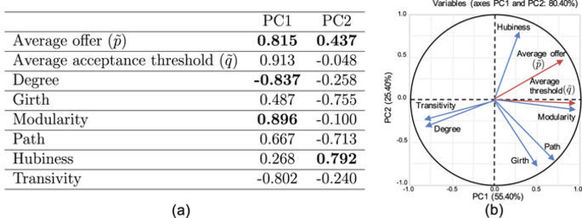
Fairness has long been argued to govern human behavior in a wide range of social, economic, and organizational activities. The sense of fairness, although universal, varies across different societies. In this study, using a computational model, we test the hypothesis that the topology of social interaction can causally explain some of the cross-societal variations in fairness norms. We show that two network parameters, namely, community structure, as measured by the modularity index, and network hubiness, represented by the skewness of degree distribution, have the most significant impact on emergence of collective fair behavior. These two parameters can explain much of the variations in fairness norms across societies and can also be linked to hypotheses suggested by earlier empirical studies in social and organizational sciences. We devised a multi-layered model that combines local agent interactions with social learning, thus enables both strategic behavior as well as diffusion of successful strategies. By applying multivariate statistics on the results, we obtain the relation between network structural features and the collective fair behavior.


Fair Topologies: Community Structures and Network Hubs Drive Emergence of Fairness Norms

Mohsen Mosleh, Babak Heydari

Source: www.nature.com