Category: Papers

Serendipity and strategy in rapid innovation

Innovation is to organizations what evolution is to organisms: it is how organisations adapt to changes in the environment and improve. Governments, institutions and firms that innovate are more likely to prosper and stand the test of time; those that fail to do so fall behind their competitors and succumb to market and environmental change. Yet despite steady advances in our understanding of evolution, what drives innovation remains elusive. On the one hand, organizations invest heavily in systematic strategies to drive innovation. On the other, historical analysis and individual experience suggest that serendipity plays a significant role in the discovery process. To unify these two perspectives, we analyzed the mathematics of innovation as a search process for viable designs across a universe of building blocks. We then tested our insights using historical data from language, gastronomy and technology. By measuring the number of makeable designs as we acquire more components, we observed that the relative usefulness of different components is not fixed, but cross each other over time. When these crossovers are unanticipated, they appear to be the result of serendipity. But when we can predict crossovers ahead of time, they offer an opportunity to strategically increase the growth of our product space. Thus we find that the serendipitous and strategic visions of innovation can be viewed as different manifestations of the same thing: the changing importance of component building blocks over time.

Source: arxiv.org

Groundwater depletion embedded in international food trade 

Recent hydrological modelling1 and Earth observations2, 3 have located and quantified alarming rates of groundwater depletion worldwide. This depletion is primarily due to water withdrawals for irrigation1, 2, 4, but its connection with the main driver of irrigation, global food consumption, has not yet been explored. Here we show that approximately eleven per cent of non-renewable groundwater use for irrigation is embedded in international food trade, of which two-thirds are exported by Pakistan, the USA and India alone. Our quantification of groundwater depletion embedded in the world’s food trade is based on a combination of global, crop-specific estimates of non-renewable groundwater abstraction and international food trade data. A vast majority of the world’s population lives in countries sourcing nearly all their staple crop imports from partners who deplete groundwater to produce these crops, highlighting risks for global food and water security. Some countries, such as the USA, Mexico, Iran and China, are particularly exposed to these risks because they both produce and import food irrigated from rapidly depleting aquifers. Our results could help to improve the sustainability of global food production and groundwater resource management by identifying priority regions and agricultural products at risk as well as the end consumers of these products.

Source: www.nature.com

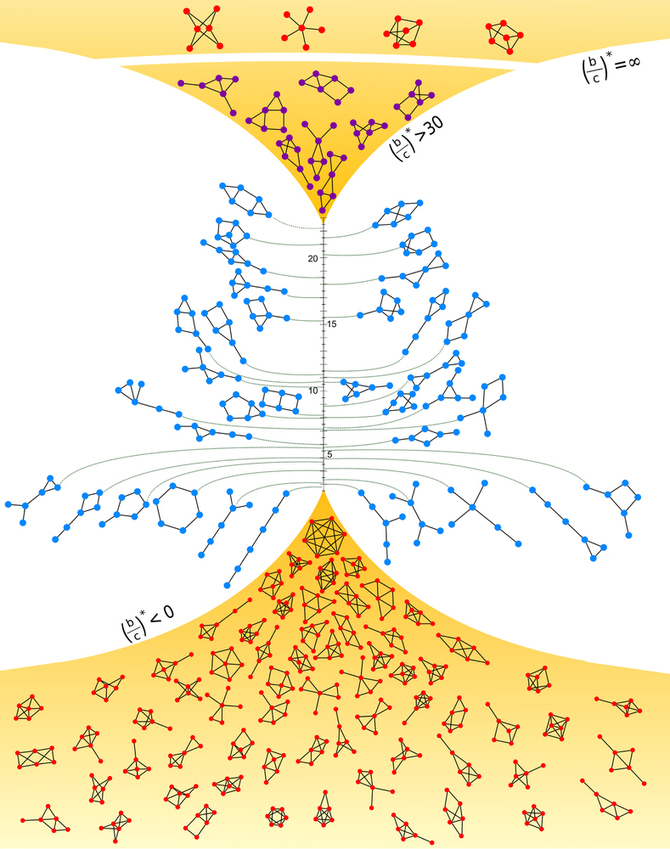
Evolutionary dynamics on any population structure

Evolution occurs in populations of reproducing individuals. The structure of a population can affect which traits evolve. Understanding evolutionary game dynamics in structured populations remains difficult. Mathematical results are known for special structures in which all individuals have the same number of neighbours. The general case, in which the number of neighbours can vary, has remained open. For arbitrary selection intensity, the problem is in a computational complexity class that suggests there is no efficient algorithm. Whether a simple solution for weak selection exists has remained unanswered. Here we provide a solution for weak selection that applies to any graph or network. Our method relies on calculating the coalescence times of random walks. We evaluate large numbers of diverse population structures for their propensity to favour cooperation. We study how small changes in population structure—graph surgery—affect evolutionary outcomes. We find that cooperation flourishes most in societies that are based on strong pairwise ties.


Evolutionary dynamics on any population structure

Benjamin Allen, Gabor Lippner, Yu-Ting Chen, Babak Fotouhi, Naghmeh Momeni, Shing-Tung Yau & Martin A. Nowak

Nature (2017) doi:10.1038/nature21723

Source: www.nature.com

Disease Localization in Multilayer Networks

We present a continuous formulation of epidemic spreading on multilayer networks using a tensorial representation, extending the models of monoplex networks to this context. We derive analytical expressions for the epidemic threshold of the susceptible-infected-susceptible (SIS) and susceptible-infected-recovered dynamics, as well as upper and lower bounds for the disease prevalence in the steady state for the SIS scenario. Using the quasistationary state method, we numerically show the existence of disease localization and the emergence of two or more susceptibility peaks, which are characterized analytically and numerically through the inverse participation ratio. At variance with what is observed in single-layer networks, we show that disease localization takes place on the layers and not on the nodes of a given layer. Furthermore, when mapping the critical dynamics to an eigenvalue problem, we observe a characteristic transition in the eigenvalue spectra of the supra-contact tensor as a function of the ratio of two spreading rates: If the rate at which the disease spreads within a layer is comparable to the spreading rate across layers, the individual spectra of each layer merge with the coupling between layers. Finally, we report on an interesting phenomenon, the barrier effect; i.e., for a three-layer configuration, when the layer with the lowest eigenvalue is located at the center of the line, it can effectively act as a barrier to the disease. The formalism introduced here provides a unifying mathematical approach to disease contagion in multiplex systems, opening new possibilities for the study of spreading processes.


Disease Localization in Multilayer Networks
Guilherme Ferraz de Arruda, Emanuele Cozzo, Tiago P. Peixoto, Francisco A. Rodrigues, and Yamir Moreno
Phys. Rev. X 7, 011014

Source: journals.aps.org

Redundant Interdependencies Boost the Robustness of Multiplex Networks

In the analysis of the robustness of multiplex networks, it is commonly assumed that a node is functioning only if its interdependent nodes are simultaneously functioning. According to this model, a multiplex network becomes more and more fragile as the number of layers increases. In this respect, the addition of a new layer of interdependent nodes to a preexisting multiplex network will never improve its robustness. Whereas such a model seems appropriate to understand the effect of interdependencies in the simplest scenario of a network composed of only two layers, it may seem unsuitable to characterize the robustness of real systems formed by multiple network layers. In fact, it seems unrealistic that a real system evolved, through the development of multiple layers of interactions, towards a fragile structure. In this paper, we introduce a model of percolation where the condition that makes a node functional is that the node is functioning in at least two of the layers of the network. The model reduces to the commonly adopted percolation model for multiplex networks when the number of layers equals two. For larger numbers of layers, however, the model describes a scenario where the addition of new layers boosts the robustness of the system by creating redundant interdependencies among layers. We prove this fact thanks to the development of a message-passing theory that is able to characterize the model in both synthetic and real-world multiplex graphs.


Redundant Interdependencies Boost the Robustness of Multiplex Networks
Filippo Radicchi and Ginestra Bianconi
Phys. Rev. X 7, 011013

Source: journals.aps.org