Category: Papers

Social status alters immune regulation and response to infection in macaques

Rhesus macaques experience variable levels of stress on the basis of their position in the social hierarchy. To examine how stress affects immune function, Snyder-Mackler et al. manipulated the social status of individual macaques (see the Perspective by Sapolsky). Social status influenced the immune system at multiple levels, from immune cell numbers to gene expression, and altered signaling pathways in a model of response to infection. Macaques possess a plastic and adaptive immune response wherein social subordination promotes antibacterial responses, whereas high social status promotes antiviral responses.

Source: science.sciencemag.org

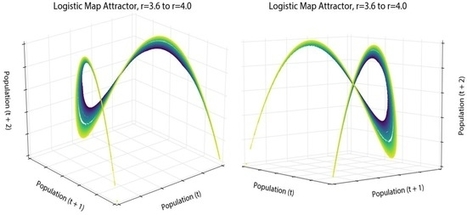
Visual Analysis of Nonlinear Dynamical Systems: Chaos, Fractals, Self-Similarity and the Limits of Prediction

Nearly all nontrivial real-world systems are nonlinear dynamical systems. Chaos describes certain nonlinear dynamical systems that have a very sensitive dependence on initial conditions. Chaotic systems are always deterministic and may be very simple, yet they produce completely unpredictable and divergent behavior. Systems of nonlinear equations are difficult to solve analytically, and scientists have relied heavily on visual and qualitative approaches to discover and analyze the dynamics of nonlinearity. Indeed, few fields have drawn as heavily from visualization methods for their seminal innovations: from strange attractors, to bifurcation diagrams, to cobweb plots, to phase diagrams and embedding. Although the social sciences are increasingly studying these types of systems, seminal concepts remain murky or loosely adopted. This article has three aims. First, it argues for several visualization methods to critically analyze and understand the behavior of nonlinear dynamical systems. Second, it uses these visualizations to introduce the foundations of nonlinear dynamics, chaos, fractals, self-similarity and the limits of prediction. Finally, it presents Pynamical, an open-source Python package to easily visualize and explore nonlinear dynamical systems’ behavior.


Visual Analysis of Nonlinear Dynamical Systems: Chaos, Fractals, Self-Similarity and the Limits of Prediction
Geoff Boeing

Systems 2016, 4(4), 37; doi:10.3390/systems4040037

Source: www.mdpi.com

An Economic Geography of the United States: From Commutes to Megaregions

The emergence in the United States of large-scale “megaregions” centered on major metropolitan areas is a phenomenon often taken for granted in both scholarly studies and popular accounts of contemporary economic geography. This paper uses a data set of more than 4,000,000 commuter flows as the basis for an empirical approach to the identification of such megaregions. We compare a method which uses a visual heuristic for understanding areal aggregation to a method which uses a computational partitioning algorithm, and we reflect upon the strengths and limitations of both. We discuss how choices about input parameters and scale of analysis can lead to different results, and stress the importance of comparing computational results with “common sense” interpretations of geographic coherence. The results provide a new perspective on the functional economic geography of the United States from a megaregion perspective, and shed light on the old geographic problem of the division of space into areal units.


Dash Nelson G, Rae A (2016) An Economic Geography of the United States: From Commutes to Megaregions. PLoS ONE 11(11): e0166083. doi:10.1371/journal.pone.0166083

Source: journals.plos.org

X-Rule’s Precursor is also Logically Universal

We re-examine the isotropic Precursor-Rule (of the anisotropic X-Rule) and show that it is also logically universal. The Precursor-Rule was selected from a sample of biased cellular automata rules classified by input-entropy. These biases followed most “Life-Like” constraints — in particular isotropy, but not simple birth/survival logic. The Precursor-Rule was chosen for its spontaneously emergent mobile and stable patterns, gliders and eaters/reflectors, but glider-guns, originally absent, have recently been discovered, as well as other complex structures from the Game-of-Life lexicon. We demonstrate these newly discovered structures, and build the logical gates required for universality in the logical sense.


X-Rule’s Precursor is also Logically Universal
José Manuel Gómez Soto, Andrew Wuensche

Source: arxiv.org

Generic temporal features of performance rankings in sports and games

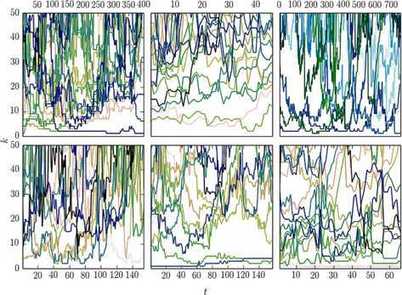
Many complex phenomena, from trait selection in biological systems to hierarchy formation in social and economic entities, show signs of competition and heterogeneous performance in the temporal evolution of their components, which may eventually lead to stratified structures such as the worldwide wealth distribution. However, it is still unclear whether the road to hierarchical complexity is determined by the particularities of each phenomena, or if there are generic mechanisms of stratification common to many systems. Human sports and games, with their (varied but simple) rules of competition and measures of performance, serve as an ideal test-bed to look for universal features of hierarchy formation. With this goal in mind, we analyse here the behaviour of performance rankings over time of players and teams for several sports and games, and find statistical regularities in the dynamics of ranks. Specifically the rank diversity, a measure of the number of elements occupying a given rank over a length of time, has the same functional form in sports and games as in languages, another system where competition is determined by the use or disuse of grammatical structures. We use a Gaussian random walk model to reproduce the rank diversity of the studied sports and games. We also discuss the relation between rank diversity and the cumulative rank distribution. Our results support the notion that hierarchical phenomena may be driven by the same underlying mechanisms of rank formation, regardless of the nature of their components. Moreover, such regularities can in principle be used to predict lifetimes of rank occupancy, thus increasing our ability to forecast stratification in the presence of competition.


Generic temporal features of performance rankings in sports and games

José A Morales, Sergio Sánchez, Jorge Flores, Carlos Pineda, Carlos Gershenson, Germinal Cocho, Jerónimo Zizumbo, Rosalío F Rodríguez, Gerardo Iñiguez

EPJ Data Sci. (2016) 5: 33. doi:10.1140/epjds/s13688-016-0096-y

Source: link.springer.com