Category: Papers

Control principles of complex systems

A reflection of our ultimate understanding of a complex system is our ability to control its behavior. Typically, control has multiple prerequisites: it requires an accurate map of the network that governs the interactions between the system’s components, a quantitative description of the dynamical laws that govern the temporal behavior of each component, and an ability to influence the state and temporal behavior of a selected subset of the components. With deep roots in dynamical systems and control theory, notions of control and controllability have taken a new life recently in the study of complex networks, inspiring several fundamental questions: What are the control principles of complex systems? How do networks organize themselves to balance control with functionality? To address these questions here recent advances on the controllability and the control of complex networks are reviewed, exploring the intricate interplay between the network topology and dynamical laws. The pertinent mathematical results are matched with empirical findings and applications. Uncovering the control principles of complex systems can help us explore and ultimately understand the fundamental laws that govern their behavior.


Control principles of complex systems
Yang-Yu Liu and Albert-László Barabási
Rev. Mod. Phys. 88, 035006

Source: journals.aps.org

Stochastic dynamics and the predictability of big hits in online videos

The competition for the attention of users is a central element of the Internet. Crucial issues are the origin and predictability of big hits, the few items that capture a big portion of the total attention. We address these issues analyzing 10 million time series of videos’ views from YouTube. We find that the average gain of views is linearly proportional to the number of views a video already has, in agreement with usual rich-get-richer mechanisms and Gibrat’s law, but this fails to explain the prevalence of big hits. The reason is that the fluctuations around the average views are themselves heavy tailed. Based on these empirical observations, we propose a stochastic differential equation with Le\’evy noise as a model of the dynamics of videos. We show how this model is substantially better in estimating the probability of an ordinary item becoming a big hit, which is considerably underestimated in the traditional proportional-growth models.


Stochastic dynamics and the predictability of big hits in online videos
Jose M. Miotto, Hogler Kantz, Eduardo G. Altmann

Source: arxiv.org

Azteca chess: Gamifying a complex ecological process of autonomous pest control in shade coffee

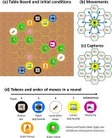
Science-based board games can help people grasp the ecological complexity of autonomous pest control (APC) in the shade-coffee agroecosystem. Azteca Chess is a board-game that captures in a stylized way the fascinating natural history and the dynamics of a complex network of direct, indirect and cascading trait-mediated interactions among five species of arthropods dwelling in shade coffee bushes (a coffee-scale, an ant, an adult and larval lady beetle, a parasitoid wasp and a parasitoid fly). In exchange for honey-dew, the Azteca ant protects scale-insects that help control the devastating coffee-rust disease. The ant repels the adult ladybeetle but inadvertently protects its larvae, which devour scales to local extinction. The head-hunting fly paralyzes Azteca and opens a window of opportunity for the adult beetle to oviposit under scales, but also for a parasitoid wasp to kill the beetle larvae. Interactions can cascade or not towards APC. Experimental test-driving shows Azteca Chess meets good modeling and game-design standards and is proved statistically to enhance understanding and application of relevant complex ecological processes.


Azteca chess: Gamifying a complex ecological process of autonomous pest control in shade coffee
Luis García-Barriosa, Ivette Perfecto, John Vandermeer

Agriculture, Ecosystems & Environment
Volume 232, 16 September 2016, Pages 190–198

Source: www.sciencedirect.com

Invasive predators and global biodiversity loss

Invasive mammalian predators are arguably the most damaging group of alien animal species for global biodiversity. Thirty species of invasive predator are implicated in the extinction or endangerment of 738 vertebrate species—collectively contributing to 58% of all bird, mammal, and reptile extinctions. Cats, rodents, dogs, and pigs have the most pervasive impacts, and endemic island faunas are most vulnerable to invasive predators. That most impacted species are insular indicates that management of invasive predators on islands should be a global conservation priority. Understanding and mitigating the impact of invasive mammalian predators is essential for reducing the rate of global biodiversity loss.

Source: www.pnas.org