
Category: Papers

Not All Fluctuations are Created Equal: Spontaneous Variations in Thermodynamic Function

Almost all processes — highly correlated, weakly correlated, or correlated not at all—exhibit statistical fluctuations. Often physical laws, such as the Second Law of Thermodynamics, address only typical realizations — as highlighted by Shannon’s asymptotic equipartition property and as entailed by taking the thermodynamic limit of an infinite number of degrees of freedom. Indeed, our interpretations of the functioning of macroscopic thermodynamic cycles are so focused. Using a recently derived Second Law for information processing, we show that different subsets of fluctuations lead to distinct thermodynamic functioning in Maxwellian Demons. For example, while typical realizations may operate as an engine — converting thermal fluctuations to useful work — even “nearby” fluctuations (nontypical, but probable realizations) behave differently, as Landauer erasers — converting available stored energy to dissipate stored information. One concludes that ascribing a single, unique functional modality to a thermodynamic system, especially one on the nanoscale, is at best misleading, likely masking an array of simultaneous, parallel thermodynamic transformations. This alters how we conceive of cellular processes, engineering design, and evolutionary adaptation.


Not All Fluctuations are Created Equal: Spontaneous Variations in Thermodynamic Function
James P. Crutchfield, Cina Aghamohammadi

Source: arxiv.org
Spectral entropies as information-theoretic tools for complex network comparison

Any physical system can be viewed from the perspective that information is implicitly represented in its state. However, the quantification of this information when it comes to complex networks has remained largely elusive. In this work, we use techniques inspired by quantum statistical mechanics to define an entropy measure for complex networks and to develop a set of information-theoretic tools, based on network spectral properties, such as Renyi q-entropy, generalized Kullback-Leibler and Jensen-Shannon divergences, the latter allowing us to define a natural distance measure between complex networks. First we show that by minimizing the Kullback-Leibler divergence between an observed network and a parametric network model, inference of model parameter(s) by means of maximum-likelihood estimation can be achieved and model selection can be performed appropriate information criteria. Second, we show that the information-theoretic metric quantifies the distance between pairs of networks and we can use it, for instance, to cluster the layers of a multilayer system. By applying this framework to networks corresponding to sites of the human microbiome, we perform hierarchical cluster analysis and recover with high accuracy existing community-based associations. Our results imply that spectral based statistical inference in complex networks results in demonstrably superior performance as well as a conceptual backbone, filling a gap towards a network information theory.


Spectral entropies as information-theoretic tools for complex network comparison
Manlio De Domenico, Jacob Biamonte

Source: arxiv.org

From Community Detection to Community Deception

The community deception problem is about how to hide a target community C from community detection algorithms. The need for deception emerges whenever a group of entities (e.g., activists, police enforcements) want to cooperate while concealing their existence as a community. In this paper we introduce and formalize the community deception problem. To solve this problem, we describe algorithms that carefully rewire the connections of C’s members. We experimentally show how several existing community detection algorithms can be deceived, and quantify the level of deception by introducing a deception score. We believe that our study is intriguing since, while showing how deception can be realized it raises awareness for the design of novel detection algorithms robust to deception techniques.


From Community Detection to Community Deception
Valeria Fionda, Giuseppe Pirrò

Source: arxiv.org

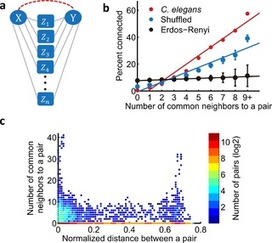
The C . elegans Connectome Consists of Homogenous Circuits with Defined Functional Roles

How can we understand the function of gigantic complex networks (e.g. the brain) based on connectivity data alone? We use the available full connectome of a nematode and apply new approaches to find that the neural network is made of structurally homogeneous neural circuits. These sets of neurons also appear in defined regions of the network where they may provide valuable functional roles such as signal integration and synchronization. Moreover, if we redraw the network considering these homogeneous sets alone, we reveal a simplified network layout that is intuitive to understand. As connectome data of higher brain systems are soon to be released our novel approaches can be immediately applied to studying these complex systems.


Azulay A, Itskovits E, Zaslaver A (2016) The C. elegans Connectome Consists of Homogenous Circuits with Defined Functional Roles. PLoS Comput Biol 12(9): e1005021. doi:10.1371/journal.pcbi.1005021

Source: journals.plos.org

Untangling the role of diverse social dimensions in the diffusion of microfinance

Ties between individuals on a social networks can represent different dimensions of interactions, and the spreading of information and innovations on these networks could potentially be driven by some dimensions more than by others. In this paper we investigate this issue by studying the diffusion of microfinance within rural India villages and accounting for the whole multilayer structure of the underlying social networks. We define a new measure of node centrality, diffusion versatility, and show that this is a better predictor of microfinance participation rate than previously introduced measures defined on aggregated single-layer social networks. Moreover, we untangle the role played by each social dimension and find that the most prominent role is played by the nodes that are central on layers concerned with trust, shedding new light on the key triggers of the diffusion of microfinance.


Untangling the role of diverse social dimensions in the diffusion of microfinance
Elisa Omodei, Alex Arenas

Source: arxiv.org