
Category: Papers

Joint estimation of preferential attachment and node fitness in growing complex networks

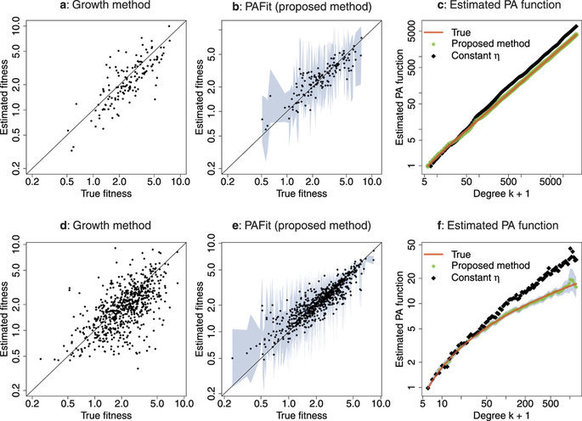
Complex network growth across diverse fields of science is hypothesized to be driven in the main by a combination of preferential attachment and node fitness processes. For measuring the respective influences of these processes, previous approaches make strong and untested assumptions on the functional forms of either the preferential attachment function or fitness function or both. We introduce a Bayesian statistical method called PAFit to estimate preferential attachment and node fitness without imposing such functional constraints that works by maximizing a log-likelihood function with suitably added regularization terms. We use PAFit to investigate the interplay between preferential attachment and node fitness processes in a Facebook wall-post network. While we uncover evidence for both preferential attachment and node fitness, thus validating the hypothesis that these processes together drive complex network evolution, we also find that node fitness plays the bigger role in determining the degree of a node. This is the first validation of its kind on real-world network data. But surprisingly the rate of preferential attachment is found to deviate from the conventional log-linear form when node fitness is taken into account. The proposed method is implemented in the R package PAFit.


Joint estimation of preferential attachment and node fitness in growing complex networks
Thong Pham, Paul Sheridan & Hidetoshi Shimodaira
Scientific Reports 6, Article number: 32558 (2016)
doi:10.1038/srep32558

Source: www.nature.com

Coupled dynamics of node and link states in complex networks: A model for language competition

Inspired by language competition processes, we present a model of coupled evolution of node and link states. In particular, we focus on the interplay between the use of a language and the preference or attitude of the speakers towards it, which we model, respectively, as a property of the interactions between speakers (a link state) and as a property of the speakers themselves (a node state). Furthermore, we restrict our attention to the case of two socially equivalent languages and to socially inspired network topologies based on a mechanism of triadic closure. As opposed to most of the previous literature, where language extinction is an inevitable outcome of the dynamics, we find a broad range of possible asymptotic configurations, which we classify as: frozen extinction states, frozen coexistence states, and dynamically trapped coexistence states. Moreover, metastable coexistence states with very long survival times and displaying a non-trivial dynamics are found to be abundant. Interestingly, a system size scaling analysis shows, on the one hand, that the probability of language extinction vanishes exponentially for increasing system sizes and, on the other hand, that the time scale of survival of the non-trivial dynamical metastable states increases linearly with the size of the system. Thus, non-trivial dynamical coexistence is the only possible outcome for large enough systems. Finally, we show how this coexistence is characterized by one of the languages becoming clearly predominant while the other one becomes increasingly confined to “ghetto-like” structures: small groups of bilingual speakers arranged in triangles, with a strong preference for the minority language, and using it for their intra-group interactions while they switch to the predominant language for communications with the rest of the population.


Coupled dynamics of node and link states in complex networks: A model for language competition
Adrián Carro, Raúl Toral, Maxi San Miguel

Source: arxiv.org

Node-independent elementary signaling modes: A measure of redundancy in Boolean signaling transduction networks 

The redundancy of a system denotes the amount of duplicate components or mechanisms in it. For a network, especially one in which mass or information is being transferred from an origin to a destination, redundancy is related to the robustness of the system. Existing network measures of redundancy rely on local connectivity (e.g. clustering coefficients) or the existence of multiple paths. As in many systems there are functional dependencies between components and paths, a measure that not only characterizes the topology of a network, but also takes into account these functional dependencies, becomes most desirable.
We propose a network redundancy measure in a prototypical model that contains functionally dependent directed paths: a Boolean model of a signal transduction network. The functional dependencies are made explicit by using an expanded network and the concept of elementary signaling modes (ESMs). We define the redundancy of a Boolean signal transduction network as the maximum number of node-independent ESMs and develop a methodology for identifying all maximal node-independent ESM combinations. We apply our measure to a number of signal transduction network models and show that it successfully distills known properties of the systems and offers new functional insights. The concept can be easily extended to similar related forms, e.g. edge-independent ESMs.


Node-independent elementary signaling modes: A measure of redundancy in Boolean signaling transduction networks
ZHONGYAO SUN, RÉKA ALBERT
Network Science , Volume 4 , Issue 03 , September 2016, pp 273 – 292
doi: 10.1017/nws.2016.4

Source: www.cambridge.org

Unifying Markov Chain Approach for Disease and Rumor Spreading in Complex Networks

Spreading processes are ubiquitous in natural and artificial systems. They can be studied via a plethora of models, depending on the specific details of the phenomena under study. Disease contagion and rumor spreading are among the most important of these processes due to their practical relevance. However, despite the similarities between them, current models address both spreading dynamics separately. In this paper, we propose a general information spreading model that is based on discrete time Markov chains. The model includes all the transitions that are plausible for both a disease contagion process and rumor propagation. We show that our model not only covers the traditional spreading schemes, but that it also contains some features relevant in social dynamics, such as apathy, forgetting, and lost/recovering of interest. The model is evaluated analytically to obtain the spreading thresholds and the early time dynamical behavior for the contact and reactive processes in several scenarios. Comparison with Monte Carlo simulations shows that the Markov chain formalism is highly accurate while it excels in computational efficiency. We round off our work by showing how the proposed framework can be applied to the study of spreading processes occurring on social networks.


Unifying Markov Chain Approach for Disease and Rumor Spreading in Complex Networks

Guilherme Ferraz de Arruda, Francisco A. Rodrigues, Pablo Martin Rodriiguez, Emanuele Cozzo, Yamir Moreno

Source: arxiv.org

Grand Challenges for Global Brain Sciences

The next grand challenges for society and science are in the brain sciences. A collection of 60+ scientists from around the world, together with 10+ observers from national, private, and foundations, spent two days together discussing the top challenges that we could solve as a global community in the next decade. We eventually settled on three challenges, spanning anatomy, physiology, and medicine. Addressing all three challenges requires novel computational infrastructure. The group proposed the advent of The International Brain Station (TIBS), to address these challenges, and launch brain sciences to the next level of understanding.

Source: arxiv.org