
Category: Papers

Experimental evidence of stress-induced critical state in schooling fish

Guozheng Lin, Ramon Escobedo, Xu Li, Tingting Xue, Zhangang Han, Clément Sire, Vishwesha Guttal, Guy Theraulaz

How do animal groups dynamically adjust their collective behavior in response to environmental changes is an open and challenging question. Here, we investigate the mechanisms that allow fish schools to tune their collective state under stress, testing the hypothesis that these systems operate near criticality, a state maximizing sensitivity, responsiveness, and adaptability. We combine experiments and data-driven computational modeling to study how group size and stress influence the collective behavior of rummy-nose tetras (Hemigrammus rhodostomus). We quantify the collective state of fish schools using polarization, milling, and cohesion metrics and use a burst-and-coast model to infer the social interaction parameters that drive these behaviors. Our results indicate that group size modulates stress levels, with smaller groups experiencing higher baseline stress, likely due to a reduced social buffering effect. Under stress, fish adjust the strength of their social interactions in a way that leads the group into a critical state, thus enhancing its sensitivity to perturbations and facilitating rapid adaptation. However, large groups require an external stressor to enter the critical regime, whereas small groups are already near this state. Unlike previous studies suggesting that fish adjust their interaction network structure under risk, our results suggest that the intensity of social interactions, rather than network structure, governs collective state transitions. This simpler mechanism reduces cognitive demands while enabling dynamic adaptation. By revealing how stress and group size drive self-organization toward criticality, our study provides fundamental insights into the adaptability of collective biological systems and the emergent properties in animal groups.

Read the full article at: www.biorxiv.org
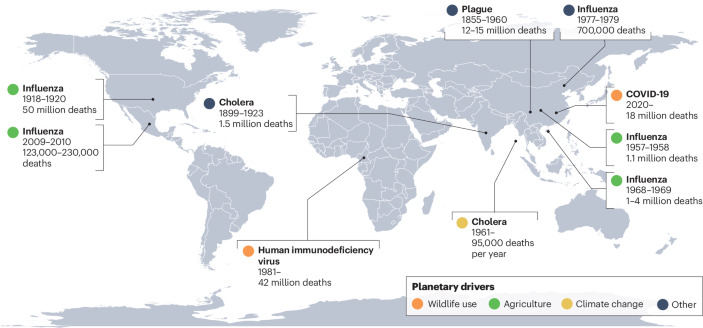
Pathogens and planetary change

Colin J. Carlson, Cole B. Brookson, Daniel J. Becker, Caroline A. Cummings, Rory Gibb, Fletcher W. Halliday, Alexis M. Heckley, Zheng Y. X. Huang, Torre Lavelle, Hailey Robertson, Amanda Vicente-Santos, Ciara M. Weets & Timothée Poisot 

Nature Reviews Biodiversity volume 1, pages 32–49 (2025)

Emerging infectious diseases, biodiversity loss, and anthropogenic environmental change are interconnected crises with massive social and ecological costs. In this Review, we discuss how pathogens and parasites are responding to global change, and the implications for pandemic prevention and biodiversity conservation. Ecological and evolutionary principles help to explain why both pandemics and wildlife die-offs are becoming more common; why land-use change and biodiversity loss are often followed by an increase in zoonotic and vector-borne diseases; and why some species, such as bats, host so many emerging pathogens. To prevent the next pandemic, scientists should focus on monitoring and limiting the spread of a handful of high-risk viruses, especially at key interfaces such as farms and live-animal markets. But to address the much broader set of infectious disease risks associated with the Anthropocene, decision-makers will need to develop comprehensive strategies that include pathogen surveillance across species and ecosystems; conservation-based interventions to reduce human–animal contact and protect wildlife health; health system strengthening; and global improvements in epidemic preparedness and response. Scientists can contribute to these efforts by filling global gaps in disease data, and by expanding the evidence base for disease–driver relationships and ecological interventions.

Read the full article at: www.nature.com

Antifragility and response to damage in the synchronization of oscillators on networks

M. A. Polo-González, A. P. Riascos, L. K. Eraso-Hernandez

In this paper, we introduce a mathematical framework to assess the impact of damage, defined as the reduction of weight in a specific link, on identical oscillator systems governed by the Kuramoto model and coupled through weighted networks. We analyze how weight modifications in a single link affect the system when its global function is to achieve the synchronization of coupled oscillators starting from random initial phases. We introduce different measures that allow the identification of cases where damage enhances synchronization (antifragile response), deteriorates it (fragile response), or has no significant impact. Using numerical solutions of the Kuramoto model, we investigate the effects of damage on network links where antifragility emerges. Our analysis includes lollipop graphs of varying sizes and a comprehensive evaluation and all the edges of 109 non-isomorphic graphs with six nodes. The approach is general and can be applied to study antifragility in other oscillator systems with different coupling mechanisms, offering a pathway for the quantitative exploration of antifragility in diverse complex systems.

Read the full article at: arxiv.org

Universal Statistics of Competition in Democratic Elections

Ritam Pal, Aanjaneya Kumar, and M. S. Santhanam

Phys. Rev. Lett. 134, 017401

Elections for public offices in democratic nations are large-scale examples of collective decision-making. As a complex system with a multitude of interactions among agents, we can anticipate that universal macroscopic patterns could emerge independent of microscopic details. Despite the availability of empirical election data, such universality, valid at all scales, countries, and elections, has not yet been observed. In this Letter, we propose a parameter-free voting model and analytically show that the distribution of the victory margin is driven by that of the voter turnout, and a scaled measure depending on margin and turnout leads to a robust universality. This is demonstrated using empirical election data from 34 countries, spanning multiple decades and electoral scales. The deviations from the model predictions and universality indicate possible electoral malpractices. We argue that this universality is a stylized fact indicating the competitive nature of electoral outcomes.

Read the full article at: link.aps.org

Coarse-graining network flow through statistical physics and machine learning

Zhang Zhang, Arsham Ghavasieh, Jiang Zhang & Manlio De Domenico 
Nature Communications volume 16, Article number: 1605 (2025)

Information dynamics plays a crucial role in complex systems, from cells to societies. Recent advances in statistical physics have made it possible to capture key network properties, such as flow diversity and signal speed, using entropy and free energy. However, large system sizes pose computational challenges. We use graph neural networks to identify suitable groups of components for coarse-graining a network and achieve a low computational complexity, suitable for practical application. Our approach preserves information flow even under significant compression, as shown through theoretical analysis and experiments on synthetic and empirical networks. We find that the model merges nodes with similar structural properties, suggesting they perform redundant roles in information transmission. This method enables low-complexity compression for extremely large networks, offering a multiscale perspective that preserves information flow in biological, social, and technological networks better than existing methods mostly focused on network structure.

Read the full article at: www.nature.com